

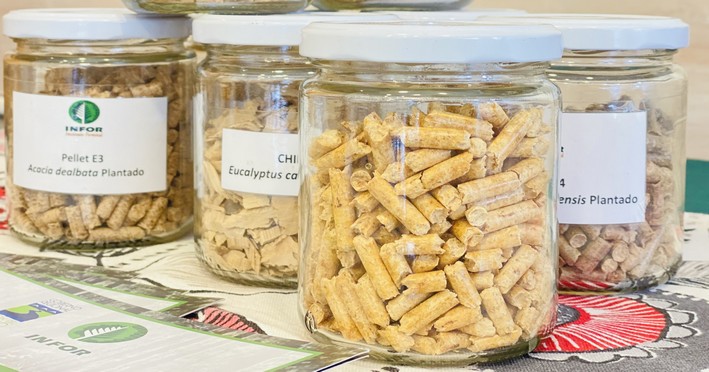
- The work is being carried out by INFOR Biobío with funds from the Bienes Públicos instrument of the Corfo Biobío Committee, which contributed nearly 120 million pesos for this initiative.
The Biobío region is the forestry capital of our country. Here, large, medium, and small companies work with this resource. In December 2022, Law 21,499 on Solid Biofuels, issued by the Ministry of Energy, was published in the Official Gazette. This law regulates the production and commercialization of solid biofuels derived from wood, thereby recognizing firewood and pellets as fuels.
This presents several challenges. One of them is to aim for a biofuel industry that ensures quality and sustainability for the pellet supply chain in the Biobío region, which a few years ago experienced stock shortages due to high demand, primarily for residential heating.
Thus, the Corfo Biobío Committee, through the Bienes Públicos instrument for Regional Competitiveness, contributed nearly 120 million pesos to address this issue. With these funds, INFOR (Forestry Institute) of the Ministry of Agriculture is currently developing a platform with three specific objectives, accessible to biofuel producers and civil society.
INFOR's executive director, Sandra Gacitúa, highlights: "This project enables dialogue across the sector—institutions and producers alike. The platform will materialize with strategic information and the incorporation of modules integrating biofuel usage regulations. Additionally, we seek to democratize information for all users."
One of the expected outcomes of implementing this platform is that it will feature three interactive modules for delivering information, mechanisms, and tools to bridge gaps and reduce shortage risks of this biofuel in the pellet market of the Biobío region (supply and consumption of pellets, deficit). This will include a registry of installed pellet appliances and their territorial distribution, methodologies for estimating and projecting pellet demand and supply, stakeholder maps, as well as the characterization and localization of raw materials (supply), including location, quality, quantity, and studies on new supply options.
The deputy director of the Corfo Biobío Committee, Ximena Riffo, emphasized: "As a Corporation, we are focused on addressing the medium- and long-term strategic challenges of our country. Diversifying the energy production matrix is key to achieving and generating more sustainable processes and products that align with decarbonization, fostering development and technological transfer through collaborative actions. This platform is a clear example."
Another goal of this initiative is to implement the Results Transfer Model, building capacities and infrastructure at INFOR Biobío, along with disseminating available centers for conducting studies and supporting processes that ensure biomass and biofuel quality according to short-term enforceable standards.
In this regard, the Regional Ministerial Secretary (Seremi) of Agriculture, Pamela Gatti, stated: "As a ministry, we are committed to the process of diversifying our territory's energy matrix. Today, in collaboration with other institutions, we are addressing the various species in the pellet production sector of the Region, their sustainability, quality, and value chain."
Pellets have nearly 90% energy efficiency, unlike firewood, which records 75%. Additionally, firewood is responsible for about 59% of particulate matter (PM10 and PM2.5) in the intercommunal area. This scenario led to the implementation of the Decontamination Plan, which includes 10 municipalities in the Biobío province, as well as the current plan in Los Ángeles.
Regarding the platform implementation project, the Seremi of Energy, Daniela Espinoza, said: "Participating in this initiative is very important for us because biomass pellets are a relevant fuel in the Region's heating matrix. We are the leading pellet-producing region in the country and have significant consumption volumes. The project will provide us with key and timely information to address supply crises."
The initiative seeks to leverage the competitive advantages and capabilities of the Region's industry, supporting economic activity, competitiveness, and productivity of regional SMEs in an environmentally sustainable framework. The platform will accurately identify diverse territorial demands or requirements to foster growth and support the bioenergy sector. Data transmission will propose support instances to promote and improve forestry, production, and commercialization processes, enhancing communication and collaboration.
Compartir:

Comments (0)
No hay comentarios aún. ¡Sé el primero en comentar!
Deja un comentario