

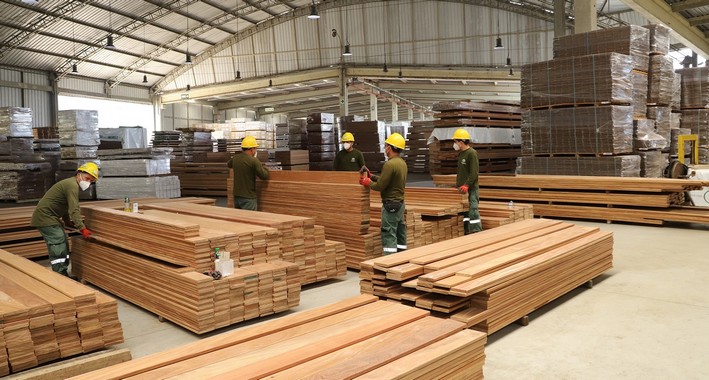
The new tariff scenario in the United States, effective next week, is described by the forestry industry, especially among small and medium-sized enterprises, as a "perfect storm." That country announced a 10% surcharge on imports of softwood and sawn timber starting October 14, along with a 25% tariff on manufactured wood products.
Furthermore, starting in January 2026, these rates would increase to 30% and 50%, respectively, unless a different agreement is reached within the framework of negotiations that the U.S. government is keeping open with countries like Chile.
The U.S. is the second destination—after China—for Chilean forestry exports. Meanwhile, Chile became the largest supplier of coniferous plywood panels to the North American country in 2023 and 2024, according to data from the U.S. International Trade Commission, published by the Forestry Institute (Infor).
Lower Demand and Impact on SMEs
"This is bad news for the sector, especially for SMEs, which have zero capacity to react, at a time when we are facing a shortage of wood and lack of demand," Rodrigo O'Ryan, president of the Chilean Wood Corporation (Corma), commented yesterday after the inauguration of the Wood Week.
Charles Kimber, Manager of People and Sustainability at Arauco, agreed, stating that "this affects the competitiveness of a sector that has been hit by fires, wood theft, and higher operating costs in Chile. Undoubtedly, the most affected will be the small and medium-sized enterprises, because large companies have investments in other countries and product diversification that somewhat cushion this for us."
One of the impacts already noted in the industry is a certain pause in the commercial activity of "economic agents" in the U.S., admitted Kimber. "We have seen a decrease in orders, and if there is no good demand, it will undoubtedly affect," he stated.
This, however, occurs after wood inventories in the United States increased in anticipation of the tariff hikes.
Kimber indicated that Arauco's wood production in the United States complements what they do in Chile to supply the North American market.
A perspective from the most affected segment, the forestry SMEs, was provided by Víctor Sandoval, president of the PymeMad Biobío guild, which represents about 100 companies. He stated that they have been facing an environment of uncertainty for six months due to the tariff scenario in the United States. "This has meant that small companies, which do not have significant financial backing, are now in a critical state with several closures, significant job losses, especially in the Maule, Ñuble, and Biobío regions, in the southern macrozone in general." He mentioned that about 3,000 jobs have been lost.
Arauco, meanwhile, assured that its pulp project in Brazil is not affected by the tariff situation between the U.S. and Brazil.
Competition with Brazil in Sawn Timber
At the same time, the forestry sector explains that the United States imposed a 50% tariff on sawn timber from Brazil, so that South American nation will seek alternative markets in the rest of the world, where Chilean products also compete.
"Brazil, which has a strong wood industry, no longer has the United States as its main market but has to look for other alternatives," commented Sandoval.
Additionally, there is another negative impact for Chilean SMEs. Kimber explained that these firms export to countries like China, Vietnam, and generally to Southeast Asia, where the Chilean wood that arrives is used to make furniture and then re-exported to the United States. However, this now creates a disruption for those shipments, as they become more expensive due to tariffs in the North American country for those Asian markets ranging from 25% to 50%, he added.
Construction Remains Weak in Chile
Víctor Sandoval asserted that the current situation for the sector is a "perfect storm." This is because, in addition to the international scenario with rising tariffs, the construction market in Chile remains weak and does not show demand that drives the forestry industry.
In this context, Rodrigo O'Ryan highlighted the importance of generating an increase in the demand for wood in construction, "that the State becomes a major buyer, for example, through social housing and the construction of public infrastructure using wood. Today we have high-strength wood; we can start building large-scale public works."
The head of Corma added that it is important to have "those kinds of measures that leverage or create a base for SMEs to invest and scale in technology. And similarly, mechanisms such as soft loans for working capital should be produced so that small and medium-sized enterprises can weather this crisis."
Work with the Ministry of Foreign Affairs
The situation of the forestry industry is being analyzed by the Government through the Ministry of Foreign Affairs, confirmed both the Executive and the companies.
The Minister of Agriculture, Ignacia Fernández, commented that "yesterday (Wednesday) there was a working table led by the Ministry of Foreign Affairs, where the Ministry of Agriculture and the entire forestry sector participated. It is the same type of work we continue to do regarding the initial tariff announcements with the agricultural industry, when there was no impact on the wood sector. Today, that is precisely what is being worked on at this table."
Rodrigo O'Ryan noted that the authorities have indicated to them that "Chile is well positioned because it is a credible country, and in the wood sector, it has provided guarantees of sustainability, legality, and quality." He added that they are talking with clients in the U.S. so that "they support us in showing that the products we offer are unique; therefore, we are not competing with a local one."
Source:El Mercurio




Comments (0)
No comments yet. Be the first to comment!
Leave a comment