

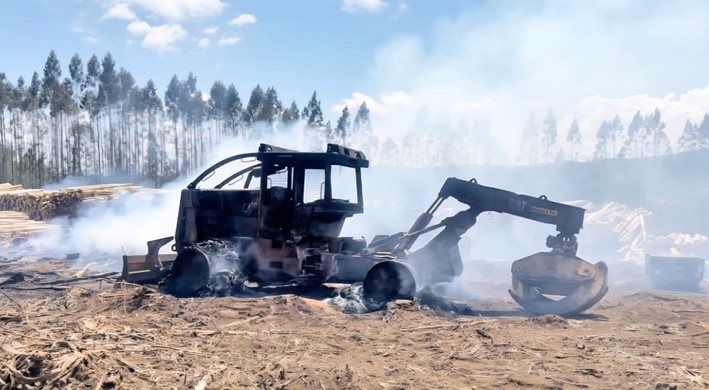
The La Araucanía region once again became the scene of a wave of rural violence over the weekend, with four arson attacks recorded in less than 48 hours, leaving not only destroyed machinery but also a growing climate of fear in the area.
The attacks occurred between Friday and early Sunday morning and affected properties in the communes of Vilcún, Carahue, and Cunco. The most recent incident was reported in the latter, occurring in the early hours of Sunday morning.
In response to this series of events, the government announced the filing of two lawsuits under the Anti-Terrorism Law, corresponding to the attacks in Vilcún and Carahue, while the most recent one in Cunco is reportedly "under evaluation."
FEAR AND INVESTMENTS
From the forestry sector, industry associations reacted with annoyance and concern. The president of PymeMad Biobío, Michel Esquerré, stated that the attacks are discouraging investment and weakening a key sector for the economy.
"The forestry sector is one that plants trees with a 20-year horizon. It is resilient and the greenest, as it plants trees and produces timber. If the country wants to decarbonize its economy, this is where we must place our future," he said.
In this context, he explained that—since it is such a long-term business—the events over the weekend in La Araucanía undermine that process, discourage investment, and generate fear.
Esquerré warned that the core issue is not the attack itself, but "the fear it generates about investing in the long term. There is a systematic problem here: as a country, we are not addressing the real underlying issue."
The forestry sector representative argued that resolving the violence crisis requires an agreement involving all stakeholders. "It's a recipe that we must agree upon among all parts of the State: civil society, politics, indigenous peoples, everyone," he stated.
In his view, the main failure lies in the lack of security and intelligence to confront the attacks and in the failure to use the tools "to find the people who are carrying them out. I believe there is a significant lack of coordination, and politics needs to stop focusing on the short term and start looking at the long term, to allow these coordination mechanisms to function," he indicated.
INSECURITY AND LACK OF INTELLIGENCE
The manager of the Association of Forestry Contractors (Acoforag), René Muñoz, lamented the persistence of the violence and accused the sector of being "abandoned."
"In our case, as forestry contractors, we have been dealing with this issue for 28 years now. Therefore, our stance is one of exhaustion and seeing that the State, with all the time it has had to solve this problem, has abandoned the sector," he detailed.
The group led by Muñoz consists of about 120 entrepreneurs associated with the forestry sector who operate in different regions of the country. According to their records, since 2014, they have suffered 515 attacks that have resulted in 1,835 pieces of equipment and forestry trucks destroyed. Of these, more than 1,100 correspond to machinery working directly in the forests, not transport vehicles.
"The patrimonial and human damage has been tremendous. There are entrepreneurs who had dreams, who provided jobs, and all that has been lost. It's hard to understand how this violence has become normalized in a country like Chile," the leader stated.
Muñoz added that the lack of promotion policies and fire prevention further worsens the outlook: "Around the world, all countries are increasing afforestation, and Chile is the exception. There are no policies to promote afforestation or to control intentional fires. The sector is under pressure from all sides, and that prevents it from contributing to the country's development," he concluded.
PRIORITIZE THE MOST AFFECTED AREAS
The president of the Chilean Wood Corporation (Corma) in La Araucanía, Los Ríos, and Los Lagos, Antonio Soto, described the events as "regrettable" and warned that the situation "has been worsening" despite announcements of reduced violence in the area. "We started on Friday and Saturday with attacks on farmers, and on Sunday another attack was recorded in Cunco, where forestry machinery was burned. We are very concerned about what is to come, especially now that the fire season is approaching," he indicated.
As an urgent measure, he proposed "prioritizing the most affected areas" and implementing permanent controls with police or military presence. "There must be hard barriers, with vehicle checks, and intelligence must be strengthened to anticipate events," he emphasized.
Soto also warned that the violence is affecting not only the forestry sector but also farmers, service companies, and even health workers. "This is reducing investment. No one dares to innovate or set up projects in the region," he concluded.
Source:La Tribuna





Comments (0)
No comments yet. Be the first to comment!
Leave a comment