

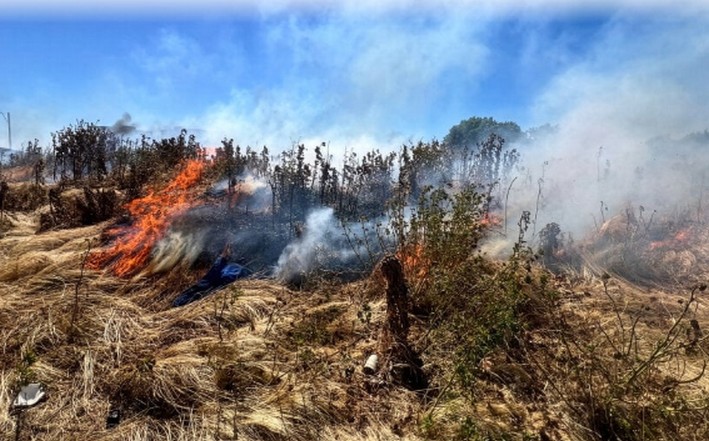
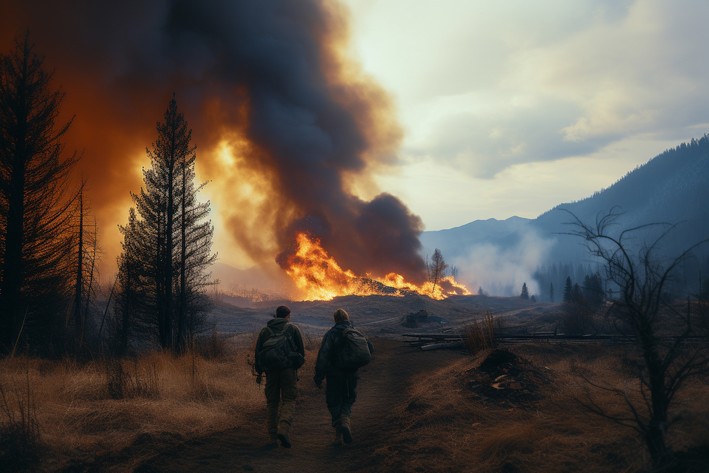
The Los Angeles Fire Department has expressed deep concern regarding the increase in grass fires, micro-dumps, and waste fires, both in the urban area and in sectors surrounding the city.
According to the National Forestry Corporation (Conaf), as of last week, the commune had recorded 21 fires of this type, a 320% increase compared to the same date last year.
This series of emergencies, described by Deputy Superintendent Raúl Márquez Márnich as absolutely preventable, is causing a triple strain on the institution – material, human, and economic – which directly affects its response capacity to more complex situations.
OPERATIONAL IMPACT
According to Márquez in an interview with La Tribuna, the organization is facing a sustained increase in calls related to vegetation fires, a scenario that has begun to generate visible impacts at various operational levels.
"Obviously, there is greater material wear and tear, which means allocating more resources to have material available for the rest of the period," Márquez stated.
Furthermore, the officer explained that the frequency of call-outs, especially on high-demand days, reduces rest margins and ultimately affects the overall performance of the teams.
"It's not that they are not available; they are, but obviously their energy or strength is more depleted," he noted.
"Adding to this scenario is that the continuous operation of the fire trucks, even for minor emergencies, implies consumption and maintenance that accumulate rapidly during the season. It also implies greater economic strain, due to increased fuel consumption and the need to reinforce the maintenance and renewal of the trucks' equipment. What is not always considered is that, even when the vehicle is stationary, from the moment its pump body works to propel water to the hoses, the engine continues running and consuming fuel, which directly influences maintenance costs and operational expenditure," he commented.
REPEATED HOTSPOTS AND THE HUMAN CAUSE
Even though summer – the period of highest risk for this type of emergency – has not yet begun, the Fire Department has already had to respond repeatedly to sectors where hotspots recur frequently, even within the urban area and a short distance from their stations. One of the most common points is the vacant lot at Avenida Cordillera with Colo Colo, near Monte Cea, where three or four calls have been recorded recently, including those on November 14th and 25th. "These are completely preventable situations. More than 99% of fires in sectors with vegetative material originate from human actions, either due to carelessness or intent," he explained.
MITIGATION STRATEGY
Faced with scenarios where several emergencies may coincide and it is necessary to prioritize resources, the organization has chosen to reinforce its operational coordination.
According to Márquez, for about a decade, the fire department has been working jointly with Conaf and forestry companies, which allows for optimizing deployment and concentrating personnel on urban and smaller-scale situations.
This is complemented by permanent coordination with fire departments from neighboring communes, such as Mulchén, Cabrero, Nacimiento, Negrete, Quillaco, Laja, and Santa Bárbara, to ensure mutual support in border areas.
However, he warned that no mechanism is as decisive as prevention. For this reason, he urged extreme caution during work that could generate sparks in areas with combustible material, such as welding tasks. "When working in that area, before repairing it, let's wet the area. By wetting the area, we will create conditions and have a hose on hand, have a fire extinguisher on hand, so that if the smallest spark is produced, we can react quickly," he commented.
TOWARDS PERMANENT FINANCIAL SUPPORT
Superintendent Márquez reiterated a call to authorities to move forward on a stable funding mechanism and recalled that fire departments, although they operate as private law corporations, perform a public service.
The proposal aims to have a guaranteed baseline of resources to sustain operations without relying solely on annual allocations. In this vein, he proposed formalizing by law a municipal subsidy equivalent to 1% of the communal budget.
According to the officer, this is not a disproportionate measure and aligns with the legal obligations of municipalities. In the case of Los Ángeles, that percentage currently equates to between $1,000 and $1,500 per inhabitant, an amount that, if established by law, would guarantee continuity and stability for the service.
Source:La Tribuna

Comments (0)
No comments yet. Be the first to comment!
Leave a comment