

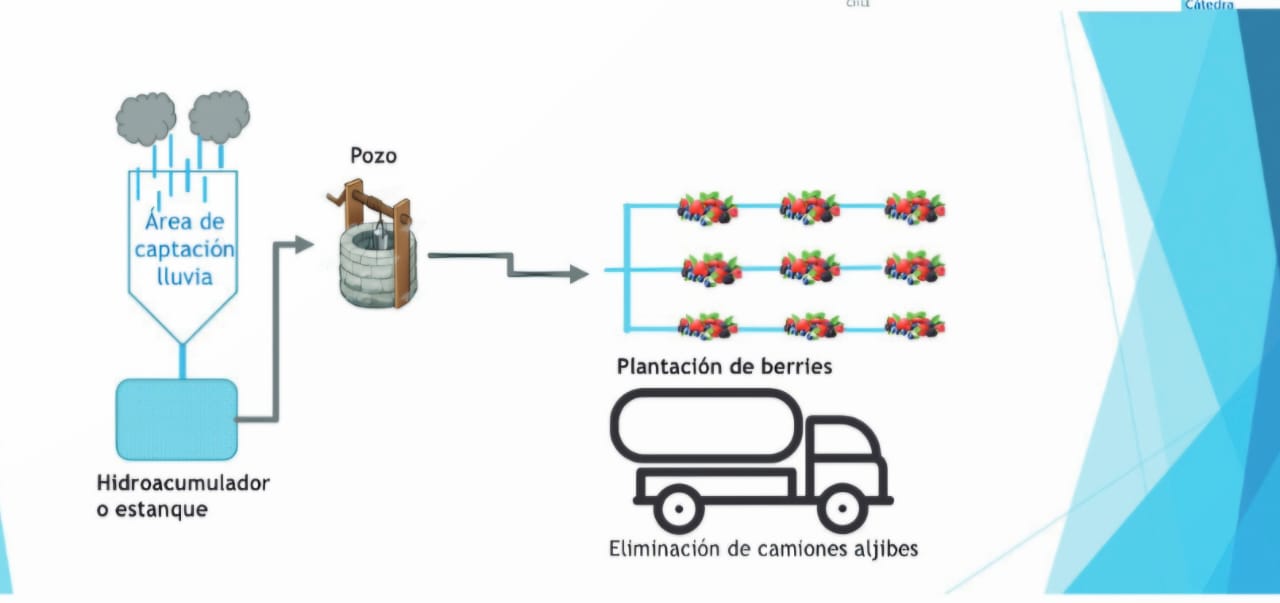
Among specialists and for years, the best way to recharge aquifers has been discussed, that is, how it is possible to recover the water supply from groundwater layers during critical periods. Recharge has been done by infiltrating water into the soil in mountainous areas, in trenches prepared for this purpose, in pools, etc., but this did not ensure that the water reached the party who had made the technical and economic effort. Then a question arose: What if a volume of water is recharged directly into the well from which groundwater is extracted in the summer? And the answer was, it is possible. Then a second question arose: and where does that volume of water come from? And the answer was by capturing rainwater. And a final question came. And where is it possible to accumulate rainwater? And the answer was in rainwater harvesting tanks. With these ideas, scientists from the University of Talca along with various specialists, won a project from the Innovation Fund for Competitiveness of the Ñuble Region, a project that is finishing and delivering interesting results.
The project has consisted of recharging rainwater into dug wells, using the groundwater layers as a reservoir for future use. With this background, work was carried out in three communes of Ñuble, selecting three rural users who had this type of dug well and were willing to accept the scientific-technological challenge of addressing a technical proposal that was unprecedented in South America.
Thus, and based on engineering criteria, rainwater harvesting systems (SCALL) were designed and implemented to accumulate amounts of up to 80 cubic meters. In parallel, the project carried out hydrogeological studies, detecting that in the project area there is a groundwater flow deficit of 300 liters per second, which, if not controlled, can lead to critical situations of water unavailability.
Likewise, with the support of neighbors in the study area, water level measurements were taken in various wells (10), in order to understand the hydrological behavior of these nearby units.
Once the storage tanks were built, the three wells were studied in detail and direct injection tests began on each well, injecting flow rates of 1 liter per second, i.e., just over 3.5 cubic meters in an hour, and it was seen that the wells withstood the injection and some even increased their water level.
The injection into the wells was maintained for several hours and for periods longer than a day, withstanding the injection. And this is relevant because through the accumulation of rainwater, hydrological balances could be restored in various territories with groundwater shortages, says Dr. Roberto Pizarro from the University of Talca, the project director.
The project has managed to demonstrate that it is possible to recharge aquifers or groundwater layers from the direct injection of rainwater into dug wells, says Dr. Claudia Sangüesa, a researcher on the project. Another researcher, Dr. José Luis Arumí from the University of Concepción, stated, "Chile endured the worst megadrought in its history based on groundwater; it is time to give back to groundwater and this project points in that direction." When consulted, the Governor of Ñuble, Oscar Crisóstomo, stated that "groundwater is more than a resource: it is security, it is food, and it is development. Therefore, we will continue to bet on experiences that allow us to use it intelligently and sustainably, and recharging wells with rainwater is an example of this."
Within the same framework, researcher Daniel Páez, a consultant for the project, expressed: "What is expected is that the recharged water will enter the aquifer and move through it according to its physical reality in the soil, but this movement is slow, and it is estimated that there will be a component that can be recovered through pumping during the summer season, as a new supply for extraction."
Finally, what is not recovered will become part of a savings to the territory's water balance account, which emerges as a clear element of sustainability for this unprecedented project in Chile.
Source. Diario de Talca
Comments (0)
No comments yet. Be the first to comment!
Leave a comment