

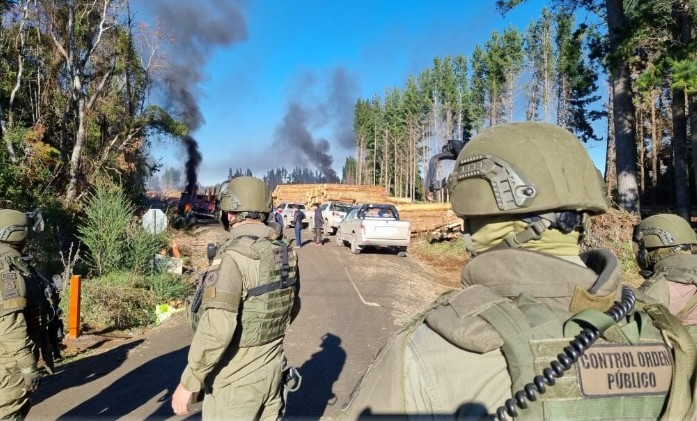
Acts of violence in the southern macrozone have been a permanent axis of debate in national politics. Arson attacks against forestry machinery, ambushes on private vehicles, threats to entire communities, and the still-latent memory of the murder of the three police officers in Cañete keep a territory under tension where conflicts reappear periodically and with varying intensity.
Several new figures will assume roles in the new cycle of the Chamber of Deputies, making it key to understand their vision on the issue to anticipate the direction the discussion will take.
The constitutional state of exception — applied to the provinces of Malleco, Cautín, Arauco, and Biobío — was decreed after years of escalating armed attacks, sabotage, usurpations, and destruction of critical infrastructure.
As stated in November by the Minister of Public Security, Luis Cordero, since 2022 nearly 400 people have been arrested and more than 600 have been charged for their alleged participation in violent organizations.
Despite this, the episodes recorded in recent months bring back to the table the same question that has been repeated for almost four years: has the state of exception been sufficient?
THE VISION OF LILIAN BETANCURT
One of the new voices that will arrive in Congress on March 11, 2026, is Lilian Betancurt (PDG), deputy-elect for district 21. For her, stepping back is not an option while there is no clarity about the groups operating in the area.
"The state of exception in the southern macrozone must be maintained because there is still no certainty regarding the behavior of the groups that have generated acts of violence. As long as that threat persists, the State has the duty to guarantee security and tranquility," she stated. Betancurt argues that the current strategy has not been up to par: "The Government fell short with citizens because the incidents keep happening and fear has already exceeded all limits, especially after the murder of the police officers in Cañete."
For her, the key lies in strengthening police intelligence, identifying those responsible, and applying effective sanctions. She advanced that she will oversee the Executive's actions in this matter.
JOANNA PÉREZ: "IT IS NECESSARY TO REINFORCE EVEN MORE"
Deputy Joanna Pérez (Democrats), who will continue in the Lower House, agrees on maintaining the measure but emphasizes that it must be accompanied by a much more robust institutional strengthening.
"It is necessary to maintain it because, despite being under it, we continue to have arson acts and terrorist events. This shows that we must reinforce security, the work of the police and the Armed Forces, especially in intelligence," she analyzed.
Pérez adds that the justice system must also speed up its processes: "We must work with the Judiciary because the cases take too long. Families and victims need results soon."
PATRICIO PINILLA: "THE EXCEPTIONAL BECAME PERMANENT"
Deputy-elect Patricio Pinilla (PDC) opts for a more critical stance. Although willing to support the continuity of the measure in the short term, he warns that it cannot become the State's only response.
"We are already almost four years in. What was exceptional has become habitual. Yes, some violent crimes have decreased, but two problems remain unresolved: the population's feeling of insecurity and the brake on economic development," he lamented.
In his view, it is urgent to move towards new mechanisms that guarantee security without scaring away tourists or investments. Although he acknowledges that for now the measure must be maintained, he stresses the need to design more sustainable and less invasive alternatives.
FLOR WEISSE: "OUR PEOPLE DESERVE TO LIVE IN PEACE"
Deputy Flor Weisse presents a position that combines both support for the measure and a warning against perpetuating it. "Our people deserve to live in peace, without threats, without attacks, without violence and without terrorism. The state of exception was indispensable for the series of attacks we experienced, to reduce the terrorism that prevailed in the province of Arauco, but that still continues," she specified.
However, she emphasizes that the measure cannot become the norm: "When the time comes, we cannot normalize extraordinary measures. I want this situation to end, but when there are real and lasting security conditions and when the State guarantees a comprehensive plan: when it allocates resources, when the roads are safe, and when families can resume their lives without fear."
Weisse emphasizes that the main challenge is to recover tranquility and reactivate productivity and tourism.
Attacks under the state of exception In the provinces of Arauco and Biobío, during this year cases such as the following have been reported: Arson attack on a residence in Cañete - December 7, 2025.
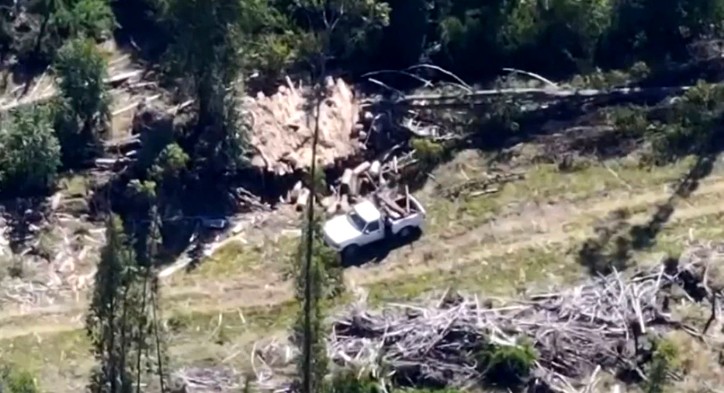
Armed attack and burning of machinery and a pickup truck in Angol - November 18, 2025.
Burning of forestry machinery in Contulmo - November 12, 2025.
Arson attack in Santa Bárbara - April 20, 2025.
Source:La Tribuna




Comments (0)
No comments yet. Be the first to comment!
Leave a comment