

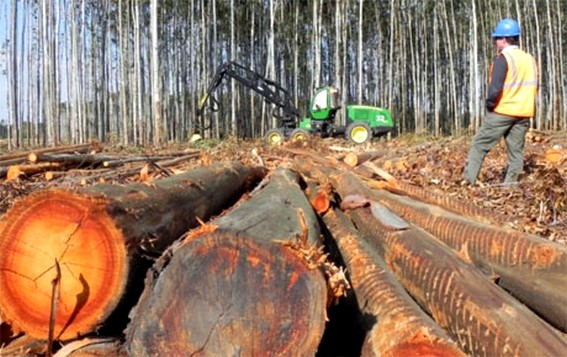
The forestry sector once again positioned itself as the main factor behind the negative export performance of the Biobío Region during October 2025. According to the Export Bulletin from the National Statistics Institute (INE), regional shipments reached US$315.9 million, representing a year-on-year contraction of 42.4% and an accumulated decline of 16.1% so far this year.
Although Biobío maintains its export profile based on industry, particularly forestry activities, the magnitude of the setback reveals a complex scenario for one of the region's productive pillars. The Industry sector concentrated 95.9% of total exports but registered a 44.1% decrease over twelve months, dragged down by the decline in forestry and pulp shipments.
Within this context, forestry activity reached exports of US$109.0 million in October, which meant a 31.1% drop compared to the same month in 2024. Despite this decrease, the sector remained the main exporting economic activity of Biobío, representing 34.5% of the regional total.
Even more pronounced was the contraction in the manufacture of pulp, paper, and cardboard, whose shipments totaled US$104.5 million, with a year-on-year decrease of 59.5%. In absolute terms, this activity stopped exporting more than US$153 million compared to October of last year, becoming the main negative influencing factor in the regional result.
Pulp and Wood: The Most Affected Products
The product analysis confirms the impact on the forestry chain. Pulp remained the main good exported by the region, with US$93.6 million, equivalent to 29.6% of the total. However, this figure represents a 63.0% year-on-year plunge, that is, US$159.3 million less than in October 2024.
Other traditional forestry products also showed declines. Sawn wood reached shipments of US$46.2 million, with a 16.9% drop, while plywood totaled US$23.8 million, decreasing 34.6% over twelve months. These are compounded by declines in wood fiberboard, profiles, and moldings, reflecting a cross-cutting contraction in the sector.
Together, the main forestry products continue to lead the regional export ranking, but at levels significantly lower than those observed the previous year, which directly impacts industrial activity, employment, and the productive linkages associated with the sector.
Lower Asian Demand Hits the Sector
From the perspective of destination markets, the decline in the forestry sector is closely linked to lower international demand, especially from Asia. This continent concentrated 39.0% of regional exports but registered a year-on-year contraction of 55.3%, equivalent to US$152.6 million less than in October 2024.
China, Biobío's main trading partner, reduced its purchases by 67.5%, dropping from US$178.4 million to US$57.9 million. This decline had a direct impact on pulp shipments and other forestry products, which are highly dependent on that market.
The United States remained the top individual destination, with a 24.5% share, although it also showed a 17.3% year-on-year drop, confirming that the slowdown affects the main markets of the regional forestry sector.
Other Sectors Grow, But Do Not Compensate
In contrast to the complex forestry panorama, some sectors showed positive results. The forestry and agricultural sector grew by 82.7%, driven mainly by fruit growing, while fishing increased by 25.9% and mining recorded a significant rise, although with a still marginal share of total exports.
However, these increases were insufficient to counteract the decline of the forestry industry, which continues to be the central axis of Biobío's export matrix.
Challenging Scenario for the Region's Main Export Engine
The INE figures confirm that the forestry sector is facing one of its most complex periods in recent years, marked by lower export volumes, the contraction of main destination markets, and a less favorable international scenario. Given its weight in the regional economy, the evolution of the sector will be key to determining Biobío's export performance in the coming months and the close of 2025.


Comments (0)
No comments yet. Be the first to comment!
Leave a comment