

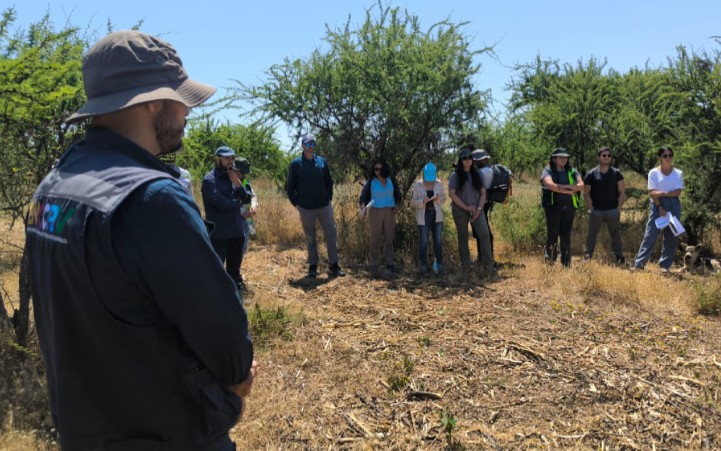
A delegation from the World Bank visited the Ñuble region on December 10 and 11 to observe on-site the progress of the Emissions Reduction Program and the +Forests project, implemented in the territory with technical advice from the National Forestry Corporation (Conaf), the Forestry Institute (Infor), and the national office of the United Nations Food and Agriculture Organization (FAO Chile).
During the mission, the specialists held technical meetings with local teams, learned about the progress of ongoing initiatives, and verified on-site the impact of forest restoration and sustainable management actions.
As part of the visit, they were informed that the +Forests project in Ñuble currently reaches 1,590 committed hectares, equivalent to 93% of the regional target, of which 1,355 hectares have already been implemented. Between 2021 and 2025, the program has intervened in 187 properties in the region with a total investment of $2,427 million, primarily concentrated in the communes of Pinto, San Nicolás, Yungay, Quillón, Ninhue, and Quirihue.
Furthermore, the delegation learned about the preliminary results of the 2025 Public Competition of the Benefit Distribution System of the National Strategy on Climate Change and Vegetation Resources, which includes 15 pre-awarded projects from the Emissions Reduction Program in the region, equivalent to 297.6 hectares and an investment of 364 million pesos. The initiatives will benefit both small landowners and other stakeholders in the territory.
Maurice Rawlins, Senior Environmental Specialist at the World Bank and Lead for the Emissions Reductions Program in Chile, stated, "We are very pleased with the visit to Ñuble, which has allowed us to observe the progress of some of its projects and learn about the challenges in the landscape and the solutions that have been sought to advance ecosystem recovery. Moreover, these are initiatives that have had a positive impact on community well-being."
The Director of Conaf Ñuble, Juan Salvador Ramírez, indicated, "We are happy to share with the World Bank the experiences of the work we are carrying out in the region, with 93% progress in the +Forests program, making it the most advanced nationally, thanks to direct work with small landowners living in 18 communes of the region. This also speaks to a significant territorial deployment to promote the increase of native forest cover, carbon capture, and the strengthening of the social fabric around forest management and carbon capture."
In the same vein, Pablo Honeyman, National Coordinator of the +Forests project, indicated that this visit "has been a great opportunity for World Bank representatives to understand the impact of what we have been doing, through projects that we trust can be maintained and replicated in other territories within the Emissions Reduction Program, once the +Forests project ends."
Visits to Territorial Implementation Projects
The World Bank mission included field trips to see the results of forest restoration and management experiences, two of which were related to managing native species to promote animal foraging, in the commune of San Nicolás.
One of them was at the "Peumo Chico" property, where its owner, David Rebeco, stated, "The work mainly involved clearing scrubland so animals could move and graze, also allowing me to move on horseback to improve cattle care, which I have increased from 20 to 50 head."
The Manager of Infor for Ñuble and Biobío, Karina Luengo, stated that these projects "have allowed injecting resources to small landowners to manage vegetation, thus concentrating growth on the best shoots and enabling land for livestock movement, thereby increasing the amount of pasture and allowing trees to become natural shelters. That is, they are projects with ecosystem and social impact."
Another project visited was the one being implemented at the "Los Quillayes Ecotourism" property, in the commune of Quirihue, where afforestation was carried out adjacent to remnants of native forest and soils devoid of vegetation.
Misael Vásquez, owner of the property, indicated that "the project has allowed improving the expansion of native forest, through prior evaluation of the types of trees that could be planted, followed by the planting of about 600 sclerophyllous forest trees, including species such as peumo, boldo, and corcolén, thereby improving our services in the dimension of sustainable tourism and conservation education."
Source:La Discusión

Comments (0)
No comments yet. Be the first to comment!
Leave a comment