

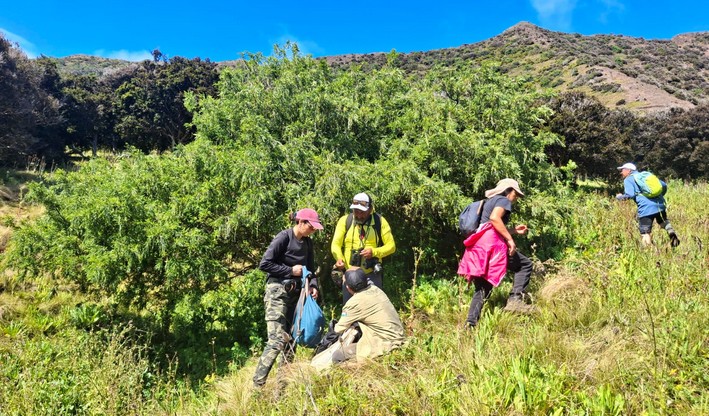
The species Sophora fernandeziana and Sophora masafuerana, endemic trees of the Juan Fernández Archipelago, are what a team of experts from the Faculty of Agronomy at the University of Concepción and from Conaf aim to protect and rescue from the danger of extinction. The team recently attended the closing activity of the project funded by Conaf's Native Forest Research Fund, which began in 2023 and concluded this year.
"In this project, what we did was search for symbiotic microorganisms that would be beneficial for the mentioned species that are in danger of extinction on Robinson Crusoe Island and Alejandro Selkirk Island in the Juan Fernández Archipelago. These two species are key to the reestablishment of the local forests due to their nitrogen contribution; they are also endemic species found in very low populations," explained Dr. Macarena Gerding González, director of the Bacteriology Laboratory and academic at the Department of Plant Production of Agronomy UdeC.
According to the expert, the species Sophora fernandeziana, which is on Robinson Crusoe Island, also known as hard wood or hard firewood, and was used for boat construction or as charcoal, has been greatly affected, especially recently, by the impact of animals such as rabbits or rodents. "These invasive animals feed on the saplings, seeds, and emerging plants. So the issue is that they need to be planted and protected."
Research Line
Since both species belong to the legume family, part of the work carried out in these two years of the project was to search for symbiotic nitrogen-fixing bacteria in different species of the Sophora genus; known as rhizobia. "Legumes are recognized in agricultural systems because they contribute nitrogen to the human and animal diet and also to agricultural systems when used as cover crops or in rotation. In forest systems, they have been less studied, and within the framework of this project, we were able to confirm that the selection of the specific rhizobium for each species is key to the plant's development and survival. In fact, during the field visit, we observed that trees are distributed in the forest, suggesting that they not only use the fixed nitrogen for their own nutrition but also contribute to other trees in the system. That's why they are considered pioneer plants, because these plants need to be there so we can later reestablish other species in the forest," stated Dr. Gerding.
On the recent trip to Robinson Crusoe Island, as part of the project closure, they were able to train Conaf officials and community members on the importance of inoculating nursery plants with beneficial microorganisms. "It's not just about propagating the plant in inert substrate and then transplanting; it's important that they are accompanied by these types of beneficial associations. In the project, we selected specific and effective rhizobia for Sophora fernandeziana and Sophora masafuerana and also mycorrhizal fungi, which are fungi that associate with roots and allow them to extend their radius of nutrient and water absorption. With the joint inoculation of these microorganisms, we had very interesting results under controlled conditions, both in foliage and root development, as well as in survival. The objective of this trip was to transfer these technologies to them, and we also developed a manual so that when they propagate the plants, they incorporate the instructions provided there."
Vital Tree for Hummingbird
One aspect highlighted by Dr. Macarena Gerding was that on the islands they were able to meet with environmentalists, Conaf representatives, and islanders who are very committed to rescuing their flora. "And in these meetings, they told me that the tree on Robinson Crusoe produces many flowers, so it is very important for the maintenance of the Juan Fernández Island hummingbird, which has also been affected by the decline of the Sophora fernandeziana tree, which is very floriferous and feeds on them. Currently, they see this hummingbird in the city, where there are more ornamental flowers; in the forests, it is not seen as much anymore."
Dr. Gerding visited the sites along with the project's executing professional, Tamara Quezada, and with Dr. Jaime Espejo, who is a forestry engineer and botanist. This team has also worked on rescuing the toromiro, the extinct endemic tree of Rapa Nui. "We have carried out work very similar to what we did on Easter Island, but now focused on these other species that we still have time to rescue before they become extinct."
Finally, according to the expert, there are still pending tasks in the Archipelago, so there is a commitment to seek funding sources for new aspects of the research. "On Robinson Crusoe, there are Conaf laboratories, but they are not equipped to mass-produce their own microorganisms. So our idea is to present a new project that allows us to enable that laboratory and conduct evaluations in the forests with inoculated plants, because until now, the attempts to reestablish them have not been very successful; very few were alive, and the older trees are dying. So we are truly living through an extinction process and must act now," she emphasized.


Comments (0)
No comments yet. Be the first to comment!
Leave a comment