

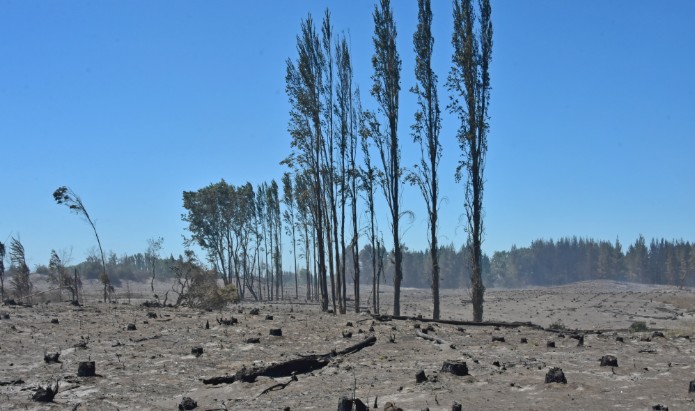
The National Forestry Corporation (CONAF) of Bio Bio announced the main critical wildfire risk hotspots identified in the commune of Los Ángeles, in a scenario where this territory concentrates the highest occurrence of emergencies at the national level.
The information was detailed by the regional director of the agency, Esteban Krause de Salazar, who listed rural and urban sectors with a historical recurrence of fires, and also issued a call for prevention and safeguarding by the local community.
This diagnosis is based on accumulated records from previous seasons and the current behavior of wildfires, which has allowed the corporation to focus on priority areas for preventive monitoring and coordinated work with municipalities and emergency agencies.
FIGURES, LOS ÁNGELES
According to CONAF data, the current wildfire season officially began on July 2, 2025, and to date, the Biobío region has recorded 258 wildfires, ranking as the second highest occurrence nationally, only surpassed by the Araucanía region.
Regarding damaged area, the regional balance reaches 499.5 hectares affected. Within this regional scenario, Los Ángeles concentrates the highest indicators. Of the 33 communes in Biobío, it leads both in the number of fires and in burned area during the ongoing season, with a total of 49 forest emergencies and 152.5 hectares damaged, representing a significant proportion of the regional total.
These figures confirm a trend observed in previous seasons and position the provincial capital as a priority territory in terms of prevention, enforcement, and early response, especially in rural and urban-rural interface areas where repeated hotspots are concentrated.
LOS ÁNGELES AND THE PREVIOUS SEASON
As Esteban Krause indicated in an interview with Radio San Cristóbal, the statistical behavior of the season reaffirms a situation that has been dragging on since the previous period, with Los Ángeles leading the regional records due to its high occurrence of wildfires.
"The commune of Los Ángeles is the commune in the Biobío region with the highest occurrence, where among all the communes, Los Ángeles is the one with the highest number of fires, and it ended the 2024-2025 season as number one on the list," he stated.
The corporation explains that this situation is due to the repetition of fires in specific sectors, which allows for focusing surveillance and cause analysis, especially given backgrounds of intentionality or human action.
IDENTIFIED CRITICAL POINTS
According to technical information compiled by CONAF during recent seasons, there are specific sectors within the commune where the occurrence of wildfires repeats more frequently, which has allowed for focusing monitoring and prevention efforts.
According to Krause, these critical points are concentrated both in rural areas and in transition sectors between populated areas and vegetation, where risk increases due to proximity to homes and human activities. "We have identified sectors where this occurrence is happening: Santa Fe, Millantú, El Pedregal, and Paraguay. In El Chacayal and that entire sector we had a high occurrence, but due to a pyromaniac who was found, there was intentionality, so that situation was controlled and dropped immediately," he indicated.
Alongside these rural sectors, CONAF has also detected a high incidence in urban-rural interface zones, where housing expansion coexists with vegetation susceptible to rapid fire spread.
"And the other place where we have a high incidence of fires is in the interface zone of Los Ángeles, in Villa Génesis and Villa Los Profesores, where we have a high occurrence," commented Krause.
This background information helps guide preventive analysis and the focus of measures such as patrols, awareness campaigns, and potential coordination actions with municipalities and local communities.
CALL FOR PREVENTION
The regional director, Esteban Krause, stated that work with the community is crucial in sectors with recurring emergencies, where accumulated experience makes it necessary to reinforce institutional coordination, surveillance of risky behaviors, and timely communication regarding suspicious situations.
"When we ask municipalities and the community to take special care, we are pointing precisely to those sectors with a history of occurrence, like Santa Fe, Millantú. The neighbors themselves have indicated signs of intentionality in some hotspots, which makes it necessary to maintain vigilance, intensify patrols, and for neighbors to adopt the necessary safeguards," he stated.
The authority emphasized that "these fires do not originate naturally, there is human intervention behind them, so the call is for community prevention."
The institution reiterated that prevention, timely reporting, and safeguarding areas near homes are key to reducing the impact of the season that keeps Los Ángeles as the main regional concern.
Source:La Tribuna




Comments (0)
No comments yet. Be the first to comment!
Leave a comment