

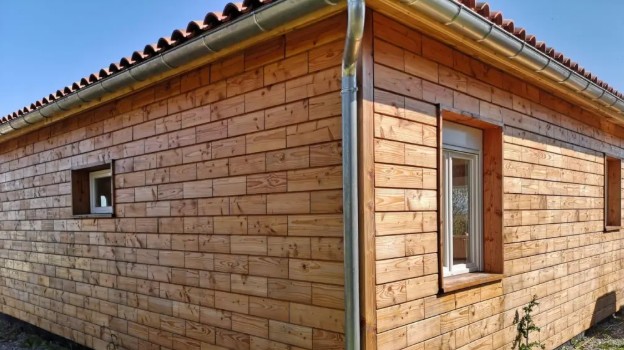
Bricks, one of the most traditional elements in construction—a sector of great importance in Spain—are being reinvented thanks to technological advances: they can now be 3D printed to offer better thermal insulation or made from plastic to be more resistant. The latest innovation in this field comes with a wooden block that makes the work of bricklayers easier.
This is Brikawood, a wooden brick that interlocks like Lego, without the need for adhesives, screws, or nails, and which offers high insulation properties, both acoustic and thermal. A block designed for building passive, ecological, and modular homes easily and quickly.
In fact, this brick was born specifically with the idea of meeting the construction needs of passive houses, homes that seek to reduce energy demand through controlled ventilation systems, optimal thermal insulation, proper orientation, and the absence of heat or cold leaks, among other standards.
They Assemble Like Legos
The French company behind Brikawood (which bears the same name) explains on its website that they researched for 10 years before launching this brick, which is set to replace conventional building materials and revolutionize the sector.
Brikawood is a block notable for being fully recyclable and 100% natural, from the beginning to the end of its use cycle. It is composed of four wooden elements, which are assembled into the shape of bricks and interlock with each other like blocks from the classic Lego game. Furthermore, it is completely demountable.
Brikawood construction kits typically range between €1,400 and €2,200 per square meter, depending on the configuration, and are fully customizable. One of its key features is its insulation, which is based on wood fiber, a material with a thermal conductivity ranging between 0.036 and 0.046 W/mK, providing excellent thermal resistance.
It should be noted that wood fiber is an element that also naturally regulates humidity, as it has an absorption capacity of up to 18%, and guarantees zero VOC emissions (volatile organic compounds, which are dangerous air pollutants) and very high-quality acoustics.
As for construction with Brikawood, it is a truly simple and fast process, and one does not need to be an experienced carpenter to work with it. The system consists of interlocking blocks that fit together, and the company provides detailed instructions that the user can easily follow. Additionally, assistance from qualified installers is available.
"Imagine a life-size Lego construction, where every element is labeled. We provide you with the complete list of house parts along with the building materials. So it's almost impossible to make a mistake! Window frames, corner posts, metal plates, top and bottom plates, reinforcement posts, and of course, the bricks!" states the company.
During assembly, neither nails nor glue are needed, and once the bricks are interlocked, the structure meets the requirements of a passive house. The piles can be loosened, allowing water to seep under the house. These bricks are also designed to "last over time" and offer "low energy consumption."
Minimal Maintenance
Brikawood was created to address current environmental challenges: energy efficiency, reduction of carbon footprint, and sustainable modular housing. Their spruce kits allow for building studios, extensions, or complete houses without complicated bureaucratic procedures and with minimal energy consumption. With these blocks, a home would not consume more than 15 kWh of energy per square meter.
This is due, among other things, to energy savings for climate control, since homes that choose this material will consume 90% less for this purpose than buildings constructed without energy efficiency criteria. These insulating qualities are especially valuable for ensuring the thermal comfort of the building's occupants, "especially since climate change is expected to increase the frequency and intensity of heat waves."
The company notes that its block even offers "surprising physiological effects. In 2019, researchers from the University Hospital of Nantes launched a scientific study on the health of people living in timber-framed buildings. They observed a significant decrease in the heart rate and blood pressure of residents."
Brikawood also serves as "a logical method for building load-bearing walls" and, being made of natural wood, "requires minimal maintenance. Only an occasional coat of linseed oil needs to be applied." These innovative building blocks have already been used to build houses in a variety of countries, from France to Norway or Canada.
Source:El Español


Comments (0)
No comments yet. Be the first to comment!
Leave a comment