

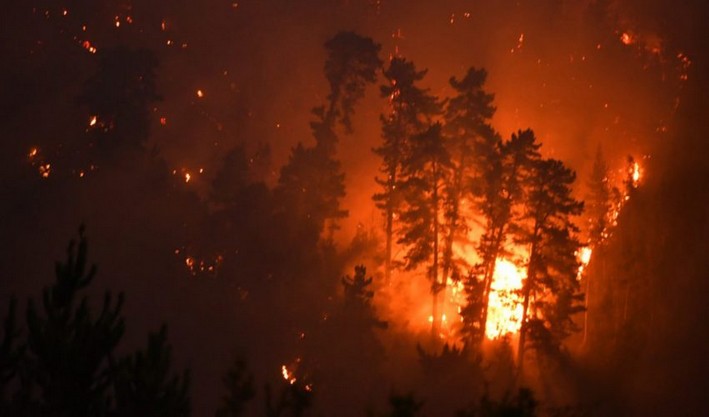
Wildfire prevention has become a priority in the Biobío Region, following a 12% increase in the occurrence of these events compared to the same period last year, with 260 incidents recorded to date, according to data released last week by Conaf.
The technical agency also reported that the affected area at the regional level exceeds the figures from the previous season by almost 500 hectares.
The numbers are not encouraging on the eve of summer, when risks increase due to more people coming into contact with natural areas during the holiday period.
"In Chile, 99.3% of fire outbreaks are caused by human action, whether due to negligence, carelessness, or intent," stated Eduardo Peña Fernández, an academic from the Faculty of Forestry Sciences at the University of Concepción (FCF UdeC) and a specialist in Fire Ecology.
Alerts are focused on the central zone because—as Dr. Peña indicated—much of the material consumed by fires in the recent past has already recovered.
"We estimate that between three to five years, enough fuel accumulates for a fire to repeat; it may not be as large as the original, but (that material) will burn," he asserted.
More Recurrent Wildfires
The researcher explained that it must be considered that, recently, the frequency and intensity of these disasters have increased, now occurring cyclically.
"In the past, a major fire occurred every eight, ten, or twelve years; but what we are seeing now is that they repeat practically every four or five years," he detailed.
Higher temperatures and prolonged drought periods driven by climate change have created favorable scenarios for fires, a reality evident in various countries.
"All this causes combustible material to dry faster and become available earlier. Before, the fire season started in December and ended in March; now it runs from October to May," he noted.
Prevention Starts at Home
Thus, the risk period for fire events has doubled. Under these circumstances, prevention work focused on managing burnable material and reducing dangers in potential emergencies is imperative.
The premise is to eliminate, reduce, or discontinue.
"This is everyone's responsibility, starting at home," affirmed Peña.
The specialist provided some basic measures to consider in homes, especially in riskier environments, both in rural areas and populated centers.
The basics are to remove fine fuel—dry grass, leaves, and moss—around the home, from gutters and roofs, and to avoid keeping firewood piled near walls.
"If I keep the yard clear, without grass; the roof clean without leaves and moss, when embers fall, the fire won't start," he explained.
On the other hand, establishing a 10-meter fuel-free zone around the home—or housing complex—must be considered, and working within the next 20 meters to reduce vegetation density.
Maintaining clear zones around homes or villas is recommended/Credit: Diario Concepción.
This means pruning trees and shrubs and cutting some if necessary, disposing of the removed material in a distant location.
"Many homes are saved because they take preventive measures. The best example is the Botania villa in Quilpué, which was saved from the fire (last year) because the neighborhood organization took care, through self-management, to keep perimeters cleared and with firebreaks," he said.
Another important recommendation is to keep hoses permanently connected to high-pressure water sources to have them on hand if needed.
In rural areas, it is essential to keep access routes open to allow emergency teams to enter when necessary.
Urban-Rural Interface and Firebreaks
The academic observes that wide separation spaces must also be built in the urban-rural interface and that in plantations, establishing vegetation-free strips to break the continuity of flammable material is very important.
"That is the idea of firebreaks and clearing lines; one sector may burn, but if there are cleared areas, the fire can be stopped. That is prevention, and that is not lacking," he said.
Dr. Peña also draws attention to certain fire behaviors that people should be aware of, such as its movement pattern, which is about 90% from south to north.
Thus, it is known that fire moves faster on the south face of hills and slows on the north slope.
The researcher emphasizes the vigilant attitude of people and communities on days of higher wildfire risk, because emergency systems' response must be rapid.
"The ideal is to reach the site within the first 10 to 12 minutes and control it before 20,".
On the other hand, he detailed that many fire outbreaks can occur simultaneously in a day, but fire protection systems have the capacity to combat and control only a portion of them.
"The others escape and can cause a lot of damage," he pointed out.
Feral Species and Ecological Restoration
Besides contributing to increased biomass that can become fuel for new disasters, the post-fire vegetation regrowth cycle poses new landscape changes, with significant challenges from an ecological standpoint.
The Forestry Sciences academic and Director of the Nature Campus, Cristian Echeverría Leal, revealed that in the time since the major fires, a noticeable invasion by exotic plant species such as pine, eucalyptus, acacia (aromo), and other feral species has occurred.
"They begin to colonize those areas where they were not present before or were present as part of a plantation," he explained.
Invasive Species
Invasive species take over burned spaces/Archive DirCom.
This impacts the landscape structure because—as the Director of the Landscape Ecology Laboratory indicated—some areas become denser with the presence of these feral species."
Dr. Echeverría commented that in some evaluated areas, up to 400 thousand plants per hectare have been detected post-fire.
"Many of these invasions have also negatively affected remnants of native forests or remnants of other natural ecosystems," he explained.
The impacts of this vegetation overpopulation can last for decades, as seen in a segment of Nonguén National Park where UdeC researchers have been conducting restoration processes.
"It is an area that burned in 1999 and was later colonized by invasive species, such as acacia and pine, and to this day we are dealing with a high density of exotic tree species in this restoration," recounted Echeverría.
Thus, the academic projects that the effects of recent wildfires will translate into restoration efforts "that will be increasingly greater in terms of cost, operational, and logistical terms."
Source:Diario Concepción




Comments (0)
No comments yet. Be the first to comment!
Leave a comment