

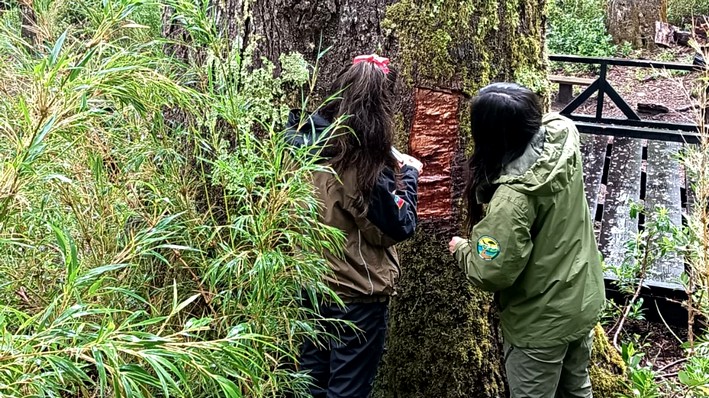
The National Forestry Corporation (CONAF) Los Ríos filed a complaint for alleged environmental damage with the Los Ríos Regional Prosecutor's Office, due to the recent illegal extraction of bark from the "Grandfather Coihue," a specimen approximately 600 years old located in the Mocho Choshuenco National Reserve, an icon of the protected area.
The regional director of CONAF, Arnoldo Shibar, filed a complaint for environmental damage, in accordance with the provisions of articles 310 and 310 bis of law 21.595 on economic and environmental crimes of the Penal Code. The action seeks for the specialized unit of the Public Prosecutor's Office to initiate the investigative procedures it deems appropriate to clarify the events that occurred in the Mocho Choshuenco National Reserve, where serious damage was recorded to the so-called Grandfather Coihue, a centuries-old tree of high ecological and heritage value. The institution also took mitigation and preventive measures to safeguard the site.
"During the month of December, various actions have been taken in relation to the situation that occurred in the Mocho Choshuenco National Reserve, directly involving a long-lived coihue tree species, involving the extraction of bark from its trunk. First, to indicate that the respective complaint was filed with the Regional Prosecutor's Office and we provided the necessary information for the complaint to follow its respective course. Additionally, other measures have been taken in the area, mainly associated with safeguarding the trail; the use of that trail was temporarily restricted, we are also incorporating the possibility of having cameras in the place, to have a daily view, hopefully, of the trail's situation. Furthermore, we want to put up signs for visitors, involving the responsibility associated with these issues of environmental damage. Along with this, we are reinforcing the patrols of park rangers and soon we will launch an awareness campaign in the region that allows us to establish the responsibilities of people who visit our protected area units in the Los Ríos region," said the regional director of CONAF Los Ríos, Arnoldo Shibar.
In addition to this, it was also possible to coordinate with the Universidad Austral de Chile, a visit by Pathologist Cristian Montalva, who was able to make an in situ evaluation of the specimen. "What was seen was an anthropogenic damage, where there was extraction of the bark, there tissue was exposed in a limited area, it is a localized damage and does not compromise the entire circumference. In this inspection, the crown was also observed, which is active, with good foliage, without a pattern of dieback attributable to severe immediate stress. In the wound, fruiting bodies of fungi are not currently apparent, mycelium was not observed nor advanced rot, although the greatest risk is that some type of fungus could enter and begin to colonize and decompose. What must be done is to protect and reinforce control around the specimen. Let the tree carry out its natural closure process and maintain monitoring."
Legal Framework: Articles 310 and 310 bis of the Penal Code
According to current legislation, Article 310 of the Penal Code establishes sanctions for those who cause serious environmental damage in specially protected areas of the country, such as virgin region reserves, national parks, natural monuments, national reserves, and wetlands of international importance.
Associated penalties include minimum-grade major imprisonment or confinement, and in cases of reckless imprudence or serious negligence, maximum-grade minor imprisonment or confinement.
For its part, Article 310 bis defines what is understood by "serious" environmental damage. This is configured when the damage meets one or more of the following conditions:
● It possesses spatial relevance, according to the ecological characteristics of the area.
● It generates prolonged effects over time.
● It is irreparable or difficult to repair.
● It affects a significant set of species in the area.
● It affects species in threat categories, such as endangered, vulnerable, or critically endangered.
● It puts the health of one or more people at risk.
● It significantly affects ecosystem services or functions.
When these events cause irreversible damage to an ecosystem, the law provides that the maximum of the penalties established for these environmental crimes be applied.

Comments (0)
No comments yet. Be the first to comment!
Leave a comment