

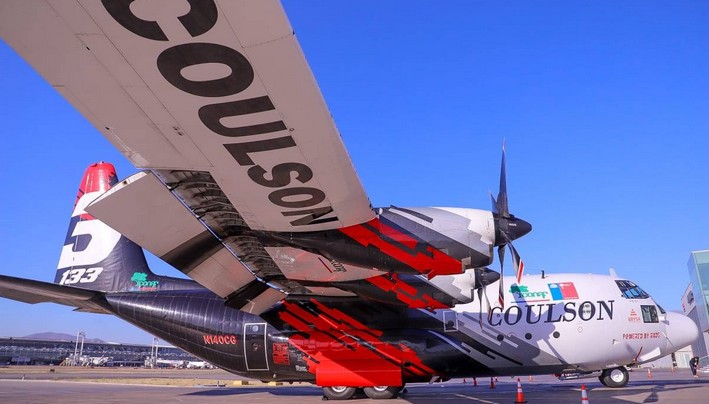
In order to prevent and combat wildfires during the 2025-2026 season, the Minister of Agriculture, Ignacia Fernández, announced that the C-130 "Hercules" aircraft will be available to tackle potential incidents in the southern zone of the country. With this, the national aerial fleet will reach 77 aircraft.
The event took place at the Arturo Merino Benítez International Airport and was attended by the National Director of Senapred, Alicia Cebrián, and the Executive Director of Conaf, Rodrigo Illesca. They detailed that the "Hercules" can transport 15,000 liters of water, suppressants, or retardants, has an autonomy of 3 hours, and will be based at the María Dolores aerodrome in Los Ángeles, Biobío Region.
Minister Fernández highlighted that "we are here to present this 'Hercules' C-130 aircraft which, along with another aircraft that has been stationed in Torquemada since Sunday, joins the tanker fleet, completing the 77 aircraft deployed this season to face the period of highest wildfire occurrence."
She added that this is part of a comprehensive prevention, mitigation, and combat strategy presented in October, "which represents an increase of more than 110% in resources compared to the resources we had to combat wildfires when we assumed the Government in the 2022-2023 season."
For his part, the Executive Director of Conaf, Rodrigo Illesca, stated that "we have prepared with a sufficient budget and resources to face a 2025-2026 wildfire season that is forecast to be very complex." He emphasized that citizen collaboration is fundamental: "Shared responsibility is key. Simple measures like removing dry grass, building firebreaks, disposing of trash in containers, cleaning roofs, and pruning trees near power lines can make a difference."
So far this year, 1,147 fires have been recorded, with 2,427 hectares affected, representing a 5% increase compared to the previous season. However, thanks to prevention and combat efforts, the damaged area decreased by 55%.
National deployment of aircraft
The distribution of aerial resources was designed considering the threat level, territorial characteristics, and historical fire behavior in each region.
Northern and Central Zone:
- Coquimbo: 1 aircraft
- Valparaíso: 9
- Metropolitan: 8
- O'Higgins: 7
- Maule: 10
- Southern Zone:
- Ñuble: 5
- Biobío: 10
- La Araucanía: 7
- Los Ríos: 1
- Los Lagos: 4
Austral Zone:
- Aysén: 2
- Magallanes: 2
Additionally, 11 national-level aerial resources are maintained for strategic support, operational redistribution, and response in high-demand events, completing the total contingent of 77 aircraft.

Comments (0)
No comments yet. Be the first to comment!
Leave a comment