

Leaders from the productive sectors of the southern macrozone expressed their rejection of the announcement made by the Government on Tuesday that it will expropriate 100 hectares of the land from the massive San Antonio squatter settlement (see note on page C 1). In regions that have been hit for years by usurpations of agricultural and forestry properties, among other private holdings, the Executive's decision was met with concern over the incentive it creates for new illegal land occupations.
"Although it is at the end of its term, the Government never ceases to surprise. It has three months left and makes a decision that goes against a judicial ruling," argued René Muñoz, manager of the Association of Forestry Contractors.
One hundred thousand hectares of forests usurped
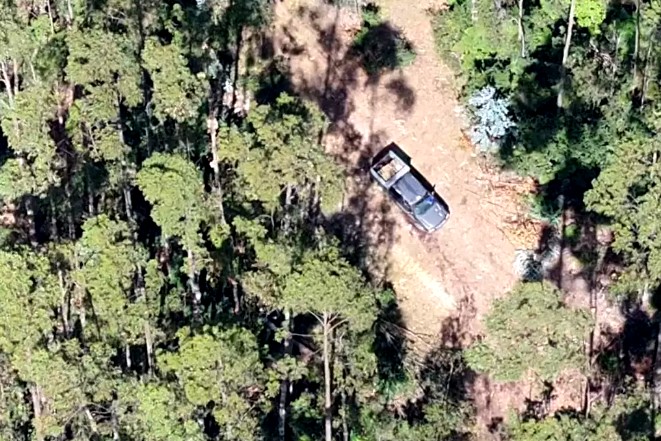
He stated that "it is a very poor decision both for those waiting in line to apply for housing and for the productive areas of the country. In our case, as a forestry sector, we suffer from usurpations that have been going on for quite some time" and detailed that "according to figures from Infor (Forestry Institute), one hundred thousand hectares are occupied, within the southern macrozone."
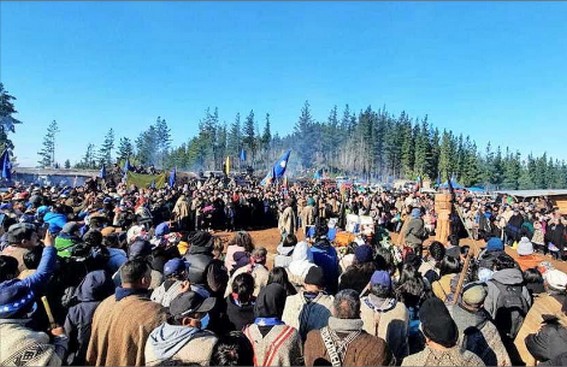
Within that area, according to the contractors' representative, is the Pidenco forestry property, in the commune of Lumaco. That land, of almost 2 thousand hectares, is illegally occupied by the Arauco Malleco Coordinator (CAM). There, moreover, is buried Pablo Marchant, an activist of that radicalized group, who died in July 2021 during an armed attack on a forestry operation in Carahue.
The president of the Malleco Farmers Association, Sebastián Naveillán, said that "it is a very bad signal, which is not only aimed at those living in the San Antonio settlement, but has a national scope and impacts the entire country." He asserted that "after this decision, who could think there is no clear incentive to seize land? because the precedent has now been set that the State will come out to expropriate it to hand it over to the usurpers."
Furthermore, he recalled that in La Araucanía, around 20 thousand hectares of agricultural land remain occupied by radicalized organizations. "This measure is also bad because it is a lack of respect for the Rule of Law, private property was not respected, action was not taken in time, and a Supreme Court ruling ordering the eviction is being disregarded," Naveillán emphasized.
"Expropriations are not for private problems"
In turn, Patricio Santibáñez, head of the Multiguild of La Araucanía, which brings together six productive guilds, described the option to expropriate as a "regrettable decision, which, in a way, violates the Rule of Law." He also said that "expropriations to resolve problems between private parties are not a corresponding practice, as it violates the law and rewards those who break the law." He expressed his expectations that "the criteria of the next government will be different."
Santibáñez stressed that "expropriation is not a good solution for this type of case, as it is a tool designed for situations where the common good of citizens is at stake, for the construction of roads and infrastructure works, and not for confronting particular conflicts and demands, especially if the law is being transgressed."
Faced with the risk that the active usurpations in the southern macrozone could lead to new expropriations, the guilds' representative advocated for "future authorities to rule out the option of expropriating, comply with the law, and evict those who illegally occupy the lands." Similarly, he emphasized that "in the southern macrozone, not only do usurpations hinder productive activity, but violence also causes many owners to have abandoned their properties due to the lack of legal certainty" and added that "we need all these properties to be put to work and for property rights to stop being violated."
Source:El Mercurio

Comments (0)
No comments yet. Be the first to comment!
Leave a comment