


The Regional Ministerial Secretariat (Seremi) of Security of Ñuble reported on various operations regarding inspections on the route of trucks transporting timber.
It was specified that, together with personnel from Conaf, Carabineros from the 5th Police Station of Quirihue, and inspectors from the Regional Ministerial Secretariats of Transport and Telecommunications and Internal Taxes, they focused on areas such as Vegas Verdes, in the province of Itata.
Although this is an operation carried out constantly, within the framework of the Timber Theft Law, a prioritized crime in the Regional Plan Against Organized Crime, this time there was special attention from the local press, especially after Conaf made public that over the last five years, nearly 1,403 hectares affected by illegal logging or timber theft have been recorded in Ñuble.
And one of the most dramatic (and unforgivable) factors is that of the total looted area, 720 hectares correspond to native forest with very slow recovery, which is essential for the environmental conservation of the region.
According to the same source, in 2025, 56 cases of timber theft have been reported to date, compared to 81 in the same period in 2024. However, this decrease in reports does not mean the problem is solved.
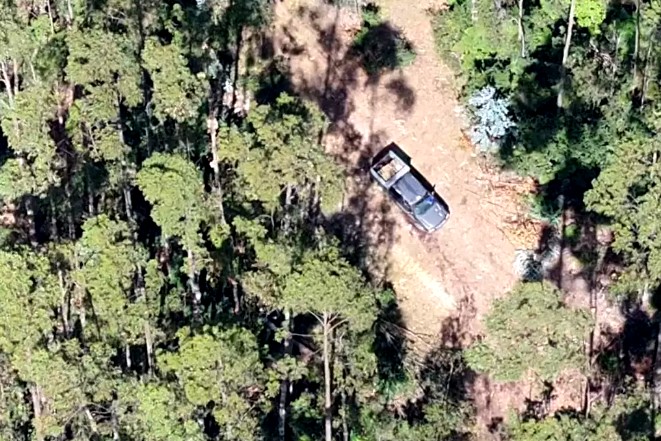
In October 2025, Conaf inspectors (along with Carabineros) detected, for example, a serious case of illegal logging and theft of native timber in the Huemul–Agua Santa sector, commune of El Carmen.
Native species such as roble (oak), raulí, were cleared, and the habitat of conservation species, such as the naranjillo, was also affected.
That operation concluded that the theft had been organized; evidence was found of groups that plan logging on specific days and times to extract timber or wood chips and then commercialize them without transit permits.
In another recent incident, in the commune of San Fabián de Alico, eight people were caught in the act while stealing timber from a forest property, with trucks, chainsaws, heavy machinery, and about 150 cubic meters of timber seized.
Despite the above, many cases still have unknown perpetrators (44 of the 56 cases in 2025), highlighting difficulties in identifying those responsible.
But the task is complex, and to understand its scale, it is enough to know that there are over 4,200 kilometers of paved roads in Ñuble to inspect.
"The work coordinated from the Regional Ministerial Secretariat of Public Security of Ñuble is focused on addressing the prioritized crime of timber theft, framed within the context of the Regional Council Against Organized Crime," explains the Regional Minister (Seremi) of Security, Jorge Muñoz.
The ministerial secretary adds that "there has been a territorial deployment in the points where certain incidents have occurred, therefore, this year we have been conducting controls on trucks and cargo vehicles transporting timber, understanding their routes, traceability, place of origin, and destination."
In 2025, Conaf alone has carried out an average of 300 inspections per year in the region, covering thousands of hectares, many of them linked to reports of illegal logging or theft.
Among the most affected communes are El Carmen (in the Huemul–Agua Santa sector) and San Fabián de Alico.
The Most Affected Species
Species such as roble (oak) have been explicitly mentioned in the majority of illegal logging operations in Ñuble, reported by Conaf.
Other species such as raulí and coigüe also appear repeatedly as affected species in recent reports of illegal logging and timber theft, while lenga and ñirre are found in areas where small illegal cuts ("floreo") have been detected, making them vulnerable.
Also on this list are tepa and citronella mucronata (naranjillo), considered a conservation species, but its smaller-scale presence in the area is a disadvantage in terms of the number of formal complaints made due to its illegal logging.
Although less reported, Conaf includes in this list of native species radal (Lomatia hirsuta), present in protected areas and forest edges; susceptible to targeted extraction; ciprés de la cordillera (Austrocedrus chilensis), scarce and of high local value; extraction and habitat damage are the risks it faces.
Also listed are simbio, tineo (a native evergreen forest tree, whose timber and local use make it vulnerable in accessible areas); laurel, whose extraction is generally for domestic or commercial use; and arrayán, extracted specifically for firewood and local uses.
On a smaller scale are maqui, of low timber value but affected when its habitat is destroyed; canelo, a species present in valuable forests, whose loss affects structure and cultural uses; avellano, in forest mosaics; araucaria (few and further south, but transition zones may have isolated individuals); alerce/Guaitecas cypress (not common in Ñuble, but in nearby reserves and mountain passes its presence is sensitive) a species mentioned for its high value and whose illegal extraction carries the most severe penalties.
Finally, quillay is mentioned, a species of traditional and commercial use (saponins); affected by vegetation removal; and arrayán, highly present locally in wetlands and ravines; vulnerable to degradation.
Crime Moves to New Areas
As a complement, the regional director of Conaf, Salvador Ramírez, adds that "the communes of the foothills, such as Yungay, El Carmen, Pinto, or San Fabián, associated with the native forest of the forest type, have historically been the most affected in the region. In addition to the reported area, lands continue to be linked for agriculture in the interior dryland zone, affecting sclerophyllous forests, such as espinal, which, although not part of the protected species, its logging is punished with fines."
It is clear that logging is no longer an attack that only damages La Araucanía or Biobío, which have been declared exceptional zones. Ñuble already shows risks.
"Although these events have been concentrated mainly in areas under a state of exception, unfortunately they are moving to sectors where this measure does not exist. From Corma, we continue to actively collaborate to eradicate organized crime, this illicit activity that mainly harms the SMEs in our sector," warns Alejandro Casagrande, president of Corma Biobío.
Source:La Discusión
Comments (0)
No comments yet. Be the first to comment!
Leave a comment