

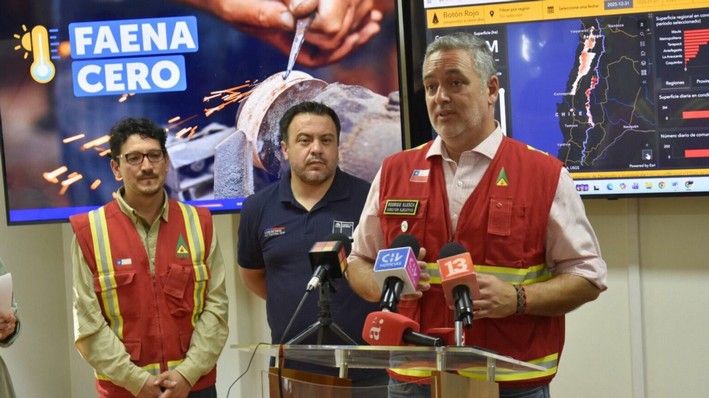
The Ministry of Agriculture, together with the National Forestry Corporation (CONAF), issued a preventive call to citizens and the forestry and agricultural sector to implement the Zero Work Hours measure, in the context of forecasted high temperatures and existing risk conditions for the occurrence of wildfires in different areas of the country.
The measure, which is preventive and voluntary, aims to restrict during the hours of highest temperature the carrying out of work and risk activities that, by their nature, can increase fires, especially those involving the use of machinery, tools, or processes that can produce sparks or heat.
The activity was attended by the highest authorities of the main public and private institutions linked to wildfire prevention and firefighting; the Acting Minister of Agriculture, Alan Espinoza; the Executive Director of CONAF, Rodrigo Illesca; the National Director of the National Disaster Prevention and Response Service (SENAPRED), Alicia Cebrián; the president of the Chilean Wood Corporation (CORMA), Rodrigo O'Ryan; and the general secretary of the National Agriculture Society (SNA), Juan Pablo Matte.
Prevention Strategy
On the occasion, the Acting Minister of Agriculture, Alan Espinoza, explained the scope of this measure and its main impacts for the productive sector. "The implementation of Zero Work Hours is part of the strategy for preventing wildfires and protecting people's health in the face of extreme heat events. The call can be activated when daytime heatwaves occur, or there are meteorological alerts or alarms, activation of the Red Button by CONAF, or declarations of a Red Alert by SENAPRED," stated the authority.
In that sense, he added: "The implementation of Zero Work Hours is focused and temporary and responds to the specific meteorological and risk conditions of each territory. In operational terms, the call contemplates the suspension or restriction of agricultural and forestry work during the hours of highest risk, particularly between 12:00 and 18:00 hours. Likewise, in situations of extreme risk, the measure can consider the temporary closure of national parks and forest reserves managed by CONAF."
For her part, the National Director of SENAPRED, Alicia Cebrián, provided details on the main threats associated with high temperatures: "The main call is for shared responsibility; people can help us with simple actions at this year's end, such as, for example, not using so-called 'wish lanterns,' which can cause a forest emergency or a structural fire, as well as avoiding the use of heat sources in places near vegetation, and not buying or handling fireworks," stated Cebrián.
From the productive sector, the president of the Chilean Wood Corporation (CORMA), Rodrigo O'Ryan, reinforced the call to adjust work schedules. "People cause fires, and that is why prevention is everyone's responsibility. As a forestry sector, we work all year round in coordination with the authorities on prevention and firefighting tasks. We comply with safety standards and invest in cutting-edge technology for detection and firefighting, but on days of extreme heat, the call is to take extreme care and avoid any risk activity and be responsible during these holidays," said O'Ryan.
Citizen Support
Along those lines, the general secretary of the SNA, Juan Pablo Matte, emphasized that while there are protocols and technology to deal with emergency periods, citizen support is fundamental. "We have protocols, we have technology, but we need people to collaborate to prevent this. That is why we have called for Zero Work Hours, or at least for that work we can change, modify, do it very early in the morning or very late in the afternoon, in order to avoid those most risky hours of high heat, high winds, which could eventually, in an agricultural or forestry task, unintentionally cause a spark and ultimately cause that fire which affects not only the fields, not only the forestry world, but affects homes, affects people. That is the most important thing," stated Matte.
Along with this call, the Ministry of Agriculture and CONAF reiterated a series of preventive recommendations, including adjusting work schedules to avoid prolonged exposure to extreme heat; avoiding tasks that generate sparks during the hours of highest temperature; maintaining hydration and personal protection measures; reinforcing animal care; respecting the ban on burning and maintaining firebreaks and preventive clearings.
Meanwhile, the Executive Director of CONAF, Rodrigo Illesca, reported on the current status of wildfires and presented the map of territories under Red Button condition. "During the months of January and February 2025, the implementation of Zero Work Hours recorded high adherence from the forestry and agricultural sector, with strengthening its incorporation into small and medium-sized agriculture identified as the main challenge. The Ministry of Agriculture and CONAF reiterated that wildfire prevention is a shared responsibility and called for acting with anticipation, self-care, and commitment to protect people, productive territories, and the country's natural heritage," Illesca pointed out.



Comments (0)
No comments yet. Be the first to comment!
Leave a comment