

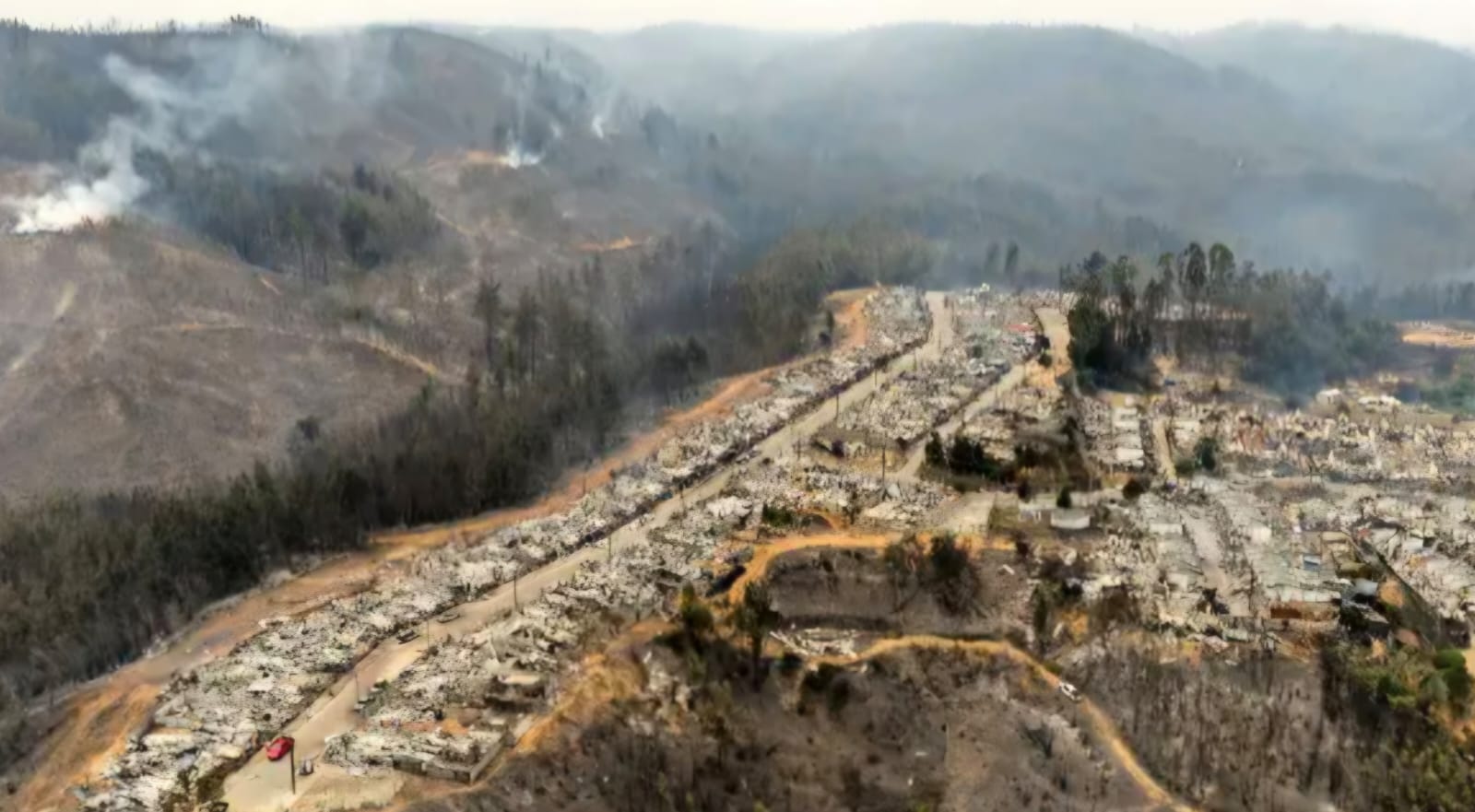
Preliminary losses from the fires affecting the Biobío and Ñuble regions since the weekend, most severely in Lirquén, Penco commune, currently exceed US$ 400 million.
This is anticipated by two reports from consulting firms that analyzed the impacts on agricultural and urban-residential assets, based on data available until noon yesterday. The National Disaster Prevention and Response Service (Senapred) reported yesterday morning that there were 20 fatalities, 630 people in shelters, 19 operational shelters, 1,533 people affected, 325 homes destroyed, and 1,140 under assessment.
The Figures
According to estimates by GPS Property, the economic losses associated with these events, primarily in agriculture, would exceed US$ 200 million. This considers the costs of aerial and ground firefighting, damaged infrastructure, destruction of productive assets, and disruption of economic activities.
The report states that this impact is not limited to burned hectares but also includes fences, warehouses, rural homes, agricultural machinery, roads, and critical networks supporting the forestry and agricultural activity of both regions. "The recurrence of these events establishes a permanent risk that increases insurance costs, raises operational expenses, and ultimately delays or halts agricultural and forestry investment decisions," commented Osvaldo Errázuriz, manager of the Agricultural area at GPS Property.
Likewise, Inciti, a subsidiary of the consulting firm, analyzed the repercussions in the more residential sphere. It indicated that "considering exclusively the value of the constructions and not the land value, preliminary potential economic losses are estimated at around US$ 230 million." For this calculation, it used satellite images and cadastral databases from the Internal Revenue Service (SII). Thus, GPS's initial global loss estimate totals approximately US$ 430 million.
On the other hand, Rodrigo Gil, manager of the Agricultural Fields area at Colliers, commented that "these fires yield a preliminary loss estimate of about US$ 300 million, considering razed forest hectares, costs associated with firefighting and reconstruction of homes, and losses in the tourism sector," he stated. The analysis was conducted yesterday when about 26,000 burned hectares were counted, primarily in Biobío.
"In addition to the loss of lives and materials, significant damages directly affect vegetation cover, ranging from agricultural land to native forests, including forest plantations and shrubland areas, showing a very important ecological and biodiversity loss," Gil stated.
For comparison, in February 2023, "El Mercurio" published that the forest fires in the south of the country—which had caused around twenty deaths—generated losses of US$ 540 million. The incidents had affected 278,000 hectares in the Ñuble, Biobío, and La Araucanía regions.
Forestry Companies Fight Fires
The Chilean Wood Corporation (Corma) stated that forestry companies halted their productive operations in the affected areas, dedicating 100% of their human and technical capacities to firefighting, focusing on protecting communities and emergency teams. The private sector's deployment involves about 5,000 firefighters, over 65 aircraft, and 120 mechanized brigades.
Company CMPC indicated that fires in Biobío and La Araucanía are being confronted by more than 260 firefighters and 13 aircraft from that company.
Source:El Mercurio

Comments (0)
No comments yet. Be the first to comment!
Leave a comment