

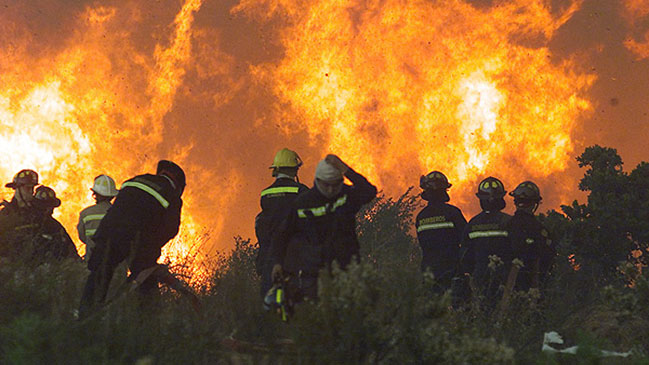
Invited by the Agriculture Committee of the Chamber of Deputies, the manager of Acoforag, René Muñoz, stated that "in Chile, burning forests is free," and pointed out that political will is required to advance in combating these disasters.
In the committee, the need to advance a fire law that more severely punishes those who carry out burns was mentioned.
Muñoz stated in the Agriculture Committee that regarding the generation of fires, "intentionality reaches 80% in the macrosur zone, with people going around looking for forests to burn them."
Criticisms of the State
Michel De L'Herbe, an emergency management expert, also testified before the deputies. He questioned that the State is not even capable of providing the basic items people need to begin working on the recovery of their homes in areas affected by the fires. He stated that the victims are working without gloves, tools, or bathrooms.
The expert also criticized that regarding community training, the Senapred's budget is $84 million for the entire country. This, he added, contrasts with the public discourse on the importance of preparing people for these emergencies.
Last October, the Chilean Wood Corporation (Corma), the country's main forestry association, announced that to combat fires for the 2025-2026 season, it would allocate resources amounting to $123 billion, more than US$130 million.
But the increase in disasters this year, their greater voracity, and the forestry sector's efforts to help affected communities —beyond protecting its forestry operations— could put the sufficiency of those resources at risk.
This was indicated to "El Mercurio" by Rodrigo O'Ryan, president of Corma, who was asked whether those more than US$130 million would be enough. "That will depend on how the emergency in Ñuble and Biobío evolves and how the season continues. Now, as the authority has pointed out, resources are always finite and can become insufficient if the number of fires keeps increasing," he stated.
He added that with the weekend's event, "the damage to lives, homes, critical infrastructure, sources of employment, and natural resources is incalculable." He recalled that "in Chile, last season we had about 7,000 fires, something that is incomprehensible in a country that does not have natural fires, where 99% of the disasters are started by people intentionally or negligently. More than the resources for combating fires, the main thing in this context is people's commitment to avoiding risky behaviors that could start a fire."
Affected Area Grows
O'Ryan attended the Agriculture Committee of the Chamber of Deputies yesterday, where —along the same lines— he maintained that "resources are limited, both Conaf and Corma companies have been increasing funds (to combat fires), but everything has its maximum capacity."
He added that if "sixth-generation fires" occur, the available resources could be overwhelmed. Therefore, he urged strengthening prevention to avoid new outbreaks.
As of last January 9th, Conaf reported that wildfires in the current season had affected 13,508.6 hectares nationwide, recording a 15% decrease compared to the 2024-2025 period. However, data from the entity, as of yesterday at 6:30 PM, indicated that the disasters had damaged an area of 60,149 hectares —more than half in Biobío—, a sharp increase of 213%.
O'Ryan stated in the committee that the global scenario for forestry activity is complicated, because in addition to the increase in fires, there is low demand, lower prices, and a demanding tariff context.
Source.El Mercurio
Comments (0)
No comments yet. Be the first to comment!
Leave a comment