

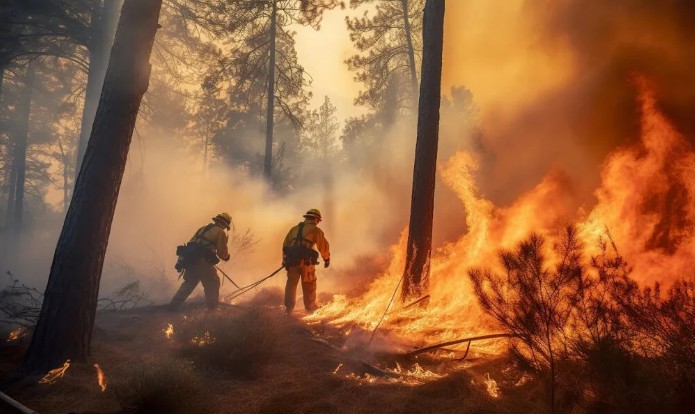
Amid the emergencies caused by forest fires that have affected various areas of the country, the current legal framework provides for significantly higher penalties for those found responsible for causing a fire, whether intentionally or under circumstances where the consequences could have been foreseen.
This was explained by criminal lawyer Diego Muñoz from the Faculty of Law at the Universidad del Desarrollo (UDD), who detailed the scope of the legal amendments incorporated after the mega-fires of recent years.
TOUGHER PENALTIES AFTER MEGA-FIRES
"The crime of arson saw its penalties increased after the recent forest fires, both in Valparaíso and in other previous mega-fires," stated Muñoz.
In that context, he specified that previously the penalties reached up to 10 years of imprisonment; however, currently there are "ranges starting from 5 years for those who set fire to a forest, grasslands, or other areas, up to 20 years in prison, with the possibility of an even greater penalty if there is an aggravating circumstance, such as committing the act at night or in an open area."
The lawyer emphasized that criminal liability is not limited only to those who act with direct intent; "the same sentence could also be imposed on those who, without having the intention, could have foreseen the fact that they could cause a fire," he explained.
As an example, he stated that "if I am aware of the alerts, like the 30-30-30 rule, and still have a barbecue or a burn, I can foresee that a major disaster could be generated, and with that, my penalty would also increase."
CASES OF NEGLIGENCE
A different scenario is related to negligence. In those cases, Muñoz explained that the penalty would be in a lower range, starting from 541 days (presumably a typo for 'imprisonment' or 'of sentence') up to 5 years.
"It's not effective imprisonment, but could be served with a substitute penalty, such as supervised release, meaning not in direct confinement," clarified the lawyer.
Cases of negligence could include situations where people have used firecrackers or had a barbecue. However, he warned that each situation must be analyzed specifically.
MODIFICATION OF PENALTIES
Regarding the legal modifications, the lawyer explained that these were introduced in 2013, and currently there is a bill in its second legislative stage to increase penalties for those who cause forest fires.
In that context, he detailed that "the forest law is being modified, and sentences for fires in forests, crops, and grasslands are being increased, but greater penalties are also added when a populated area could be affected," he affirmed.
Furthermore, the specialist said that "when it can affect a large part of the population, the sentences could even exceed 20 years."
DIFFICULTY IN PROVING INTENT
When asked about the existing difficulties in judicially proving the intent to cause a fire, Muñoz indicated there are several challenges. "The first problem is evidence, because as everything burns, it often disappears," he explained.
Added to the complexity is proving whether the person foresaw the risk, which depends on their experience and knowledge. "It's not the same for a firefighter or someone who works in the countryside and knows the danger, as it is for a person with no experience in a rural fire," he exemplified.
Finally, he warned that time works against investigations. "The farther we are from the events, the harder it is to find those responsible. The first days are very relevant because the evidence disappears," he concluded.
Source:La Tribuna

Comments (0)
No comments yet. Be the first to comment!
Leave a comment