

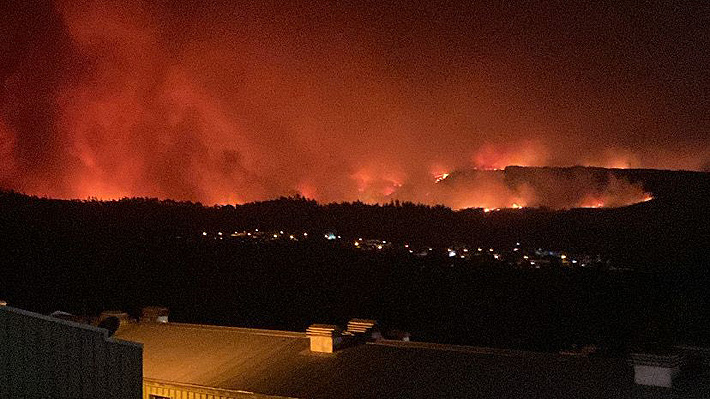
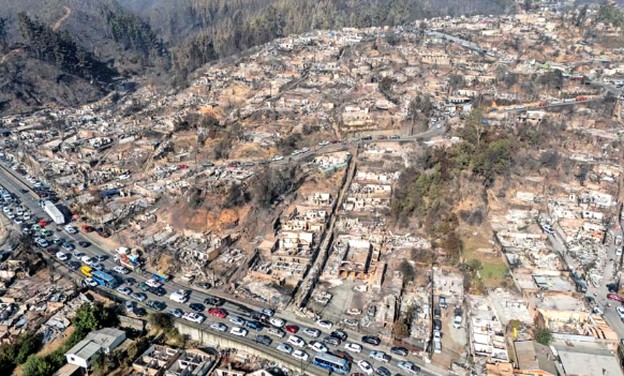
Amidst the ashes, in what until last week was their home, thousands of people are carrying out cleanup work —to later rebuild— in the commune of Lirquén, in Penco. "Riquelme Guarda Family" or "Cisterna Pereira Family," could be read in recent days on improvised signs to identify the plots in the so-called "ground zero" of the fires in the Biobío Region.
The scene is not unusual, as every summer in the country, disasters with similar characteristics are recorded. Just in the first 20 days of the year, at least 215 crimes linked to forest fires have been counted nationwide, according to information provided by the National Prosecutor's Office. The details, with figures from the last five years, reveal how many illicit acts of this nature were criminally investigated and how these inquiries ended.
"Impossibility of Overcoming the Standard of Reasonable Doubt"
Between 2020 and January 20, 2026, nearly 11,000 cases entered the prosecutor's office, including crimes such as forest arson, possession of items to cause fires or devastation, and illegal use of fire, as contemplated in the Forest Law.
In that period, there were about 13,500 case closures related to these illicit acts, which includes investigations from previous years that concluded within these years. Of these, 60% ended with a provisional dismissal, and less than 2% of the cases ended with a conviction.
The Specialized Unit for Economic and Environmental Crimes of the National Prosecutor's Office explains that these results are due to the complexity of the investigations, as fire often destroys the crime scene. Other complexities include the presence of evidence difficult to preserve, the use of specialized investigative techniques, and the existence of simultaneous fire outbreaks.
In this regard, they exemplify with one of the types of case closures: the decision not to persevere. This "constitutes a legal authority that allows not continuing with the investigation when it is estimated that there is insufficient background to file charges against a defendant, a decision that in no case can be arbitrary, but rather such determination stems from the impossibility of overcoming the standard of reasonable doubt, as a consequence of the inherent complexities of this type of crime," they explain.
The data also show that between 2024 and last year, there was an increase in cases filed. In this regard, the Public Ministry maintains that, on one hand, "there are multiple factors that could explain this phenomenon," such as climatic conditions, which "have become extreme in recent years, precisely in both regions (La Araucanía and Biobío)." Furthermore, they add, "as the National Prosecutor's Office, we have adopted a series of modifications to better classify this type of crime, generating a greater and better record of complaints, which allows us to have a greater representation of the phenomenon."
Brigade Members and Firefighters Among Those Formally Charged in the Last Year
Regarding the type of defendants, at least among the most recent, there are recurring characteristics, and one stands out: a significant number were public officials, belonging to an institution whose work was firefighting.
The formal charges filed have accounted for at least 13 officials involved in such incidents between 2024 and 2026. In turn, at least eight people —with no link to public entities— were arrested for causing fires, both through negligence (4) and intentionally (4).
For example, one of the cases with the greatest public notoriety occurred on February 2, 2024, when the fire in Viña del Mar happened. On that occasion, 138 people died as a result of the disaster, and those affected exceeded 12,000.
On May 23, the captain of the 13th Fire Company of Valparaíso, José Jerez Camus, and a volunteer from the same unit, Matías Cordero de la Fuente, were formally charged, adding to seven other people who allegedly participated in starting the fires; in total, five of them were firefighters and four were brigade members of the National Forestry Corporation (Conaf). All were placed in preventive detention and face life imprisonment sentences.
A similar case was that of a volunteer from La Cruz, in the Valparaíso Region, whose behavior was recorded in a video showing him lighting a piece of toilet paper by the side of a road and throwing it into grasslands. On December 10, 2025, he was formally charged and placed in preventive detention. This incident resulted in four hectares being burned.
Further south, in the city of Coronel, in the Biobío Region, on January 12 of this year, Carabineros arrested another firefighter who, in turn, was a Conaf brigade member, for his alleged participation in starting a forest fire in the El Patagual sector, which he himself had reportedly attended to control. He is in preventive detention.
These investigations are still ongoing, and to date, none of the defendants have been convicted.
The penalties for the use of fire, as stipulated in the Forest Law, start at 61 days, but the use of this element on hills, forests, grasslands, and other vegetated areas can reach up to 20 years of imprisonment, specify officials from the specialized unit of the National Prosecutor's Office. The use of fire in protected areas can be sanctioned with penalties ranging from 61 days to three years in prison.
Regarding the last season, yesterday the Minister of Security, Luis Cordero, stated on Canal 13 that since September, 357 people associated with fires have been arrested and "more than 130 of those arrested are linked to arson crimes that have posed a risk to people."
Source:El Mercurio
Comments (0)
No comments yet. Be the first to comment!
Leave a comment