

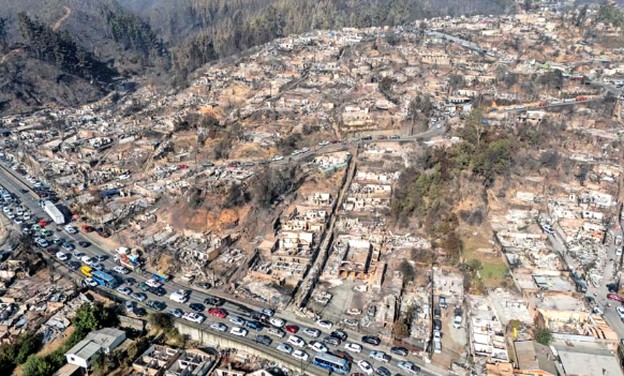
Last Wednesday, seven weeks after the change of government, the Fire Law bill was dispatched from the Finance Committee to the Senate floor. This legislative progress was preceded by President Gabriel Boric's call to Congress to vote on the initiative "as soon as possible," in the context of the forest fires hitting the Biobío and Ñuble regions particularly hard.
Some organizations are even asking the Government to withdraw the bill so that it can be processed in the next legislative session, which begins on March 11. Among them is René Muñoz, manager of the Association of Forestry Contractors. "As it stands, the Fire Law bill will not solve the problem. It transfers the responsibility for stopping fires to small and medium-sized forest owners but says nothing regarding intentionality," he warns.
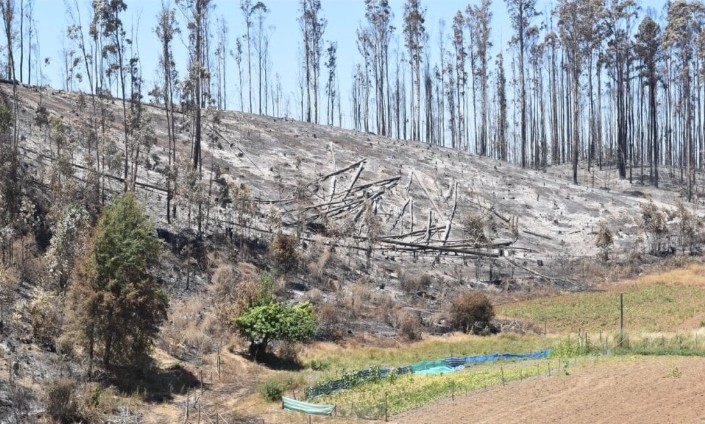
Óscar Crisóstomo (PS), governor of Ñuble, one of the areas hit by the fires, did the same. That region, with over 9,000 hectares devastated, saw the burned area increase almost fivefold compared to the previous season. In his plea, he pointed out that the Regional Government (Gore) invested $15 billion in prevention, "but it is impossible to avoid emergencies." Alongside "the lack of the Fire Law," he urged speeding up the "regulation of firebreaks" and the Land Use Planning Plan, which has been in process since 2021.
Details of the initiative
The bill, submitted by the Executive in October 2023, aims to regulate the prevention and mitigation of forest and rural fires in interface zones (common border) between urban and rural areas.
Commenting on the initiative, PS Senator José Miguel Insulza stated that the regulation lacks funding. "It is necessary to say how this will be financed. It's a lot of obligations that are proposed, even for public services, and it is made conditional on having the resources," he said. He added that "the bill has a financial report, but it is insufficient."
In his opinion, "it is a very good law regarding what fire prevention should be, but, at the same time, it needs to be funded." He also stated that the bill enshrines "shall" and "may," rather than "must" or "can."
Meanwhile, Senator Ximena Rincón (Democrats) believes that "this bill, unfortunately, does not address the prosecution of those responsible for the fires, does not provide more tools or resources to the prosecutor's office, nor does it address other issues."
Guilds linked to forestry activities, for their part, disagree with the focus of the regulation and ask for it to be given a framework law character.
Some organizations are even asking the Government to withdraw the bill so that it can be processed in the next legislative session, which begins on March 11. Among them is René Muñoz, manager of the Association of Forestry Contractors. "As it stands, the Fire Law bill will not solve the problem. It transfers the responsibility for stopping fires to small and medium-sized forest owners but says nothing regarding intentionality," he warns.
The executive secretary of the College of Forestry Engineers, Julio Torres, says that "the bill is unfair because it focuses on pursuing owners, who are not the ones causing the fires, and sidelines mechanisms to prevent the disasters." He is also in favor of halting the processing.
Four pillars
Andrés Meneses, Public Policy Manager of the Chilean Wood Corporation (Corma), argues that "the bill, although it is progress, does not address something essential, which is reducing the occurrence."
He adds that the bill "partially focuses on prevention measures consisting of more regulations on rural land, without considering support measures for those who will have to comply with them."
For the law to be effective, Meneses posits that it must include four pillars: prevention, such as "preventive patrols on routes and strategic sectors when weather conditions favorable for fire spread are forecast"; firefighting, "for which it is necessary to strengthen nighttime operations, both aerial and ground"; investigation — "it is essential to grant intrusive powers to the police so they can investigate the origin of fires and reach those responsible," he says on the matter — and recovery, "which in economic and environmental terms must consider support for reforestation" because without new vegetation cover, new emergencies can be unleashed.
Source:El Mercurio
Comments (0)
No comments yet. Be the first to comment!
Leave a comment