

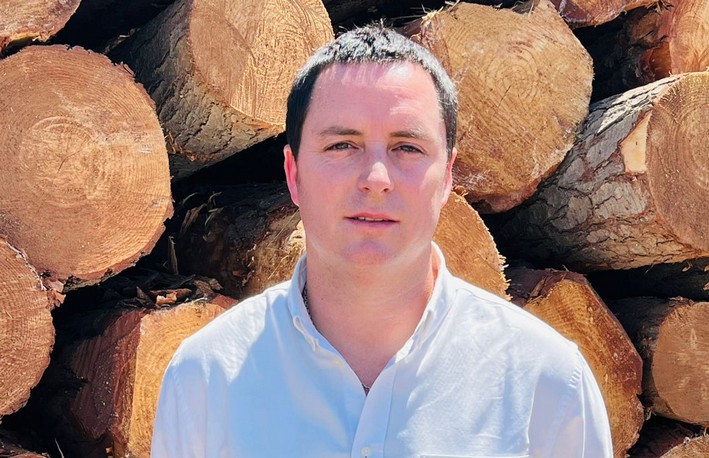
By Ignacio Vera Izquierdo, General Manager of Forestal Santa Blanca
COP30 places two central pillars on the table: limiting the temperature increase to 1.5°C and ensuring a Just Transition with adequate financing. In this context, the sawn timber forestry industry is a strategic asset for decarbonization, but it faces unsustainable economic pressure.
Sawn timber is a concrete climate solution; when integrated into construction, it substitutes highly emissive materials like concrete and ensures carbon sequestration for decades. A robust timber sector is equivalent to a country meeting its Nationally Determined Contributions (NDCs).
Chile has taken important steps. In March 2025, it implemented a PEFC certification standard that reinforces traceability and the "zero deforestation" principle, sending a signal to the world.
However, this vision clashes with commercial reality. The Just Transition seems to leave the sector behind, which faces two critical challenges:
Internal Contraction: The study "Commercialization of Sawn Timber in Chile" by the Forestry Institute (INFOR, 2025) shows that 2023 production reached 6.89 million m³, reflecting the weakness of domestic demand, hit by the construction crisis. If we do not stimulate the national market, the industry's foundation erodes. The solution lies in the State formally recognizing timber as a strategic material in social housing and public works. This policy would inject dynamism, stabilize the industry, and accelerate the decarbonization of our cities.
U.S. Tariff: The decision to apply an additional 10% tariff on imports of coniferous timbers starting October 2025 directly impacts 83.1% of our exports, concentrated in higher-value remanufactured products. The measure penalizes competitiveness and threatens the investment capacity of medium and small sawmills. A collateral risk is the diversion of Canadian supply, which could displace Chilean timber in key Asian and Latin American markets.
Chile must negotiate against this tariff to protect a key sector for economic diversification and meeting our climate goals. It is fair to acknowledge the efforts of Sofofa, led by its president Rosario Navarro, in defending international competitiveness.
We cannot allow the main carbon sink of our productive economy to weaken due to a lack of vision and action. A strong, competitive, and innovative sawn timber forestry industry is an indispensable condition for Chile to achieve carbon neutrality. COP30 must not be just a space to talk about the Amazon: it is the time to act strategically on our own climate assets.
The column in ourRevista Contratistas Forestales
Comments (0)
No comments yet. Be the first to comment!
Leave a comment