

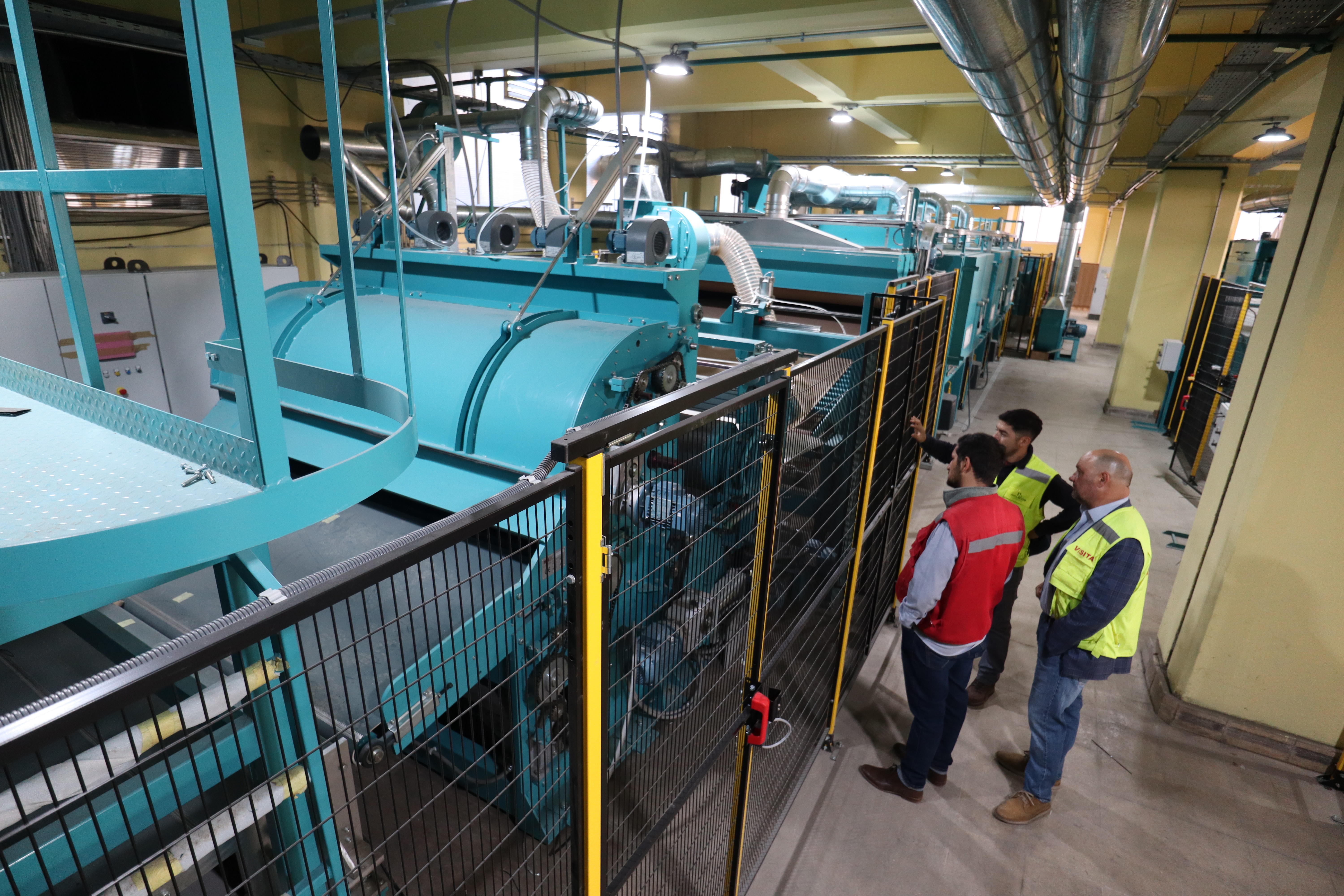
Aislacor was born from a simple yet strategic question: what to do with the thousands of tons of eucalyptus bark generated by Forestal Collicura as a byproduct of its industrial process. This material, traditionally destined for biomass boilers, began to be seen as an opportunity to create a high value-added product.
The idea took shape in 2007, when a program supported by Corfo allowed for research to begin in Europe on potential uses for the bark. Those initial studies led to panel prototypes, but the initiative was put on hold.
The project resurfaced in 2017 and gained momentum when the Technological Development Unit (UDT) of the University of Concepción joined. This alliance enabled progress toward what is now the world's first plant capable of manufacturing thermal, acoustic, and fire-resistant insulation made from eucalyptus bark for floors, ceilings, walls, and SIP-type solutions. "In 2022, we already gave the green light to acquire the machines and turn this into an industrial operation," recalls Jacques Esquerré, Operations Manager of Aislacor.
The machines – manufactured in Europe especially for the project – went through multiple testing phases. Aislacor sent Chilean bark to the old continent to validate the process and adjust the engineering. "They are unique equipment in the world, built specifically for this product," details Esquerré.
The results even exceeded expectations: the insulation achieved a thermal conductivity coefficient (Lambda) of 0.036, better than traditional materials like fiberglass and rock wool, in addition to outstanding acoustic and fire-resistant properties.
Industrial Rebirth
Installing the plant in the historic Bellavista Oveja Tomé complex not only gave the project a home but also opened the door to revitalizing a space deeply linked to the city's productive identity. "It's nice to give a second life to a facility that was frozen in time. Today there is already a café, a restaurant, and other projects setting up. An ecosystem is being formed," highlights Esquerré.
Currently, Aislacor has about 26 workers across its two plants (the other in Santa Juana), with a strong presence of neighbors from Tomé. The local connection has been key in rebuilding the productive spirit of the facility. "The idea is to provide employment where one arrives. In Tomé, that generates identity," he adds.
The operation is also designed with a circular economy approach. The bark is processed at the Santa Juana plant, dried using energy generated from forest waste, and then transported to Tomé. Everything functions as a cycle where the waste from one process is the raw material for the next. "We seek to minimize waste and make the most of every resource," he emphasizes.

Growth in Retail
The company began its stable production in early 2025 and quickly reached a key milestone: its entry into all Easy stores across the country. "We are in more than 40 stores and constantly sending trucks. For a company just starting out, it's a huge step," states the executive.
Today, Aislacor produces between 15,000 and 40,000 m² per month, although its maximum capacity ranges from 25,000 to 100,000 m², depending on the density of the product being manufactured. This flexibility allows it to serve both retail and construction companies and industrialized housing firms, markets with which they are already in advanced talks.
The new thermal regulation coming into effect in November 2025 opens even more opportunities. The requirements for greater insulation in buildings and homes – according to climate zone, orientation, and design – will increase the demand for efficient solutions. "Good insulation isn't just about comfort. It's energy savings for households and for the country," stresses Esquerré.
Aislacor's product, besides being more thermally efficient, offers better fire behavior and superior acoustic properties, making it attractive for residential and industrial projects.
New Frontiers
The work with the UDT continues, now focused on perfecting processes and developing new products. In parallel, the company is evaluating international markets for the insulation, especially in Europe and Asia.
Aislacor operates today with the conviction that forest innovation can open new development paths. "The plant has worked very well, and the team's learning has been enormous. We're aiming for more," emphasizes Esquerré.
From Acoforag, we value the project, highlighting that initiatives like Aislacor are a concrete example of innovation applied to the responsible use of forest resources. The entity stated that this industry, based on circular economy, local employment, and cutting-edge technology, represents the type of development the sector seeks to promote for the country's future.
You can also read the article in ourRevista Contratistas Forestales

Comentarios (0)
No hay comentarios aún. ¡Sé el primero en comentar!
Deja un comentario