

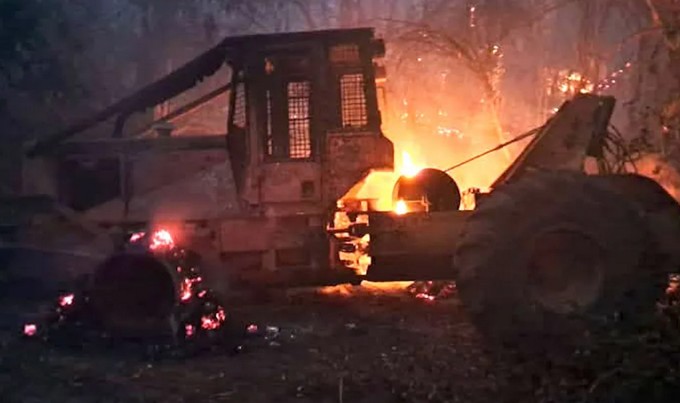
The first and last recorded attacks in the Southern Macrozone during 2025 targeted the forestry industry. The year began on January 1st with an attack by the Weichan Auka Mapu (WAM) in Los Álamos, Biobío Region, where they claimed responsibility for burning four trucks and a pickup belonging to Forestal Arauco. The cycle of violence closed on December 31st in Collipulli, La Araucanía Region, with an arson attack that destroyed two more forestry trucks. Thus, of the 69 violent incidents recorded by El Líbero's Violence and Impunity Indicator in 2025, 27 were directed against this sector.
Saturday, August 23rd will remain one of the darkest days for La Araucanía. Within a span of just 18 hours, two attacks were recorded; the last one, occurring around 10:30 PM at the Los Prados estate, Victoria commune, resulted in the murder of Manuel León Urra (60) and serious gunshot wounds for César Osorio (50). Both were employed by Green America, a firm providing asset protection services for CMPC. That night, four subjects with long guns and bulletproof vests ambushed the victims, in an incident that the regional prosecutor of La Araucanía, Roberto Garrido, formally classified as an "ambush."
Despite the State of Exception, forestry activity remains the primary target of radical groups in the Southern Macrozone, with seven attacks in December alone. The insecurity scenario led the Forestry Contractors Association A.G. (Acoforag) to file a complaint with the International Labour Organization (ILO), which was accepted on December 22nd. The text alludes to non-compliance with Convention 187, concerning the Promotional Framework for Occupational Safety and Health, by the Chilean State.
"Occupational safety and health policy must be a realistic policy that is applied. Today we do not see the State guaranteeing the safety of workers and forestry contractors. That is, there are no tools that guarantee us that. And that is what we are asking for. That the State guarantees us that we can work freely in an environment of tranquility and that, ultimately, the lives and health of workers are not being attacked," René Muñoz, manager of Acoforag, told El Líbero.
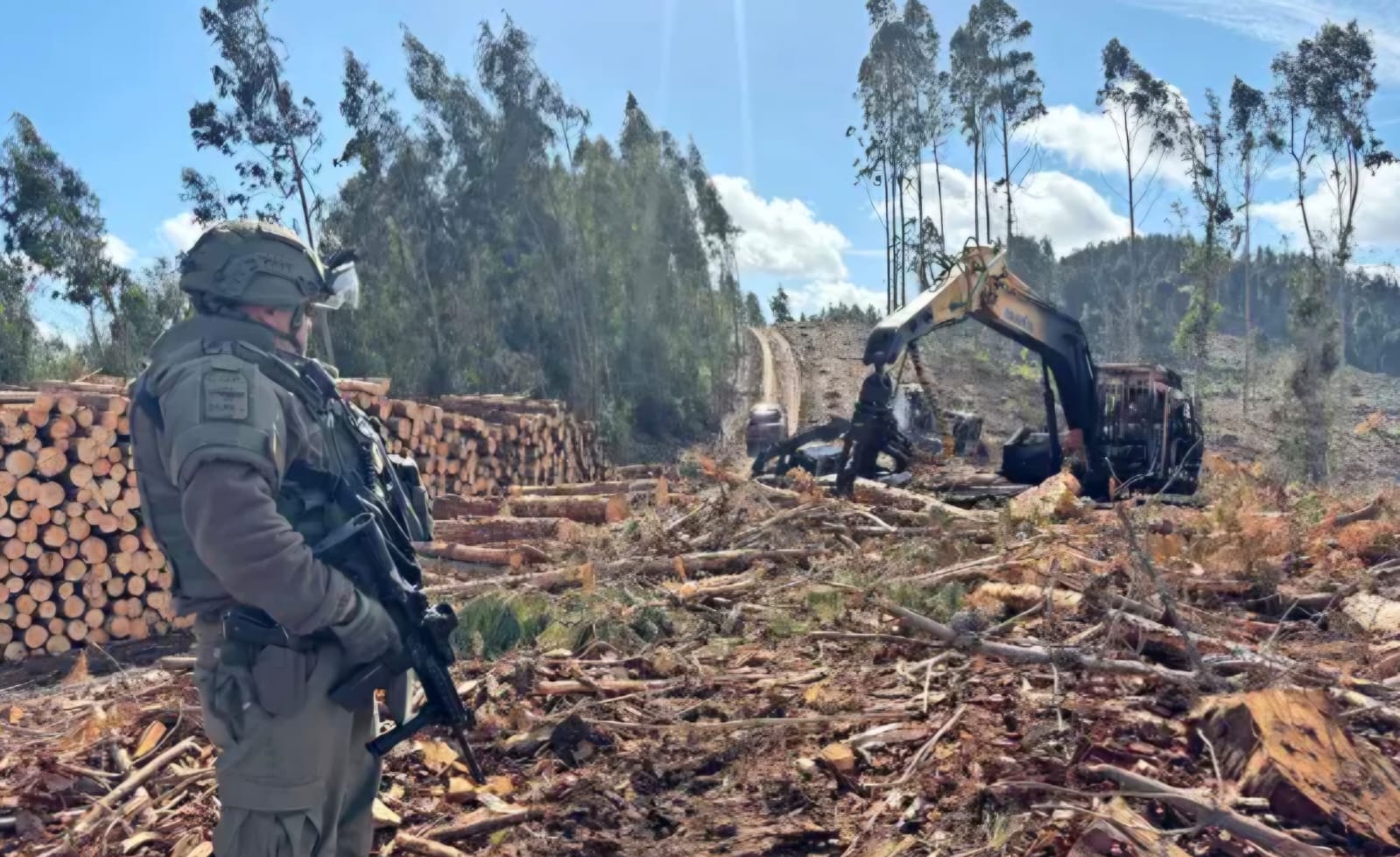
The impact on the sector was not only human but also operational and economic. Of the 27 attacks directed against the forestry industry, 21 were concentrated in the La Araucanía Region. In material terms, the violent offensive resulted in the destruction or damage of 74 pieces of equipment and machinery, with losses that, according to sector estimates, approach $9 billion.
Attacks fell by only 10% compared to 2024
El Líbero's Violence and Impunity Indicator recorded a total of 69 violent incidents in 2025, representing a 10% decrease compared to the 77 attacks counted in 2024. The violence was mainly concentrated in La Araucanía (51), followed by Biobío (15) and Los Ríos (3), while the Los Lagos Region recorded no incidents.
In line with this, the most affected municipalities are located in the La Araucanía Region. The focus of the conflict remained in the municipalities of Ercilla (11 incidents), Collipulli (8), and Angol, Victoria, and Los Sauces, with 5 attacks each.
However, this decrease in frequency did not translate into lower danger. On the contrary, the indicator reveals an increase in the magnitude of the attacks: the number of victims rose from 100 in 2024 to 124 in 2025, and the affected assets increased from 176 to 250.
In an interview with El Diario de Cooperativa on October 14th, the regional prosecutor of La Araucanía, Roberto Garrido, stated that, although criminal prosecution has been effective and violent incidents have decreased by almost 70% compared to 2021, "the groups, although they commit fewer actions, are increasingly violent and attack the population directly."
For example, the months of October and November were marked by violence on the roads. One of the most critical episodes occurred on October 12th, when an armed group intercepted traffic at the Pidima intersection, on the main Route 5 South. The attackers fired multiple shots and burned a vehicle that was reported stolen. The level of crossfire forced the preventive suspension of traffic between Collipulli and Victoria, also leaving two injured. The ballistic analysis at the scene was revealing: the use of at least four firearms was identified, two of which were assault rifles.
Terrorism complaints
Of the total 69 episodes of violence recorded in 2025, 20 were claimed by one of the radical organizations operating in the south. The Weichan Auka Mapu (WAM) led the claims with 8 attacks, followed by the Arauco Malleco Coordinator (CAM) with 6, the Mapuche Malleco Resistance (RMM) with 4, and the Mapuche Lafkenche Resistance (RML) with 2.
Faced with this scenario, the Government used the new Anti-Terrorism Law to formally classify these four groups as terrorist associations. The legal offensive began on April 25th against the WAM, following the attack on the Rucalhue hydroelectric project. With the burning of nearly 50 trucks, that incident was considered the largest terrorist act in the Province of Biobío.
In less than two months, the Executive extended this classification to the RML, for an attack in Contulmo, and to the RMM, following the burning of a waste center in Collipulli.
The last organization to be included under this designation was the CAM. The Ministry of Public Security filed a complaint in Carahue for an attack that occurred in the early hours of August 23rd, where five pieces of machinery and various installations were destroyed. In the complaint, the Government not only imputes a terrorist character to the CAM but also lists eight attacks linked to the group since 2022 to substantiate the illicit association.
Regarding the CAM, El Líbero revealed that its former spokesperson, Juan Pichún, at the time of his arrest in June of this year, was a Community Agent for the Human Rights Reparation Program of the Traiguén Municipality, for which he received a gross remuneration of $950,000. After his preventive detention was ordered, he had to resign from the municipality.
Violent escalations
Judicial decisions and the arrests of emblematic figures also acted as triggers for violence during 2025. One of the most complex milestones was the arrest of the lonko (traditional leader) of the Temucuicui community, Víctor Queipul, on June 10th in Temuco.
The episode originated when Queipul went to the Gendarmerie Directorate to demand authorization for a Mapuche ceremony in the Angol prison. Since the authorities did not agree to his conditions, the lonko refused to leave the premises. For this, the Prosecutor's Office charged him with the crime of attack against authority for the occupation of the office. During the eviction, Queipul assaulted two officials, adding a charge for minor injuries. However, the most alarming event occurred before his definitive arrest, when he issued public threats through the media: "This matter is without tears. I hope that when something happens to you, you don't go around asking for justice and for help." He also stated: "Be careful, at some point, when you are no longer officials, we might meet out there. I'm telling you this here, publicly." These statements earned him a third charge for the crime of threats.
Queipul remained detained until June 12th, a period during which a violent escalation of reprisals was recorded: between June 11th and 13th, five of the six attacks that occurred in the entire Southern Macrozone that month were concentrated: there were arson attacks against churches and trucks, barricades were erected, shots were fired on roads, and a carabinero was shot in the leg. After Queipul's release, there was a pause in violent incidents.
In November, there was a similar escalation. The Oral Criminal Court of Cañete sentenced Miguel Llanquileo Cona and Eric Montoya Montoya to 24 years in prison. The men, members of the WAM, when arrested had in their possession two grenades, a submachine gun, a carbine, and about 500 rounds of ammunition of different calibers. After the sentence was known, the radical group claimed responsibility for four arson attacks within 48 hours.
Also declared guilty is Alejandro Andrés Liguen Venegas, for the homicide of Investigations Police (PDI) Inspector Luis Morales Balcázar, which occurred on January 7th, 2021, during a failed operation in the Temucuicui community, Ercilla commune.
Another event that marked 2025 was a banner with the inscription: "Warning: if you do not comply with Law 20b 'your airport' will explode," which was left on the perimeter fence of La Araucanía Airport (Freire commune), between the night of Monday, October 27th, and the early morning of Tuesday, October 28th; a period during which they also lit barricades near the air terminal.
The last attack of 2025 and the first of 2026
The year 2025 ended as it began: with the forestry industry in the crosshairs. In the early hours of December 31st, an armed attack shook the commune of Collipulli, specifically at the former Santa Balbina Estate. Around 5:00 AM, three hooded individuals armed with shotguns broke into the premises of Agrícola Juan Gallardo, intimidating the workers starting their shift to force them off their machines.
After dousing the cabins with accelerant, the attackers completely destroyed two forestry trucks. At the site, the PDI found pamphlets demanding the freedom of the so-called "Mapuche political prisoners" and proclaiming the exit of forestry companies from the area, mentioning figures like Alex Lemún and Camilo Catrillanca. Despite the deployment of Carabineros, the year ended with no arrests for this incident, leaving the annual record of El Líbero's Indicator at 69 attacks.
Friday, January 2nd, saw the first attack of 2026 in the commune of Nueva Imperial. In a coordinated action in the rural sector La Junta, unknown individuals destroyed two excavators belonging to different aggregate extraction companies.
The 500-meter separation between the two fire sites suggests, according to the Prosecutor's Office, deliberate planning. Although no banners or claims were found in this first attack of the year, Commissioner Jorge Chavarría of the BIPE Temuco confirmed the intentionality of third parties, marking the start of a cycle that maintains the 2025 trend: attacks in rural areas near urban perimeters and a focus on productive machinery.
Source:El Líbero




Comentarios (0)
No hay comentarios aún. ¡Sé el primero en comentar!
Deja un comentario