

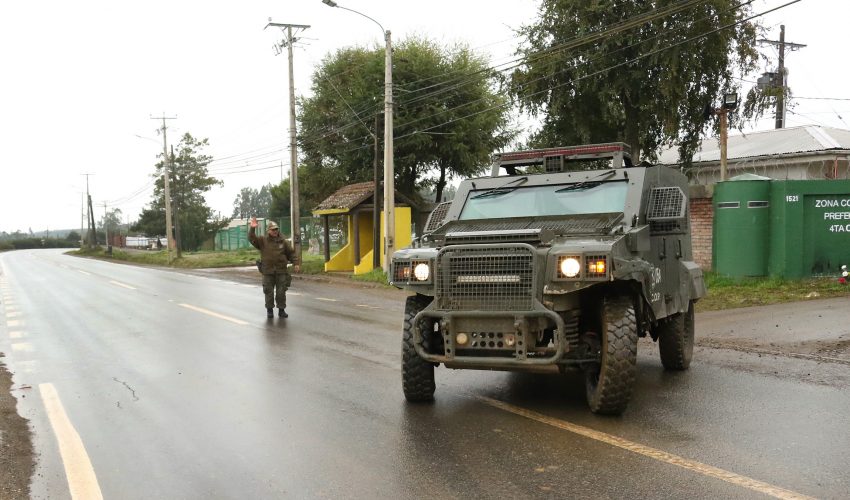
The State of Exception in the Southern Macrozone, requested by the Government and ratified by the National Congress, is extended at least until next February 25th, though subject to a possible new extension.
Thus, the measure currently in force in the provinces of Arauco and Biobío, in addition to all of La Araucanía, has been in effect for 1,366 days since May 18, 2022, becoming the longest State of Exception since the return of Democracy.
In this way, the constitutional tool, originally conceived as limited and temporary, has remained continuously active for almost the entire term of President Gabriel Boric. In detail, the current administration of the Executive Power has lasted 1,434 days, meaning the State of Exception has been maintained for 95.3% of its period.
From La Moneda, they have highlighted with this measure a 78.6% decrease in rural violence incidents in the so-called Southern Macrozone over the last 4 years, according to figures provided by Carabineros de Chile. While 1,161 incidents were recorded in 2022, 2025 ended with 359 situations.
"Both in Biobío and La Araucanía are in better conditions than in 2022 to face their development. Countries that succeed are those that manage to navigate these processes across different governments. The work we have carried out is bearing fruit, not only in the reduction of violence, but today we have record tourism in the province of Arauco, we have commerce that has been activated in Malleco and Cautín, a decrease in poverty according to Casen," emphasized Undersecretary of the Interior, Victor Ramos, during the last review of the constitutional measure in January, who also ruled out the application of a possible "de-escalation."
Furthermore, the authority from the Ministry of the Interior highlighted progress in dialogue with the Mapuche people, such as the work of the Commission for Peace and Understanding and the work developed by the National Corporation for Indigenous Development (Conadi) for territorial restitution, through the Land and Water Fund.
Previous Periods
The previous longest period of State of Exception corresponds to the beginning of Sebastián Piñera's first government, after the 2010 earthquake, when the State of Catastrophe lasted for 51 days, equivalent to about 3.5% of his term.
Sebastián Piñera's second term is the second that used this legal tool the most. The state of emergency decreed during the social outbreak lasted for approximately 24 days. Additionally, due to the pandemic, the State of Exception due to catastrophe was decreed on March 18, 2020 and was in force until March 13, 2021, totaling 360 days.
New Government
During the last presidential campaign, the president-elect, José Antonio Kast, placed security as one of the central pillars of his programmatic proposal. In that context, he was particularly critical of the current Government's use of the State of Exception in the Southern Macrozone, arguing that its prolongation has been "unusual and unjustified," which in his view would demonstrate a capitulation in the face of violence.
However, the now incoming President was emphatic in stating that he would not rule out resorting to this constitutional tool in scenarios he described as "internal war," especially after high-impact events, such as the murder of three carabineros in the commune of Cañete in April 2024.
In his definitions, Kast has insisted that there are no autonomous territories in Chile and that the State must fully exercise its authority.
Along those lines, he proposed measures such as controlling the entry and exit of people in sectors like Temucuicui (La Araucanía), with the participation of police and Armed Forces, in addition to strict enforcement of basic Rule of Law norms, such as inspecting vehicles without documentation or irregular situations that, in his opinion, are not adequately controlled today.
Source:Diario Concepción





Comments (0)
No comments yet. Be the first to comment!
Leave a comment