

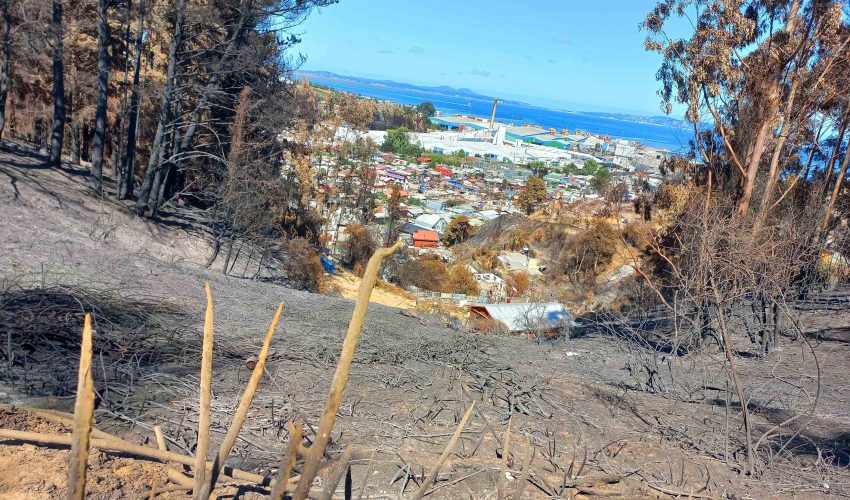
Forest fires, like those of the catastrophe in Biobío, leave behind a loss that goes far beyond the visible, in addition to the regrettable loss of lives and destruction of homes. Beyond the growing emergencies, Chile has had to face a silent problem that begins once the fires are controlled: the crucial stage of restoring damaged ecosystems.
In that context, Esteban Krause, the regional director of the National Forestry Corporation in Biobío (Conaf), in conversation with Diario Concepción, explained the impact of the fires on the soils and the slow recovery of the ecosystems and plantations consumed by the flames.
Thus, Krause indicated that of the fires recorded during the summer of 2023 in Biobío, there are still more than 40 thousand hectares affected that have not recovered, either for productive use or native forest.
Along those lines, the Conaf director stated that "what we should be working on is creating an Environmental Recovery Fund, because when you travel through the hills of Penco, Concepción, and Tomé, the soils are exposed to rain, exposed to potential landslides."
"We are not only talking about pine plantation forests, but also about a native ecosystem that played a protective role," Krause added.
To illustrate the situation, the Conaf director in Biobío pointed to the situation of the gullies – large ditches or ravines formed in the soil by water erosion – towards the Biobío River and other streams. "Those gullies are now exposed (...) the native vegetation that existed, all of that has disappeared," he specified.
According to Krause, there are currently no state instruments focused on the recovery of those sectors consumed by fire. Hence, the proposal at Conaf aims to generate a public-private fund, which could even consider international contributions.
This with the goal of "gradually recovering those soils that are at higher risk of eroding and causing problems for populations, for cities. And it is very difficult to get resources allocated for that (...) In the case of housing reconstruction and the public infrastructure situation, what needs to be done is clear. But on the issue of environmental recovery, there is not much clarity."
Historic Agreement
It is worth remembering that in November 2025, in a historic agreement reached, the Biobío Regional Council (CORE) approved an investment of $12.8 billion pesos aimed at addressing two urgent challenges for the Region: the recovery of areas affected by forest fires and the strengthening of community prevention.
These are two projects promoted by Conaf, which seek to support small and medium forest owners, as well as the communities most vulnerable to this type of threat.
The first project corresponds to the FNDR Program for Productive Recovery of Forests Affected by Fires, included in the Biobío Industrial Strengthening Plan. This initiative considers an investment of $9.8 billion pesos over an execution period of 36 months. The goal is to reforest 4,000 hectares of native forest and productive plantations, directly benefiting 450 families who lack the resources to replant after the recent emergencies.
However, the recovery plan approved by the Biobío Core only manages to cover 10% of the forest and plantations consumed by fire during the summer of 2023.
Source:Diario Concepción

Comments (0)
No comments yet. Be the first to comment!
Leave a comment