

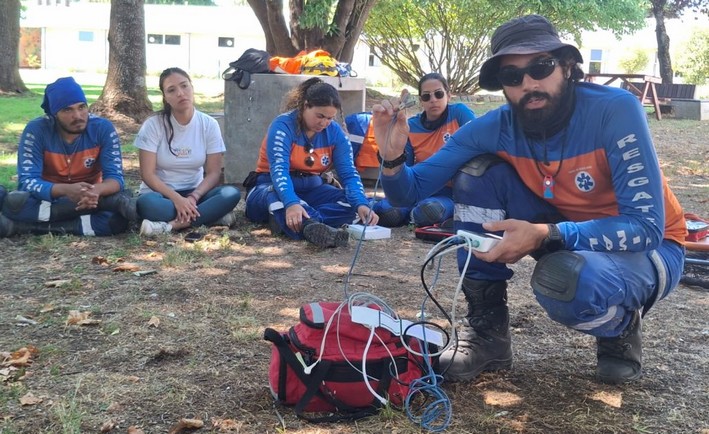
Amid the emergency generated by the wildfires that have affected Biobío and Ñuble, the team of rescuers from Brazil has taken time to train volunteers from the Rehabilitation and Education Center for Wildlife of the Universidad de Concepción, Andes-UdeC, to better face natural emergencies.
As a true frontline for wildlife protection, the Brazilian experts have shown that this is a discipline of high technical specialization. Therefore, they wanted to transfer some of their knowledge to the volunteers of Crefs Andes-UdeC, not without first highlighting that they have been active in the recent disasters in Chile.
"We are here in Chile for the third year; we have come since 2022 for the fires in Concepción, Tomé, and Coronel. In 2023, we came to support the fire in Valparaíso, and now we return to this area to do our work. Whenever we have come, what amazes us is that we are very well received by everyone. One thing that impresses us as Brazilians is that in all the places we have been, people always say 'Fuerza Chile,' and those who lost their homes have the flag raised and are eager to move forward. Just as we support people, we also take care of animals because they have no nationality, and we believe all animals in the world deserve our work—to be rescued and sheltered."
The group of professionals operates under rigorous veterinary protocols for wildlife containment and evacuation logistics in extreme conditions. Their professionalism is manifested in their ability to maintain surgical calm where others see chaos, executing rescue maneuvers that require a deep understanding of animal behavior under stress and precise coordination with human emergency services.
This work has been highlighted by the Director of the Rehabilitation Center, Dr. Paula Aravena Bustos, who also emphasized the efforts made by the Chilean Veterinary Medical Association, Colmevet, to facilitate the arrival of the rescuers to the areas affected by the fires.
"As a University, our role transcends the classrooms. It is essential to provide students with opportunities that expand their formative horizons, especially in a critical area like wildlife. In this training, we not only strengthen their clinical and technical rescue competencies in complex environments but also enhance their empathy and interpersonal skills. By integrating academic, technical, and psychological aspects, we ensure comprehensive preparation that defines them as professionals and human beings," she emphasized.
For her part, Mireya Ferrada, a trainee from the Faculty of Veterinary Sciences at UdeC who participated in the training session, highlighted the importance of updating knowledge in emergency contexts. "I thought it was a good opportunity to see other realities, to act in these emergency scenarios where decisions must be made quickly."
Volunteer Francisca Espinoza, who also attended the session, added, "The opportunity that arose was excellent, given the contingency that is ultimately becoming recurrent every summer, so I am very grateful for the training. I was surprised that all the equipment they used, which was also very compact, is extremely important for the pre-hospital care of affected patients."
Finally, during the training, the critical role between environmental tragedy and the preservation of life was highlighted, demonstrating that operational efficiency and empathy can, and should, work in harmony.




Comments (0)
No comments yet. Be the first to comment!
Leave a comment