

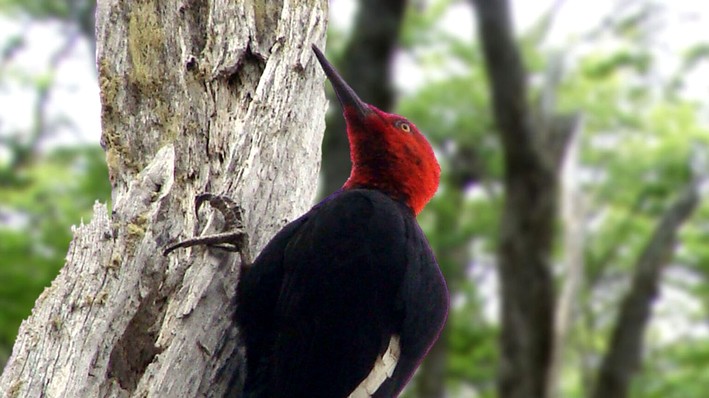
The black woodpecker or Magellanic woodpecker (Campephilus magellanicus) is not only one of the most emblematic birds of the southern temperate forests of Chile but also a high-value ecological indicator for assessing the health of these ecosystems. This is demonstrated by a study conducted by national scientists, who analyzed the relationship between this species' foraging activity and the diversity of beetles inhabiting decaying wood in living trees.
Published in the journal Insect Conservation and Diversity, the study evaluated whether trees selected by woodpeckers for feeding concentrate a greater richness of saproxylic insects, key organisms for nutrient recycling and forest ecosystem functioning. The results confirmed that this is a strategy associated with the internal state of the wood and not random behavior.
The study identified that beetle communities present in excavated trees include various functional groups—groupings of species that perform similar roles in an ecosystem—such as predators, mycophages, and borers. Species from these functional groups interact with each other and with the woody substrate, forming an ecological network sensitive to environmental variations like temperature, humidity, and forest structure.
"The abundance and taxonomic richness of predatory beetles, wood borers, and mycophages were higher in sections where Magellanic woodpeckers foraged. This behavior of the black woodpecker acts as a high-value biological indicator, a thermometer of forest health," said Silvio Crespin, a research academic at the Faculty of Veterinary Medicine and Agronomy of the University of Las Américas and co-author of the paper.
The exploration was conducted in 22 plots of native forests in southern Chile, where 132 living trees were analyzed, half with recent evidence of woodpecker foraging and the other half used as a control. Beetles were collected over 15 months to systematically compare the biodiversity present in both types.
A total of 297 species of wood beetles were recorded, of which 257 were found in trunks excavated by woodpeckers, compared to 159 in the control group, confirming that their activity points to the areas of greatest biological diversity in the forest. "By monitoring the presence and foraging activity of the black woodpecker, we are obtaining an indirect and reliable measurement of the health of the entire community of decomposer insects," Crespin noted.
The work brought together researchers from various Chilean and international institutions, originating from the ANID-Fondecyt 1231806 project at the University of Santiago de Chile (USACH), with collaboration from the Institute of Ecology and Biodiversity (IEB), and CONAF, plus international support from the Laboratory of Biological Conservation and Applied Ecology of the Tropical Research Institute of El Salvador (El Salvador).
The ecological network of decaying wood
Saproxylic beetles, dependent on dead wood or wood in various states of decay, represent a significant fraction of forest insect biodiversity. These organisms are responsible for nutrient release and the sustenance of complex trophic networks, which include fungi, other insects, and vertebrates.
According to the study, beetle communities present in trees form an ecological network sensitive to environmental variations such as temperature and humidity. The degree of wood decay also influences the diversity of guilds: while borers play a facilitating role in the initial stages, more advanced decay favors predators and mycophages, increasing the attractiveness for woodpeckers.
Crespin explains that parameters such as drought indices and tree diameter also modify the woodpecker's selectivity and alter the structure of the ecological network. "The stability of this relationship, which goes from dead wood, through insects, and culminates in the woodpecker, is extremely vulnerable to environmental pressures. When this chain breaks, the ecosystem's regeneration capacity is directly impacted."
Implications for forest conservation
The results have direct implications for the conservation and management strategies of southern temperate forests, the researchers state. By confirming that the Magellanic woodpecker acts as an indicator of saproxylic beetle diversity, they propose its use as an umbrella species to protect microorganisms in decaying wood, as well as organisms that use microhabitats created in dead wood by the combined effect of insects and woodpeckers.
According to Silvio Crespin, the findings warn that forest degradation and climate change exert control from the base of these ecological networks, accelerating certain decay processes but putting at risk species that sustain ecosystem functioning. "Decaying wood is not 'waste' or a risk to be removed. It is a vital resource that drives biodiversity and ecosystem health." In fact, Law No. 20,283 on native forest recovery does not establish the levels of dead wood that are critical for the conservation of saproxylic species such as the woodpecker, decomposer fungi, and coleopterans that live in wood.
The study suggests that forest policies incorporate this knowledge, promoting the conservation of old trees with internal deterioration, as well as monitoring post-excavation succession to better understand the role of the black woodpecker as an ecosystem engineer. In the context of climate change, protecting this species will allow monitoring invisible ecological processes to assess forest health.
Comments (0)
No comments yet. Be the first to comment!
Leave a comment