

It has been more than 17 years since the eruption of the Chaitén volcano in the province of Palena, a natural event that marked a turning point for the communities in the area.
The explosion was sudden and occurred on May 2, 2008. More than 4,000 people were evacuated and 27,000 hectares of nature were affected. The eruption was so large that several facilities in Pumalín National Park were damaged, the course of some rivers was altered, and the roads were devastated. It was the most violent volcanic event recorded in Chile since 1932.
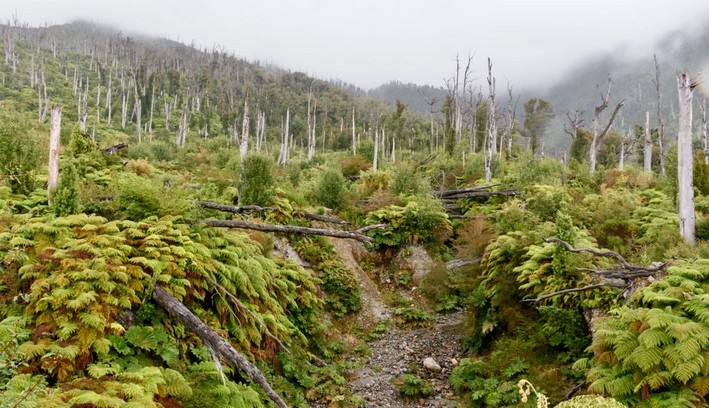
However, today, this landscape has transformed into a fascinating natural laboratory, where scientists can study a process of resilience and ecological succession, in which the native forest gradually reconquers areas that once seemed lost.
The Rebirth of the Forest: A Remarkable Natural Laboratory in Pumalín Park
In areas where, after the explosion, only skeletons of dead trees and bare soil remained, a forest of great beauty is now emerging. Scientists define this phenomenon as an extremely accelerated ecological succession, a natural process where life reconquers the land in stages.
First came creeping plants, herbaceous plants, and ferns. Then, seeds from nearby slopes gave way to the first trees, and currently, it is already possible to find epiphytes. These are plants that grow on others and serve as a sign of a healthy forest.
Life also resurges through biological legacies, such as roots, shoots, and trunks that were buried and, after the eruption, have managed to sprout again and generate new buds from the depths of the volcanic soil.
Some factors that may have contributed to the great resilience recorded in the area are the abundance of water, its distance from the town, which prevents excessive livestock use of the soil, and the ability of some native species to regenerate after a catastrophe.
Tourism at Chaitén Volcano: A Route to One of the Main Attractions of Pumalín National Park
It is currently possible to make ascents to the volcano, which allow visitors to appreciate the caldera and the beautiful views of the surroundings. This is one of the most popular trails in Pumalín National Park, which allows one to see burned forests in recovery, in addition to other natural attractions in the area.
The route has a medium-high difficulty due to its steep slope, with an elevation gain of 600 meters in just over 3 km (round trip). The total journey takes between 3 and 4 hours, so it is recommended to bring appropriate footwear and clothing, water, snacks, and sunscreen.
Access to the trail is at km 178 of Route 7 or the Carretera Austral, about 26 km from the city of Chaitén. At the starting point, there are restrooms and parking. Access is free and visiting hours are usually from 8:30 a.m. to 5:30 p.m.
Source:Meteored





Comments (0)
No comments yet. Be the first to comment!
Leave a comment