

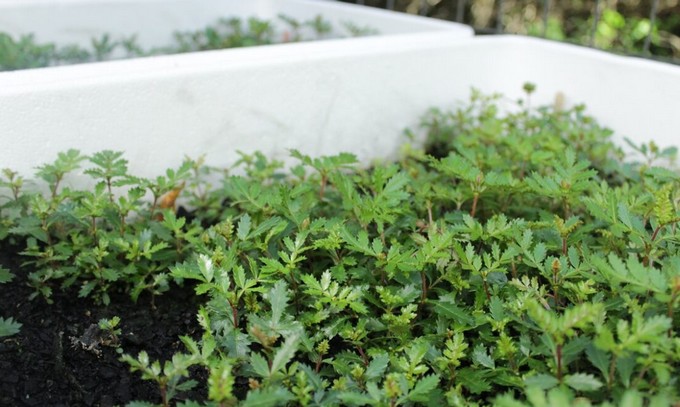
Accelerating the growth of tineo (Weinmannia trichosperma) for restoration purposes is the main focus of a project by CONAF's Native Forest Research Fund, which is being executed by the Faculty of Forest Sciences and Natural Resources of UACh through the Socio-Ecological Restoration Laboratory, led by Dr. Milen Duarte. The slow growth of this native species, its cultural value for indigenous peoples, and its ability to produce quality honey are the main reasons for seeking to mass-produce it.
UACh academic from the Institute of Conservation, Biodiversity and Territory, Dr. Milen Duarte, explained that the project 029/2024 "Production of slow-growing honey plants for repopulation" is in its first year of execution and aims to develop nature-based techniques to accelerate the growth of tineo.
"We are interested in this particular species because it is slow-growing, has a very important cultural value for indigenous peoples, and is also a honey-producing species. Currently, institutions dedicated to ecological restoration use fast-growing species for which there is knowledge on how to propagate them. Tineo is practically left out because its slow growth makes the cost per plant very high for nurseries," explained the researcher.
Tineo is an evergreen species, mainly from the temperate forests of southern Chile. Its distribution is increasingly compressed. It usually grows associated with small microhabitats near watercourses and very humid places.
Use of Mycorrhizae
The proposal, therefore, is to use this native species as a study model and attempt to accelerate its growth. To this end, Dr. Duarte and her team will resort to using native soil mycorrhizae, the same ones that associate with tineo in its natural habitat and help it grow.
Mycorrhizae refer to a symbiosis that occurs between soil fungi and plant roots, where this relationship typically generates benefits for both.
"We will imitate what happens in nature, but in a nursery. That is, we will bring the mycorrhizae that are naturally associated with tineo and cultivate the trees with them. Furthermore, we will use mycorrhizae from the same site where the tineo seeds were collected and also from mixed sites. This way, we can verify if there is any difference related to the site specificity of the mycorrhiza," she explained.
For this work, the team traveled from Los Ruiles Reserve to Queulat National Park, covering most of the distribution range of tineo. During the trip, they collected seed and soil samples.
During this first stage of the project, the plants and mycorrhizae have been propagated, while in the coming months the plants will be inoculated with the mass-produced mycorrhizae.
Since the intention of this initiative is for nurseries to eventually use this model, the team is also testing a native commercial mycorrhiza from the company Bionativa. "If we think in practical terms, it is complex for producers to bring mycorrhizae from the seed collection sites to their nurseries. So, the idea is also to test commercial ones, as they could be an alternative," added the professor.
Learning School
Sharing the results and generating learning that contributes to producers and to propagating native forests through restoration actions is the purpose of this experiment, which will create a learning community and also convene nurseries from the Los Ríos region to learn about the technique used. "But the idea is also for them to propose improvements because we are not nursery growers and, therefore, do not know all their needs," she pointed out.
The UACh academic indicated that this experiment could allow for improving long-term restoration processes. "Tineo is a semi-shade species, which is another interesting point because today, when restoration is done, it is with light-tolerant species, like coihue. The problem is that in more advanced stages of restoration, shade-tolerant trees must be incorporated, so it is necessary to increase the diversity of species being produced in nurseries."
This project by the Austral University of Chile has the collaboration of the Universidad Católica del Maule, the Pontificia Universidad Católica de Chile, and professional Maritza Obando.





Comments (0)
No comments yet. Be the first to comment!
Leave a comment