

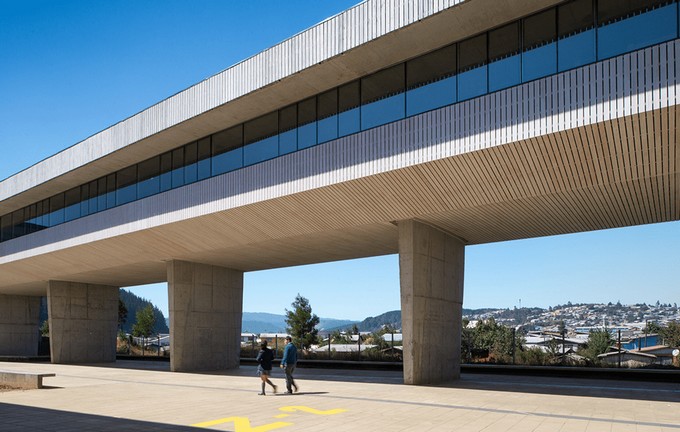
Located 93 kilometers from Concepción, in the commune of Curanilahue, Biobío Region, stands the Liceo Polivalente Bicentenario Mariano Latorre. This educational facility is part of a set of projects marking the country's reconstruction after the 2010 earthquake, with wood playing a leading role. In 2014, the establishment joined the map of national works that demonstrate the versatility of this noble material in construction and its potential for public infrastructure.
The project responds to a proposal driven by BHP Billiton, aimed at building schools of excellence in areas affected by the earthquake, Minera Escondida, and the Ministry of Education. Following an architecture competition, the commission was taken on by the firms Macchi Jeame Danus Arquitectos and Boza Boza Labbé Ruiz Risueño Arquitectos. They developed a proposal that highlighted the geographical and climatic conditions of the area and worked in coordination with the Municipality of Curanilahue, the Regional Ministerial Secretariat of Education of Biobío, and BHP Billiton.
Construction began in February 2012 and was inaugurated in 2014, establishing itself as one of Curanilahue's main public facilities. In 2015, the project was recognized as an outstanding work at the Valparaíso Architecture Biennial and was later cited by the Inter-American Development Bank as a reference for 21st-century educational establishments.
The design
The design relies on an elevated spatial organization that frees up the ground level to form a large public square protected from the rain. Through bridges and elevated walkways, the volumes create meeting spaces that separate community and academic programs, allowing the school to also function as a social and cultural center. This condition is reinforced by the inclusion of a gymnasium, dining hall, and library.
One of the central spaces of the project is the auditorium, designed considering the role of the Curanilahue Youth Orchestra, one of the country's most recognized musical groups in the educational field. The venue has 108 seats, a wooden ceiling, and exposed concrete walls with fractured geometries, a combination that favors acoustics and allows for intensive use for rehearsals and presentations. The incorporation of natural lighting reduces energy consumption during the space's extensive hours of use.
The materiality
Materiality is one of the project's core principles. The structure combines reinforced concrete in the foundations with laminated wood in main elements, especially in the gymnasium, while the envelope is resolved with a ventilated wooden facade and thermopane glass. This solution improves the building's thermal performance and strengthens its connection with the area's productive environment, where the forestry industry is part of the landscape and local economy.
During construction, products from Arauco were incorporated, including Hilam laminated beams, Araucoply panels (a radiata pine plywood board with phenolic resin), and MSD or Arauco Kiln-Dried Dimension Lumber, which corresponds to kiln-dried and planed radiata pine with high dimensional stability and uniform surfaces.
The incorporation of laminated wood, initially not considered for all areas of the project, was expanded during the process to include the gymnasium, following a joint evaluation between the architects and the construction company. This decision allowed for the resolution of large interior spaces, cost optimization, and the exploration of structural wood solutions in an educational building of almost 10,000 m2, with an investment close to 10 million dollars.
Beyond its academic program, the school was conceived as a space open to the community. The covered and outdoor areas allow the facility to be used for sports, cultural, and social activities, reclaiming a public space that had been affected after the earthquake.
Source:Madera21



Comments (0)
No comments yet. Be the first to comment!
Leave a comment