

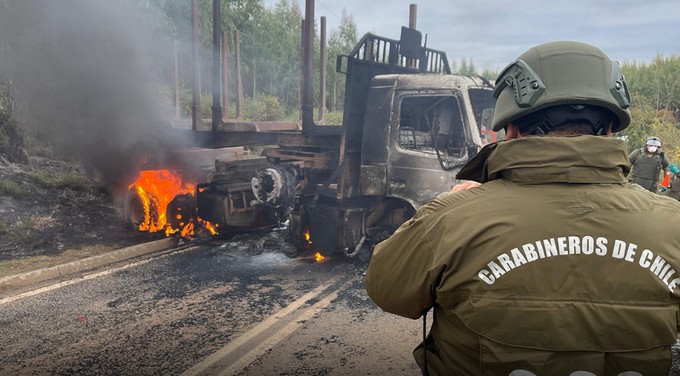
Nearly 4 years after the implementation of the State of Exception in the Southern Macrozone, Edition No. 61 of the Regional Bulletin by the Faro UDD Humanities and Social Sciences Hub, titled "Insecurity in the Southern Macrozone and its Impact on the Forestry Industry," is now available. The report analyzes how the persistence of violence has impacted forestry activity, employment, and investment, as well as its effects on regional development and the perception of impunity.
The conflict intensified from the 1990s onward, with the emergence of radicalized organizations such as CAM, WAM, RML, and RMM, responsible for attacks against public and private infrastructure, especially in the forestry sector.
Viviana Véjar, an economist and research professor at Faro UDD, stated that between 2019 and 2024, 629 arson attacks were recorded in the southern macrozone, with losses close to US$124 million. "What effect has this level of violence had on economic activity and investment in the area? The violence has hit the economy of the southern macrozone hard, causing losses in infrastructure and machinery, and generating uncertainty that deters private investment. The attacks increase costs, delay projects, and cause many companies not to expand or to withdraw. In practice, this weakens confidence and growth in an area with high productive potential. In Biobío, closed wood production fell thirty-eight percent between two thousand sixteen and two thousand twenty-three, and the planted area decreased by eleven percent. What explains this setback in one of the region's most important productive sectors? This setback responds to several factors, but sustained insecurity is central. The forestry industry needs long-term planning, protection, and certainty to invest and produce," she emphasized.
Productive Impact on the Forestry Industry
Forestry activity is the main exporting sector of Biobío and maintains significant weight in La Araucanía. Between 2018 and 2025, forestry exports from Biobío reached nearly US$38 billion. However, various indicators show a sustained deterioration in productive activity.
Between 2016 and 2023, annual planting in Biobío decreased by 11%, while sawn wood production fell by 38%. In La Araucanía, the planted area was reduced by 32% between 2019 and 2023, and sawn wood production decreased by 23% between 2016 and 2023. In the same period, 59 sawmills closed in both regions, reflecting the sector's contraction.
Territorial Gaps in Production
Provincial analysis confirms these trends. In Biobío, sawn wood production is concentrated in Arauco and Biobío, but between 2013 and 2023, declines of 24% in Arauco and 68% in Concepción were recorded, while Biobío province showed a reduction of 2%.
In La Araucanía, the gap between provinces is also significant. Cautín recorded an average production of 787 thousand m³ annually, compared to 99 thousand m³ in Malleco, where production also decreased by 52% in the last decade.
Impact on Employment and Regional Development
The decline in forestry activity is also reflected in the labor market. Between 2016 and 2023, sector employment decreased by approximately 38% in Biobío and 17% in La Araucanía.
This scenario coexists with lagging social indicators. La Araucanía has a multidimensional poverty rate of 19.8% (CASEN 2022), one of the highest in the country, highlighting the difficulties in transforming its productive base into higher levels of well-being.
Impunity and Institutional Weakness
In parallel, criminal prosecution shows limited results. Only about 3% of cases related to rural violence end in formal charges and around 4% in conviction, while approximately 80% of cases are closed without persisting in the investigation.
Public Policy Challenges
Faced with this scenario, the analysis raises the need to advance simultaneous measures in security, justice, and economic development. These include strengthening the State's presence with permanent security strategies, improving investigative capacity, and accelerating judicial response.
Likewise, it proposes implementing economic reparation programs for victims, including reconstruction subsidies, temporary tax exemptions, and preferential access to credit, along with a long-term territorial development strategy that promotes investment, productive diversification, and greater opportunities for local communities.




Comments (0)
No comments yet. Be the first to comment!
Leave a comment