

The entrance winds through a deep green forest, where oak, coihue, ulmo, tepa, laurel, and olivillo trees rise towards the sky, creating a majestic setting characteristic of the heart of the Araucanía Region.
Light filters through the canopy, the ground smells of earth and wood, and the silence of the place conveys a feeling of time standing still. This is not a recently altered landscape: it is a native forest with decades of history, having undergone natural regeneration processes and selective management over generations.
In this environment, dead trees are not waste. They remain standing or fallen, playing a key ecological role as shelter for insects, birds, and microorganisms. "That is also part of the forest," explain those who work here, aware that biodiversity is sustained both by the living and by what has already completed its life cycle.
Daily Work
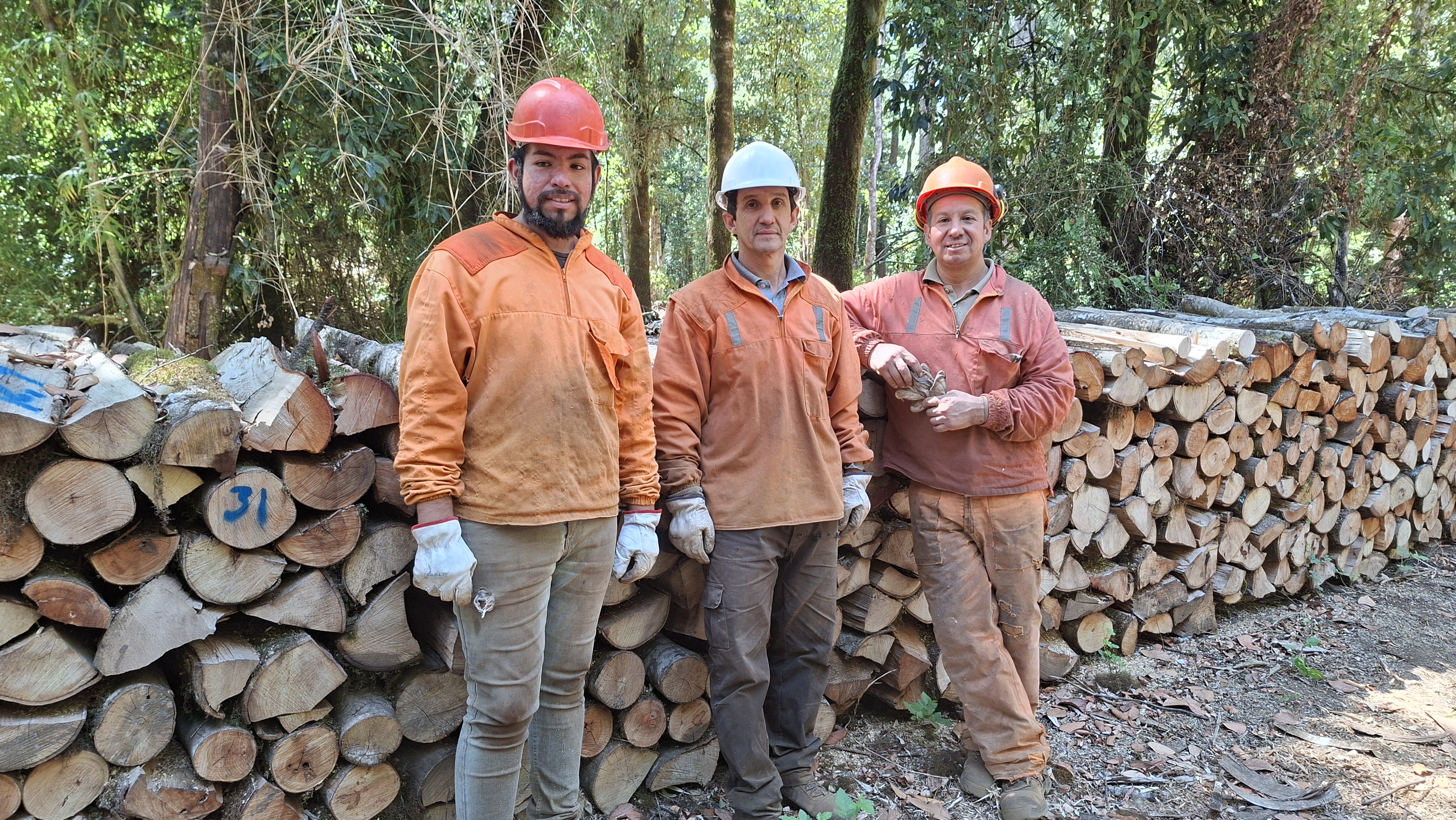
The silence breaks early. From 8 a.m., a crew begins the workday. They are few but experienced. They load tools, check equipment, and disperse into previously defined sectors. Machinery advances carefully along narrow paths, marking the start of a task that demands precision and respect for the environment.
Patricio Contreras Montoya, a forestry contractor, observes and actively participates in each stage. He has been connected to the forest for 17 years, though his bond is much older: his grandfather and father were loggers, and he grew up seeing that trade as a natural part of life. "I always liked it, but the opportunity doesn't always come. When it did, I dedicated myself one hundred percent," he recounts.
Work in native forests is different from that in homogeneous plantations. Here, selective thinning is carried out, removing defective or diseased specimens of species like coihue, oak, and ulmo, to give space to the trees that will reach final harvest. There are no large storage yards; often processing is done on the spot, tree by tree. Daily production varies according to the terrain and species but can reach around 20 meters of firewood and up to 10 cubic meters in logs.
The firewood is mainly sold within the region, while the logs remain in the local market. The requirement for dry firewood forces planning ahead: what is cut one winter is often sold the following year, after a careful drying and storage process.
Family Roots
The work team is mostly family. Brothers, nephews, and cousins share the task, reinforcing a model where the trade is passed on directly, without manuals or classrooms. "It's a tough, demanding job. Those who do it, do it because they like it," says Patricio, convinced that the forest provides sustenance but also demands respect and commitment.
Although he acknowledges that forestry work has allowed him to support his family, he also admits he doesn't necessarily wish that path for his children. "It's a hard life," he repeats, with the honesty of someone who knows the daily effort it entails.
The forest being managed today is about 70 years old and has already undergone several interventions over time. It is second-growth, naturally regenerated, where species like tepa, laurel, and olivillo coexist, proof that responsible management can coexist with conservation. In this area, prevention is also part of the daily work: no smoking, taking care of machinery, and maintaining order are basic rules in a context where forest fires represent a permanent threat.
Amidst oak and coihue trees, the work of Patricio Contreras Montoya reflects a deep relationship between humans and the native forests of La Araucanía: a bond made of effort, inherited knowledge, and a fragile but possible balance between production and nature.
Although it is an artisanal labor, it is possible to modernize it and harness the potential of the 300,000 manageable hectares that exist in Araucanía, the same figure for the Los Ríos region. The volume could support a new industry of wood products, unique in the world.
From Acoforag, we emphasize that native forests are an invaluable environmental, social, and productive heritage for the country. Their responsible management allows for protecting biodiversity, generating local employment, and ensuring these natural formations continue to deliver benefits to communities and future generations.
The report in theAcoforag Magazine


Comments (0)
No comments yet. Be the first to comment!
Leave a comment