

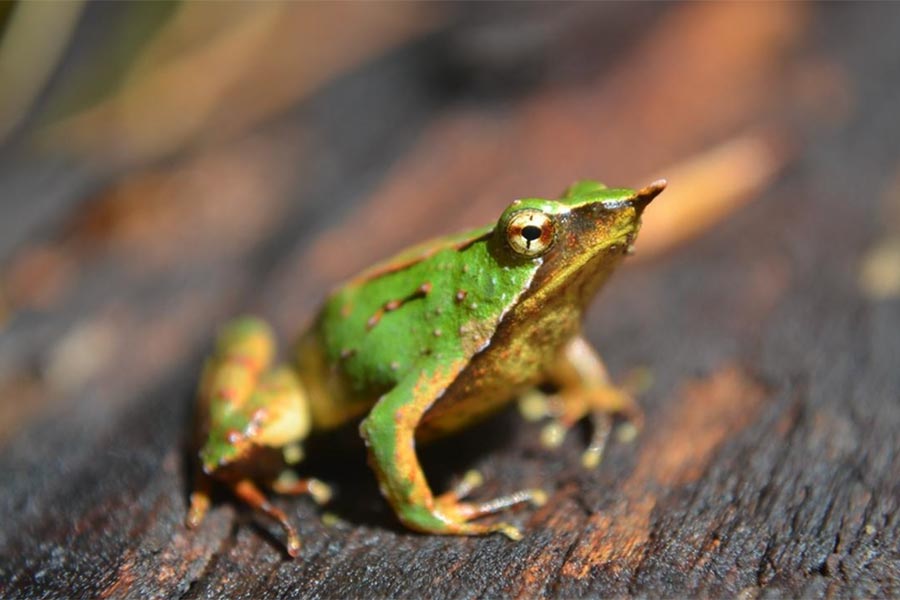
The Undersecretariat of the Environment withdrew 43 decrees from the Comptroller General's Office on the 12th of this month for "review." On Thursday, the regulatory body approved the document that enables the Recoge Plan (Recovery, Conservation, and Species Management) for the Darwin's frog. Both species of this amphibian are recorded as threatened.
One of these amphibians corresponds to the species Rhinoderma darwinii, which inhabits the temperate forests of Chile and Argentina, including Chiloé. In late 2024, researcher Andrés Valenzuela reported that 1,362 individuals from Tantauco Park, in the commune of Quellón, died due to an outbreak of the chytrid fungus (Batrachochytrium dendrobatidis). The microorganism represents a global threat to amphibians.
Francisca Toledo, Minister of the Environment (MMA), stated: "After an exhaustive review of this instrument, we resubmitted the decree for the Recovery, Conservation, and Management Plan (Recoge) for the Darwin's frogs to the Comptroller General's Office, an instrument that has now been approved by this body. This is a key measure to protect these unique species of Chilean biodiversity, which are in 'endangered' and 'critically endangered' status, respectively, due to habitat loss and the impacts of climate change."
Rediscover the population
The ministry reported that the plan's objective is to rediscover a viable population of the Northern Darwin's frog or Chile mountain false toad (Rhinoderma rufum), and to expand the area of occupancy of the Southern Darwin's frog (R. darwinii) to improve its conservation status. The document outlines 11 lines of action focused on protecting reproductive sites, ecological restoration, environmental education, and institutional strengthening.
The administration of Tantauco Park valued the approval of the Recoge Plan. The private reserve described the measure as a "key instrument" and indicated that the institution participated in the process, "working collaboratively with various institutions to advance its recovery and conservation."
The park administrator, Alan Bannister, added: "This is a concrete signal in favor of an emblematic species of our Norpatagonian forests, now threatened by the chytrid fungus. We hope this plan continues to drive effective actions for its protection and reproduction, and that the conservation of endangered species remains a priority for the country."
The non-governmental organization Ranita de Darwin rescued 53 specimens from Tantauco Park in 2024. Researchers transferred the individuals to the Zoological Society of London in the United Kingdom to protect and study them. The entity highlighted the approval by the Comptroller General's Office and stated that the NGO itself presented the draft of the Recoge Plan, following a multisectoral collaborative process initiated 10 years ago.
Andrés Valenzuela, president of the NGO Ranita de Darwin, commented: "Darwin's frogs have become much more than an object of scientific study. They are a flagship species: their image, their story, and the peculiarity of their reproduction have managed to awaken national and international interest in protecting the native forests of Chile and Argentina."
Union of worlds
He, who is also the leader of the Governance Committee of the Binational Conservation Strategy for Darwin's Frogs, added: "That ability to convene the community, to unite different worlds, from scientists to forestry companies, and from government agencies to NGOs, is what makes Darwin's frogs a fundamental ally in nature conservation in our country."
The movement Defendamos Patagonia, formerly called Defendamos Chiloé, posted on its social media: "Great citizen victory! The massive pressure from millions of people, environmental organizations, scientists, and coastal communities forced the Kast government to backtrack: the decree protecting the Darwin's frog has been approved by the Comptroller General's Office. The frog will remain safe!"
Source:Soychile.cl




Comments (0)
No comments yet. Be the first to comment!
Leave a comment