

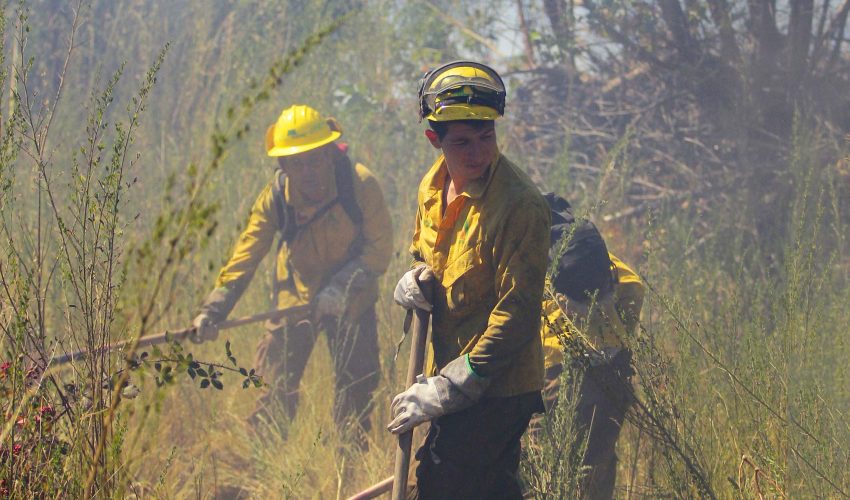
The legislative process for the bill regulating the prevention and mitigation of forest fires entered a new stage after the Chamber of Deputies failed to approve the text, which will force the initiative to be reviewed by a mixed committee.
The legislative initiative aims to establish a new regulatory framework to improve prevention tools, strengthen risk management, and regulate land use in areas exposed to forest fires.
What does the bill say?
One of the central pillars of the bill is to more strictly regulate wildland-urban interface zones, meaning those areas where homes or cities directly border forest vegetation and where a large portion of the fires affecting different regions of the country each summer are concentrated.
In general terms, the bill proposes land-use planning tools, new enforcement powers for the State, and a series of obligations for landowners, forestry companies, and other actors carrying out activities in areas considered at risk.
Among the measures included in the initiative is the conduct of national forest fire risk analyses, to classify territory according to its threat level—low, medium, high, or critical—and thereby guide prevention policies.
Furthermore, the bill formally introduces the concept of the wildland-rural interface, establishing that mandatory prevention measures must be applied in these sectors.
This is in addition to the creation of buffer zones or safety perimeters around inhabited areas, where combustible vegetation must be reduced to prevent fire from reaching homes or critical infrastructure.
Another relevant point is the creation of new enforcement powers for the future National Forestry Service, SERNAFOR, which would be the agency responsible for overseeing compliance with preventive measures, conducting inspections, and applying sanctions in case of non-compliance.
Shared responsibility in prevention
However, one of the aspects that has generated the most debate in the discussion is the principle of shared responsibility between the State and private parties in fire prevention. The bill establishes that landowners, forestry companies, communities, and individuals must fulfill legal obligations aimed at reducing the risk of fire spread.
Among these responsibilities are actions such as clearing dry vegetation, pruning trees, reducing combustible material, maintaining safety perimeters, and implementing firebreaks in high-risk areas.
It also includes the obligation to comply with prevention plans defined by the forestry authority. In case of non-compliance, the regulations consider fines, mandatory work orders, and the possibility for the State to carry out the work and charge the cost to the owner, with sanctions that can reach up to 10,000 UTM in serious or repeat cases.
From the region's productive associations, the initiative has been received with reservations. The president of the Biobío Agricultural Society, José Miguel Stegmeier, expressed a critical stance regarding the bill, stating that in his view the legislative proposal has significant shortcomings.
"For us, it is an incomplete project and has severe imbalances. It is very punitive and demanding for property owners, yet it does not properly address the main cause of fires in Chile, which is intentionality," he stated.
The association leader added that, from his perspective, if that aspect is not adequately addressed, the regulation could end up assigning responsibilities to those who have no relation to the origin of the fires.
"If this most critical aspect is not resolved, obviously the required prevention would not be achieved, and at the same time it would generate responsibilities for third parties, the owners, who bear no responsibility for the origin of these fires," he indicated.
The view from the forestry sector is more nuanced. The regional president of the Chilean Wood Corporation (Corma) Biobío and Ñuble, Alejandro Casagrande, stated that the country needs to advance legislation to better confront this phenomenon.
"From the forestry sector, we believe Chile needs to advance a good Wildfire Law, that strengthens prevention, firefighting, investigation and prosecution of occurrences—whether due to negligence or intent—and the recovery of burned areas," the leader stated.
Casagrande explained that the current legislative process opens an opportunity to review key aspects of the bill. "Today the legislative process contemplates the formation of a mixed committee, an instance that will have to review different aspects of the bill, including the issue of shared responsibility," he commented.
The leader added that the association has raised the need to carefully analyze the impact the new obligations could have on small and medium-sized landowners.
"As an association, we have stated that it is important to analyze with special attention how these provisions impact small and medium-sized landowners, to ensure that the obligations established are viable and allow maintaining the productive use of agricultural, livestock, and forestry lands," he affirmed.
Perspective of Biobío parliamentarians
In the political sphere, parliamentarians from the Biobío Region have also expressed different positions regarding the bill. Deputy Cristóbal Urruticoechea, of the Republican Party and representative of District 21, stated that the initiative still requires significant improvements.
"It is not a good bill, it is a start of something, but that doesn't mean it's a good bill," the parliamentarian affirmed. In his opinion, one of the problems lies in the lack of clarity regarding the role of private parties. "What happens with the private party who doesn't have enough capital? Who will help them, the municipality or the State?" he posed.
In a similar vein, Deputy Patricio Briones of the People's Party stated that the discussion must be urgently resumed. "Definitely, the discussion about the Wildfire Law has to be resumed as soon as possible here in Parliament," he affirmed.
Briones also recalled the impact fires have had on the region. "We have the example of Penco and Lirquén, which were devastated precisely by these disasters, and I don't see culprits, I don't see sanctions," he indicated, adding that the country needs stricter laws. "We have the great mission to put a stop to this type of action now with laws that are tough and with sanctions that set an example," he emphasized.
From a perspective more favorable to the bill's progress, Deputy Joanna Pérez, of Democrats, welcomed that the initiative continues its processing, although she warned that it needs refinement. "I believe it is positive that the Wildfire Bill continues its processing, because we are facing a problem that every year affects many communities and requires a more robust response from the State," she stated.
The parliamentarian added that the bill must be analyzed in detail to ensure the regulation is effective. In her opinion, it is necessary to consider the reality of the territories and the different productive activities that coexist in risk zones.
Deputy Lilian Betancurt, also of the People's Party, stated that the bill must continue to be discussed in Congress. "I agree that this bill continues its discussion and is strongly resumed in this new legislative period," she indicated.
Betancurt stated that the private sector's shared responsibility must be analyzed seriously, but always considering the impact on communities. She also recalled that in the Biobío Region, fires have severely affected many families, so she considers it necessary to advance towards more severe sanctions and regulations that allow preventing these events.
For his part, Deputy-elect for District 21, Patricio Pinilla (DC), affirmed that the approval of a law on this matter is urgent in the face of the catastrophes that repeat every summer. "The wildfire law is a necessary law, especially with the major catastrophes we are witnessing every summer, particularly in our region," he stated.
Pinilla regretted that the bill got stalled in the Chamber of Deputies and emphasized that the mixed committee will now have the task of seeking agreements. In his view, the private sector's shared responsibility is part of the minimum measures that must be required in a society seeking to prevent disasters.
Source:Diario Concepción



Comments (0)
No comments yet. Be the first to comment!
Leave a comment