

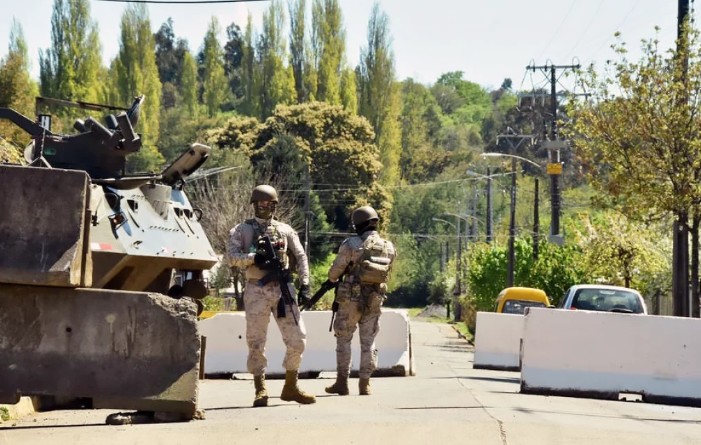
The Constitutional State of Exception for the Southern Macrozone will complete five years on October 12, 2026. The measure was established during the second term of former President Sebastián Piñera in response to the escalation of violence in the provinces of Arauco and Biobío, a territory that has since operated with a permanent presence of the Armed Forces.
Since its implementation, the measure must be renewed every 15 days by the National Congress, which has made its vote a recurring discussion on the parliamentary agenda.
This week, Parliament must vote for the first time under the administration of President José Antonio Kast on whether to maintain this security measure or not. The vote comes at a key moment, as legislators from district 21 — which groups the provinces of Arauco and Biobío — have begun to raise their voices to demand a more permanent mechanism to end the uncertainty generated by the biweekly discussion in Congress.
PROPOSES COMPREHENSIVE STRATEGY
The recently sworn-in deputy for district 21, Lilian Betancurt (PDG), expressed the need to move towards a permanent and complementary security mechanism. In her opinion, the State of Exception in the Southern Macrozone remains a necessary measure because it has proven effective in containing violence and restoring a greater sense of security to families in Arauco and Biobío.
However, she considers it unreasonable for the same discussion to be repeated in Congress every 15 days, something which, for the parliamentarian, is a waste of time while citizens demand certainty.
"I am in favor of moving towards a more permanent mechanism that provides stability and continuity to the strategy," stated the legislator. Betancurt advanced that her vote will be favorable and emphasized that "the State of Exception cannot be the only tool and must be accompanied by a comprehensive strategy that includes intelligence, prosecution of organized crime, police strengthening, and an effective state presence, with the goal of definitively recovering peace in the territory."
PROGRESSIVE NORMALIZATION
For his part, Deputy Patricio Pinilla (DC) emphasized that, until now, no alternative to this measure has been presented; therefore, there is no choice but to approve and support the renewal.
As a member of the Lower House Security Commission, Pinilla acknowledged that he would have liked some other way of addressing this issue to have already been proposed, one less burdensome and less damaging to investment and tourism development, particularly in the province of Arauco.
"It's true that it perhaps maintains current investment levels, but under no circumstances does it encourage an increase in quality of life. Furthermore, it scares away tourism and everything that brings development and employment," emphasized the legislator.
The deputy also pointed out the need, in his opinion, to aim for a normality with social dialogue, constant police surveillance, greater public investment in connectivity, and support for local entrepreneurs.
"To aim for a stage of progressive normalization, perhaps by addressing criminal actions that may occur in this territory in a targeted manner. The truth is that we demand much more from the current government than it has done so far on this security issue," he stated.
IMPROVE OPERATIONALITY AND LOGISTICS
Deputy Flor Weisse (UDI) agreed that there is no other alternative for now.
The legislator argued that, although the measure was conceived as temporary, today it must be maintained because there is no other tool that contributes to generating the security that the inhabitants of the Southern Macrozone require.
"By itself it is not enough, and to withdraw it or begin de-escalating, an action plan must be generated and demonstrated that provides a solution to what the citizens of the Southern Macrozone need today, which is precisely to improve their peace of mind and recover peace. Today we are going to approve this State of Exception because it is necessary, and we also hope that its operationality and logistics can be improved," she indicated.
Weisse added that the time to de-escalate or withdraw it will be when there are concrete measures and actions, as well as an evaluation of the acts of violence and terrorism that allow us to affirm that peace of mind has been recovered in the Southern Macrozone.
Meanwhile, she reiterated, the State of Exception must remain.
INCORPORATE OTHER ACTORS
Deputy Joanna Pérez (Democrats) stated that the State of Exception is one of the multiple measures required in the area, and that it must be strengthened with more technology and by incorporating other actors. For the legislator, this cannot be something exclusive to the Armed Forces.
"That is why a valued effort has been improving, but this must be accompanied by other measures as well, and we are reinforcing this day by day through Congress, the Executive Power," she stated.
Pérez said she trusts that the government will make the best decisions, but insisted that the State of Exception must be maintained in the region, at least in the province of Arauco and in the mountainous part of Biobío.
Source:La Tribuna



Comments (0)
No comments yet. Be the first to comment!
Leave a comment