

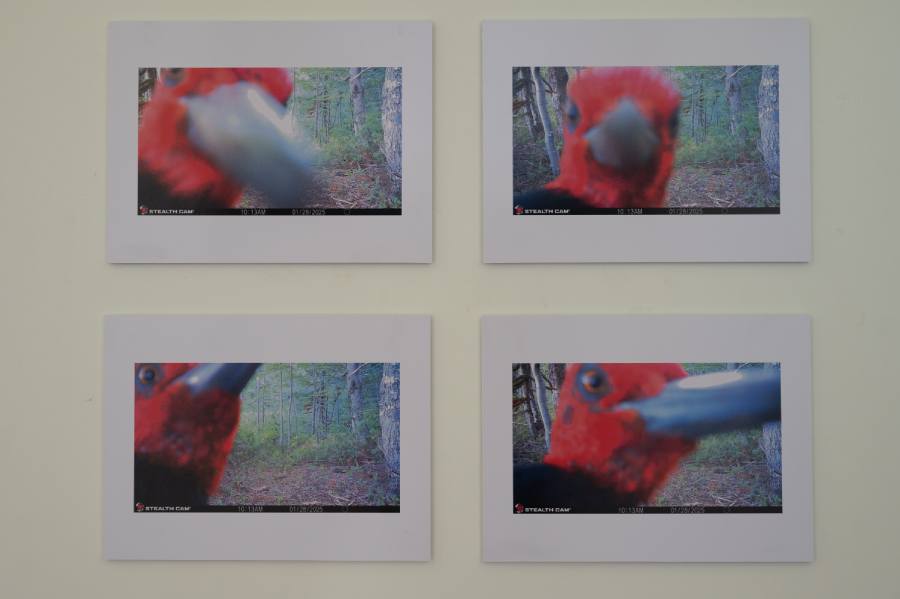
Composed of a series of 48 images recorded in Villarrica National Park, in the Puesco and Quetrupillán sectors; as well as in Conguillío National Park and Malalcahuello National Reserve, the exhibition titled "Camera Trapping in Andean Araucaria Forests," directed by Dr. Oscar Skewes Ramm, an academic from the Department of Animal Science of the UdeC Faculty of Veterinary Sciences, and which involved the participation of undergraduate Veterinary Medicine students from the Chillán and Concepción Campuses, was inaugurated at the Galería Tránsitos Visuales of the Chillán-based University before all its constituencies.
According to the academic, it was in 2016 that his friend Edmundo Schuster Stange showed him a wildlife trail that seemed suitable for installing a camera trap. Based on that discovery, they decided to independently initiate a study focused on the medium-sized mammals or mesomammals that inhabit these forests. Over the years and thanks to various donations, the project managed to expand both the number of cameras and the monitoring sites.
"This exhibition has great value, as it allows students to see images of wildlife in its natural environment. This generates a virtuous circle of conservation and interest in the environment. Showing this material to the student body is valuable for that very reason: to make use of it and prevent it from being stored away on a computer. I am very happy that we have managed to materialize this exhibition in this gallery," described Dr. Oscar Skewes.
The goal is to finish the fieldwork in May 2026, which will allow completing the record of three cycles of pine nut fall in these forests. Dr. Skewes also highlighted the participation of undergraduate students in the project, who have developed thesis projects based on these studies. So far, the collected data has given rise to two scientific publications.
"All those trips have been memorable, some with very long trails, where you end up tired or sometimes we get lost because they are places within the forests, away from the trails, with steep climbs. Those are the adventures one remembers most. We are a group of students who go regularly and have met new people on the trips. I always liked nature, but I didn't imagine that, while studying, I could get so involved in this world of conservation, but here I entered the Centro de Rehabilitación y Educación de Fauna Silvestre (CREFS) Andes UdeC and came into contact with another type of animal," recounted Sofía Anabalón Flores, a fifth-year UdeC Veterinary Medicine student and assistant to Dr. Skewes, who revealed that they are planning a new outing to record more images.
For her part, Ángeles Pávez Sepúlveda, a UdeC Veterinary Medicine graduate and assistant to Professor Skewes, who also works at the Centro de Rehabilitación y Educación de Fauna Silvestre (CREFS) Andes UdeC, hopes to continue down that path.
"The first thing I highlight are the landscapes, the opportunity to see places I wouldn't have been able to without the professor inviting me to participate in the camera trapping. The places are incredible, we were even in the landscape that appears on the two-thousand-peso bill, you can't always get to those corners, because we also have special permits to walk outside the established trails, so we can look beyond what people can see on a usual walk. There I have been very impressed by the professor's memory, apart from his physical capacity, he walks more than anyone, he likes to test his ability to remember where the cameras are, while we guide ourselves by GPS, and several times he finds them first, just by remembering where there was a valley, a coigüe tree, a tree, it's very impressive," added the assistant.
"It is an exhibition that combines art, science, conservation, and reflection about our ecosystems and how to protect them. It originates from a rather particular technology: camera traps. In a way, the records obtained have a fascinating aesthetic quality, since there is no person taking the image. This makes them honest records, which makes them very special, testimonial, and natural. The context in which this work is generated is very interesting and represents a valuable opportunity for our UdeC community to learn about it through this gallery," stated the Director of CECAL UdeC, Amara Ávila Seguel.
Meanwhile, the General Director of the University of Concepción Chillán Campus, Dr. Pedro Rojas García, highlighted that "this gallery has a great reach among all our constituencies, as it is a very high-traffic space. It is a pleasure to learn about the work of Dr. Skewes and the contributions his wildlife research represents. The impact of these studies on our ecosystem underscores the importance of this topic for our institution, which has been addressed for some time. This exhibition gains special relevance by highlighting the value of protected flora and fauna because, furthermore, it is linked to institutional initiatives of UdeC, and we have it present here, at the Chillán Campus," concluded the authority.
The exhibition will be available until Tuesday, May 19 at the Galería Tránsitos Visuales, Central Building of the University of Concepción Chillán Campus.
Source:La Discusión




Comments (0)
No comments yet. Be the first to comment!
Leave a comment