

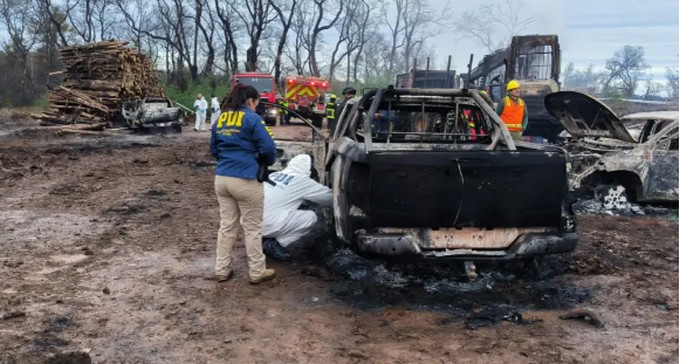
The scenario facing the Southern Macrozone has brought direct consequences, especially for workers and rural areas, following the revelation that almost four years after the implementation of the State of Exception in the Southern Macrozone, the debate over its effects remains open. While some indicators show a decrease in arson attacks, the uncertainty and violence accumulated over more than a decade continue to leave their mark on forestry activity, employment, and regional development.
This is presented in issue No. 61 of the Regional Bulletin of the UDD Faro Humanities and Social Sciences Center, titled "Insecurity in the Southern Macrozone and its Impact on the Forestry Industry," which analyzes how this scenario has affected one of the most relevant productive sectors in the south of the country.
Half of the destroyed properties were homes or cabins, while 30% affected sheds, demonstrating the extent of the damage beyond large companies.
However, beyond the violence statistics, the impact is more clearly reflected in the evolution of productive activity.
AN INDUSTRY IN DECLINE
The forestry industry is one of the main exporting sectors of the Biobío region and one of the economic pillars of La Araucanía. Between 2018 and 2025 alone, forestry exports from Biobío reached nearly 38 billion dollars; despite this, indicators show a sustained deterioration.
The report notes that between January 2019 and January 2024, 629 arson attacks were recorded in the area, with estimated losses of 124 million dollars.
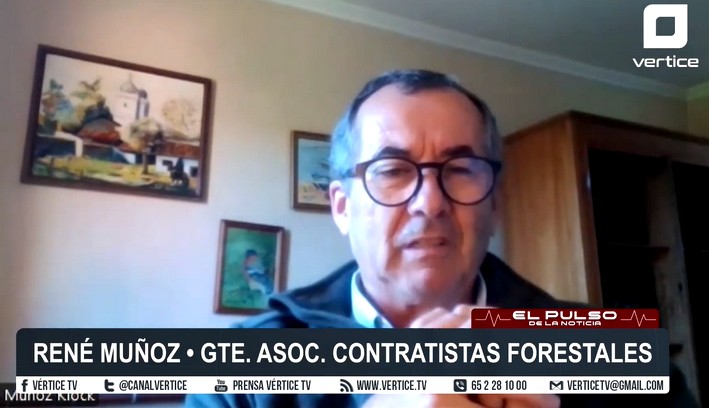
"The main impact has been on the workers. Today there are fewer jobs and a smaller labor market for forestry contractors," stated the manager of the Forestry Contractors Association, René Muñoz.
As Muñoz explained, insecurity has even limited access to productive areas. "There are approximately 100,000 hectares captured by violent groups; that means they cannot be intervened because it is too unsafe. We are not going to expose our workers."
The manager of Acoforag added that this situation has halted local development in communes where forestry activity was one of the main sources of employment. "Today, there are entire areas where there is no formal work," he warned.
This is compounded by the closure of 59 sawmills in both regions, evidencing a structural contraction of the sector.
For economist and researcher at Faro UDD, Viviana Véjar, this scenario responds to multiple factors. "The forestry industry has been greatly affected. The causes are multi-causal, but the trade associations and judicial outcomes indicate that many events are related to arson attacks," she stated.
However, she warned that in recent years other elements have been added, such as the international context. "Today, the decline in exports and production also has to do with external demand, especially with the slowdown in China, one of the main trading partners," the expert noted.
The deterioration has not been uniform. In Biobío, sawn wood production is concentrated in the provinces of Arauco and Biobío, but between 2013 and 2023, declines of 24% in Arauco and 68% in Concepción were recorded, while Biobío had a marginal decrease of 2%.
In La Araucanía, the differences are even more marked. The province of Cautín reaches an average annual production of 787 thousand cubic meters, compared to just 99 thousand in Malleco, where, in addition, activity fell by 52% in the last decade.
These figures reflect not only a productive decline but also a growing territorial inequality in the sector's development.
One of the most visible effects of this contraction is employment. Between 2016 and 2023, work in the forestry sector decreased by about 38% in Biobío and 17% in La Araucanía.
CONFLICTING VIEWS AND CRITICISMS OF THE DIAGNOSIS
Not all actors in the forestry sector agree with the analysis of the report prepared by Faro of the Universidad del Desarrollo. From the world of forestry contractors, they question the document's focus.
"The figures do not reflect the complete reality because they do not consider the impact on those of us who are directly on the ground," stated Muñoz, who criticized the study for focusing on destroyed infrastructure rather than productive activity.
Meanwhile, from the sector's SMEs, they point to a broader structural problem.
The president of PymeMad Biobío, Michel Esquerré, argued that the insecurity in the Southern Macrozone responds to a structural problem that the State has failed to address in a sustained manner over time.
The lack of continuity in public policies and the absence of cross-cutting political agreements have prevented progress on a common strategy to confront a crisis that combines historical, territorial, and cultural factors.
In that context, Esquerré maintained that one of the critical knots lies in the inability to generate a comprehensive policy that addresses the demands of indigenous peoples, particularly regarding issues such as land restitution and cultural recognition.
This debt, he argued, has allowed the conflict to prolong and, in parallel, for violent groups to emerge that, without necessarily representing all communities, have positioned themselves as spokespersons for these causes.
In the opinion of the trade representative, the lack of effective State presence in certain areas has favored dynamics of territorial control by violent groups. In these spaces, he noted, intimidation, silence, and impunity predominate, further weakening conditions for productive development and social coexistence.
One of the most affected sectors is forestry, whose productive planning is long-term. With cycles that can extend over 20 years between planting and harvesting, the uncertainty generated by acts of violence has halted investments, reduced activity, and limited both reforestation and resource exploitation. This, in turn, impacts employment and the economic stability of local communities.
Faced with this scenario, Esquerré proposed the need to move towards a State policy approach, inspired by international experiences, that transcends current governments and articulates long-term solutions. The proposal aims to integrate the demands of indigenous peoples, the needs of productive sectors, and the reality of the communities inhabiting these territories, with the goal of building conditions for peace and sustainable development.
In this vein, the leader is critical of the measures implemented so far, such as states of exception and the deployment of security forces, which he considers insufficient to solve the underlying problem. While acknowledging their role in the immediate control of violence, he warned that these actions tend to keep the conflict in a state of containment rather than solving it.
"Peace is not built with police protection alone," he stated. In his view, the challenge lies in designing and implementing a strategy that provides certainty to all involved actors and allows progress towards coexistence based on respect, security, and equitable development of the territories.
FORESTRY TRANSPORTERS
For his part, the president of the National Federation of Forestry Transport Unions, Heriberto López, explained that the union he represents groups together cargo drivers, road workers, forestry plant operators, and personnel directly linked to forest operations.
This is a broad network of workers who sustain a key part of the forestry production chain, but who today perform their functions under conditions marked by uncertainty. "The fear of going to work is increasing," he warned, alluding to the constant exposure to acts of violence in the territories.
From his perspective, the conflict has led to a scenario where different actors seek justice through parallel channels. On one hand, the State promotes judicial processes for arson attacks, timber theft, and other crimes that have affected both companies and public infrastructure. On the other, historical demands from communities claiming land restitution and recognition of rights they consider violated persist.
Amid this tension, workers claim to be caught in a middle position. "We are in the middle of this scuffle," summarizes López, emphasizing that they represent neither companies nor communities, but people who depend on this work to survive. This condition, he notes, forces them to avoid any kind of confrontation and to opt for a stance focused on dialogue.
In this sense, he insisted that the call is to build minimum conditions for coexistence that guarantee free transit and safe access to work sites. However, he warned that episodes of violence often have collateral effects that fall directly on forestry transport and productive operations. "When there are arrests or judicial processes, the reactions are not directed at the courts, but at the territories. And that's where we are," stated López.
The persistence of the conflict has forced the sector to modify its work dynamics. Among the adopted measures, he highlighted avoiding night travel and restricting access to areas considered higher risk. These decisions, often coordinated with companies in the sector, reflect an attempt to reduce exposure in a context where, they claim, security guarantees remain insufficient.
"We have had to change our routines, avoid working at night or entering certain sectors. That shows the problem is still there."
President of the National Federation of Forestry Transport Unions, Heriberto López.
While López acknowledged that the presence of police and military forces, along with states of exception, has helped reduce the number of attacks; however, he was emphatic in stating that these measures do not solve the underlying problem. "This is not resolved with police presence alone. Dialogue and agreements between the State and the communities are needed," emphasized the president of the National Federation of Forestry Transport Unions.
In the leader's opinion, the current scenario is far from allowing a normalization of activities as occurred decades ago, adding that this reality has been internalized by the workers, who continue to perform their duties under conditions of controlled but persistent risk.
Despite this, the union insists on a clear stance: not aligning with any sector in conflict, but safeguarding the right to work. "The only thing we seek is to be able to work safely, but today neither the State nor the current measures fully guarantee it," he stated.
THE PENDING CHALLENGES
Faced with this scenario, the report proposes advancing a comprehensive strategy that combines security, justice, and economic development.
Among the proposed measures are strengthening investigative capacity, a faster and more effective judicial response, and the implementation of reparation programs for victims, such as reconstruction subsidies, tax exemptions, and preferential access to credit.
Likewise, it highlights the need for a long-term territorial development strategy that promotes investment, productive diversification, and greater opportunities for local communities.
Source:La Tribuna





Comments (0)
No comments yet. Be the first to comment!
Leave a comment