

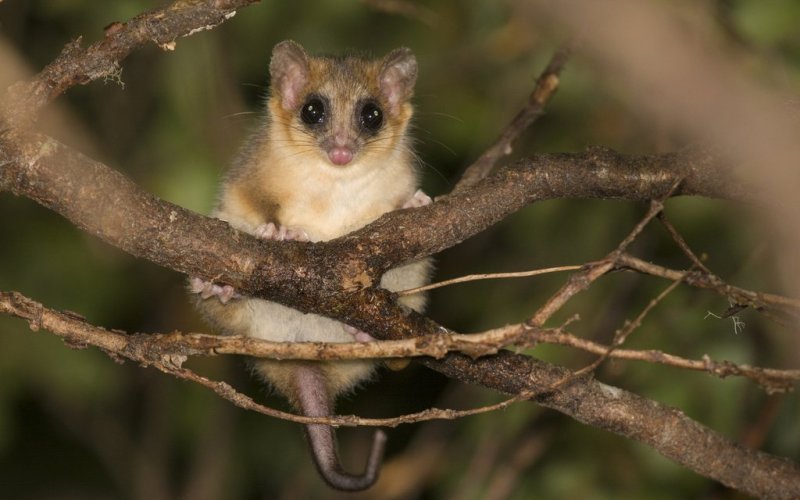
An important and positive development for the biodiversity of the Protected Areas in the Aysén Region was the recent recording of the presence of the monito del monte (Dromiciops gliroides) in Queulat National Park, specifically in the Angostura sector. This small nocturnal marsupial is endemic to the temperate forests of southern Chile.
According to Marcela Piñones, regional director of CONAF, this success highlighted the work of the park ranger team: "The detection of this species with conservation issues is possible thanks to the effort and consistency of the entire technical team, particularly the park rangers. Among other functions, they systematically monitor biodiversity in their protected areas," she stated.
The Scientific Discovery
The discovery is part of a CONAF study with scientific support from the Patagonian Ecosystems Research Center (CIEP), which aims to detect the presence of this species in the protected areas of Aysén.
Fieldwork was essential to achieve the recording. A passive monitoring system was implemented, including the strategic installation of camera traps in the species' microhabitat.
Camera traps are technological devices that allow monitoring of present species through photographs. In this way, this species was captured, and from now on, it will be part of the conservation targets of the National Park.
A "Living Fossil" in Queulat
The monito del monte is a unique species in the world. It is considered a "living fossil" because it belongs to an ancient lineage of marsupials and has no close living relatives on the continent, being more closely related evolutionarily to the marsupials of Australia.
This small forest inhabitant stands out for its large black eyes (adapted for nocturnal life) and its tiny size, barely larger than that of a common mouse.
Its presence is an excellent sign for CONAF, as it acts as an "indicator species": its survival depends on ancient and healthy forests, confirming that the ecosystem of Queulat National Park remains in a good state of conservation.
Andrea Bahamonde, Head of the Protected Wilderness Areas Department, emphasized that "This type of research allows, through systematic monitoring, the discovery of low-visibility and key species. The monito del monte is extremely sensitive to habitat fragmentation and the loss of the understory (the low, dense vegetation like quila). The confirmation of the presence of this species is an indicator of ecosystem health."
Juan Reyes, administrator of Queulat National Park, highlighted that "this new record reinforces the relevance of Queulat National Park as a refuge for biodiversity and as a fundamental space for scientific research and conservation in Chile."




Comments (0)
No comments yet. Be the first to comment!
Leave a comment