

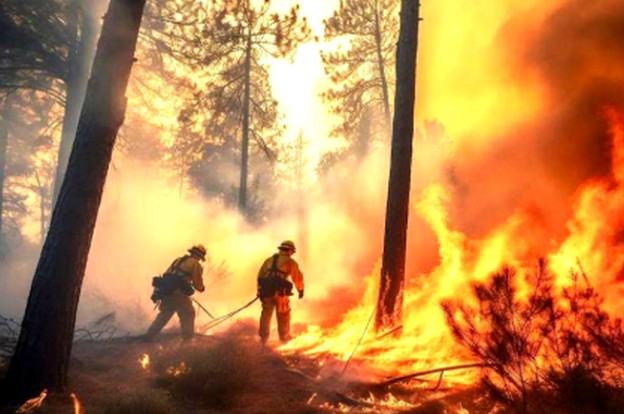
A total of 14 forest fires originating from natural causes, specifically from thunderstorms, have been recorded so far in the Ñuble Region during the 2025-2026 period.
The information was provided by the National Forestry Corporation (Conaf), which indicated that this figure contrasts with the 2024-2025 season, when no fires associated with this type of phenomenon, known as a dry thunderstorm, were reported, drawing the attention of specialists and forestry authorities.
"We always had one or two per year, but not today. This time we had them, in the valley and also in the mountain range, meaning there were fires in Coelemu caused by lightning, in Quillón, Pinto, and San Fabián. So, it's another factor we haven't seen in the last five years," explained the regional director of Conaf, Juan Salvador Ramírez.
The most recent fire from this cause was last week in the Ñuble Reserve, specifically in the mountain area known as "Las Águilas," where a lightning strike started the fire, burning a total of 3.99 hectares over the seven days the emergency lasted.
Climatologist and Director of the Department of Geophysics at the University of Concepción, Dr. Martín Jacques-Coper, explained that this type of storm in that area is usually generated by the passage of a cut-off low.
"Essentially, a cut-off low consists of a large mass of air of polar origin in the upper levels of the atmosphere. Due to the contrast between the low temperature of the air at high levels and the higher temperature of the air at the surface, what we call 'atmospheric instability' occurs, meaning the ascent of relatively humid and warm air," he clarified.
In this case, he added, the moisture came from Argentina, which favored the formation of thunderstorm clouds with significant vertical development.
"If this development is very vigorous—as happened this time—even thunderstorms occur. The occurrence of lightning and its impact on the Earth's surface, when it encounters relatively dry fuel, can cause an ignition point and therefore give rise to forest fires," he warned.
The academic from the Faculty of Science at the University of Santiago de Chile and climatologist, Dr. Raúl Cordero, emphasized that the energy released by lightning is sufficient to start fires in the presence of combustible material.
"Electrical discharges involve a large amount of energy, more than enough to start a fire if they affect combustible material, such as a tree," he stated.
Furthermore, the Usach climatologist detailed that the increased presence of this phenomenon could be related to changes in climate dynamics.
"This has been a summer with several cut-off low events. It doesn't seem to be a coincidence. The number of days with cut-off lows has increased by about 20% in recent decades, likely as a consequence of climate change," he commented.
Frequency
In light of studies, the UdeC academic noted that the mountain area between Ñuble and La Araucanía shows a higher frequency of thunderstorms between November and March, reaching its annual peak during February.
"Furthermore, we know that thunderstorms concentrate in the afternoon hours, when the heating of the mountain surface favors the ascent of air masses," he said.
In a broader context, Jacques-Coper explained that cut-off lows are more frequent between autumn and spring in south-central Chile, although they can also occur in isolation during the summer.
"Recent studies have found that, at least in the last 50 years, there is a trend towards a higher frequency of these events each year, which is partly explained by dynamic phenomena associated with human-caused climate change," he concluded.
Source:La Discusión
Comments (0)
No comments yet. Be the first to comment!
Leave a comment