

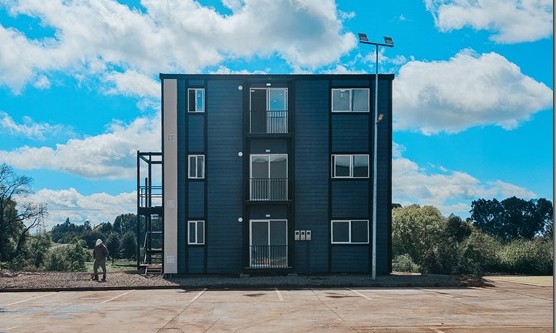
The Araucanía Region positions itself at the forefront of construction innovation with the launch of a three-story condominium developed entirely using industrialized wood systems. The project, led by the company Canada House, represents a concrete step towards more efficient and sustainable housing models in Chile.
The initiative not only introduces a new standard for mid-rise wood construction but also demonstrates the potential of so-called Modern Methods of Construction to address the housing deficit. Through this approach, a large part of the process is moved from the construction site to an industrial plant, allowing for improved precision, shorter timelines, and reduced environmental impacts.
This development is part of the Construye Zero program, promoted by Corfo and coordinated by CTEC. The initiative seeks to accelerate the transformation of the construction sector through solutions that address key challenges such as the climate crisis, productivity, and efficient resource use.
One of the most notable aspects of the project is its modular system. The homes —60-square-meter apartments— are manufactured with a high level of finishing in the plant and subsequently assembled on-site in significantly less time than traditional construction. This model also allows for greater traceability and control at each stage of the process.
From the industry's perspective, they value these types of advances as concrete signals of change. The president of CChC Araucanía, Lorenzo Dubois, highlighted that the incorporation of new technologies not only improves the sector's efficiency but also opens opportunities to offer higher-quality housing solutions.
In parallel, regional authorities emphasize the impact of these developments on the innovation strategy. The acting regional director of Corfo, Julio Salas, indicated that this type of project is part of a broader portfolio that, in recent years, has promoted initiatives aimed at climate change adaptation and industry modernization.
The environmental component is precisely one of the pillars of this proposal. According to program data, industrialized systems allow for a significant reduction in water and energy consumption and waste generation, positioning themselves as a cleaner alternative to traditional methods.
In that vein, the manager of Construye Zero, Daniela Vásquez, emphasized that the main value of this type of solution lies in its scalability. "These are not isolated prototypes, but models that can be replicated and scaled up in the short term," she stated.
With this project, La Araucanía not only adds a new housing development but also consolidates its role as a laboratory for innovation in sustainable construction, where wood —one of the most abundant resources in southern Chile— emerges as the protagonist of a new way of living.




Comentarios (0)
No hay comentarios aún. ¡Sé el primero en comentar!
Deja un comentario