

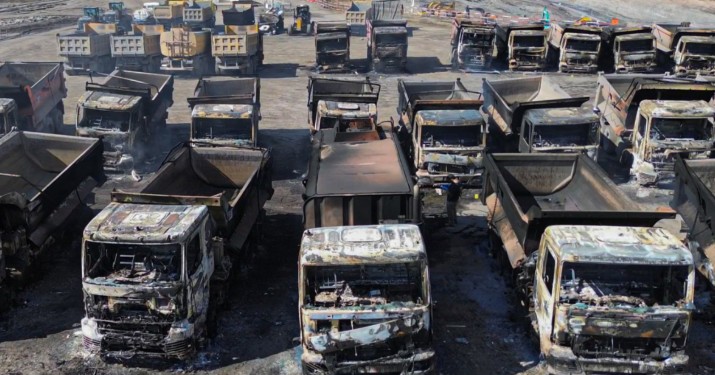
The discussion about the continuity of the Constitutional State of Exception in the Southern Macrozone has gained a new precedent. The Multigremial (Multi-Association) of La Araucanía released its March 2026 report, in which it argues that the decrease in violent incidents recorded in recent years does not represent the end of the conflict, but rather a fragile containment scenario marked by remaining operational capacity, territorial mobility, and high economic impact.
The report records two violent incidents during March and a cumulative total of five in the first quarter of this year. The historical series presented by the organization shows 72 cases in 2021, 60 in 2022, 68 in 2023, 37 in 2024, and 17 in 2025, considering incidents that occurred in Bío Bío, La Araucanía, Los Ríos, and Los Lagos.
However, the core of the document is not the drop in numbers, but the political reading of that data. According to the Multigremial, each weakening of the State of Emergency was followed by resurgences of violence, so they warn that withdrawing extraordinary tools without first neutralizing the active groups could open a new cycle of escalation.
Attacks Continue Despite Military Presence
The report divides recent evolution into four stages. The first corresponds to the "complete" State of Emergency, between October 2021 and March 2022, a period during which an average of 21 incidents per month were recorded. It then identifies a phase of "weakening of the State," between March 2022 and June 2023, when the average rose to 33 monthly attacks and peaked at 42.
The third stage, described as "delayed reaction," extends between July 2023 and February 2024, with 23.8 incidents monthly. Finally, from March 2024 to March 2026, the association places a reduction phase, with 4.8 incidents per month, although it insists that there is no real dismantling of the violent structures operating in the area.
March: Territorial Displacement
In March, all reported incidents corresponded to arson attacks that occurred in the La Araucanía Region, specifically in the communes of Lautaro and Teodoro Schmidt. In January, meanwhile, armed attacks were recorded in Curanilahue, Angol, and Concepción.
For the organization, this demonstrates that the violence has not disappeared, but has modified its behavior. The text states that during 2026 attacks were distributed across different provinces and communes, ruling out rigid focalization and revealing an adaptable strategy that exploits territorial gaps.
Fewer Attacks, Greater Impact
Another highlighted point is that the lower frequency does not imply an equivalent reduction in the severity of the incidents. As an example, the report recalls the murder of three police officers in Cañete in April 2024 and the attack on Rucalhue in January 2025, where more than 50 machines were destroyed.
In that vein, the Multigremial states that in the last 24 months a trend of "lower frequency, higher intensity" has been consolidated, warning that normalizing an average of 4.8 attacks per month would be unacceptable under any public safety standard.
Economic Blow
The report also focuses on the economic cost of the conflict. Between March 2024 and March 2026, it quantifies the losses suffered by forestry contractors, construction companies, and aggregate plants at more than 110 burned trucks, equivalent to 1.3 trucks set on fire per week.
It adds that the Rucalhue attack alone caused estimated damages between US$5 and US$7 million. Furthermore, forestry contractors reportedly lost 49 trucks between 2024 and 2025, with total estimated damages of US$22.4 million.
Seven Active Groups and 35% of Attacks Claimed
In its final chapter, the document states that 35% of the attacks were claimed and that 39 incidents executed by seven different groups are identified, including the Arauco Malleco Coordinator (CAM), Weichan Auka Mapu, and Resistencia Mapuche Lafkenche, among other acronyms recorded in the report.
The association's conclusion is direct: the violence has not been defeated, but contained. Therefore, it proposes maintaining the reinforced presence of the State, recovering territorial control, and advancing the complete dismantling of the active organizations. "This is not resolved. It is contained," concludes the report.
The Leader's Warning
Interviewed by Radio Bío Bío, the president of the Multigremial of La Araucanía, Patricio Santibáñez, reinforced that stance, stating that "the double withdrawal of the state of emergency in the southern zone could be a premature and, at the very least, risky decision. We know that when this measure did not exist, or when it was lifted, serious violent incidents increased and reached extremely high levels. Terrorism remains present, with around four attacks per month, something that is not normal anywhere in the world."
The promises made at the time by presidential candidate José Antonio Kast (2025) were for more and better security.
"The government and the candidate made a promise regarding security, and it cannot be that, shortly after starting, we are already talking about less protection. To withdraw the state of exception, there must be a complete dismantling of the terrorist groups. That is the minimum condition."
Santibáñez stated that "the demand of the people in the conflict zone, where the new government was largely supported with votes close to 75%, is clear: order and security. That is the foundation. That is what citizens demand from the government."
"That is why, although we all want this situation to end, the reason for doing so must be only one: that the groups are completely dismantled and that the objective has been achieved," he explained.
Source:BiobioChile



Comments (0)
No comments yet. Be the first to comment!
Leave a comment