
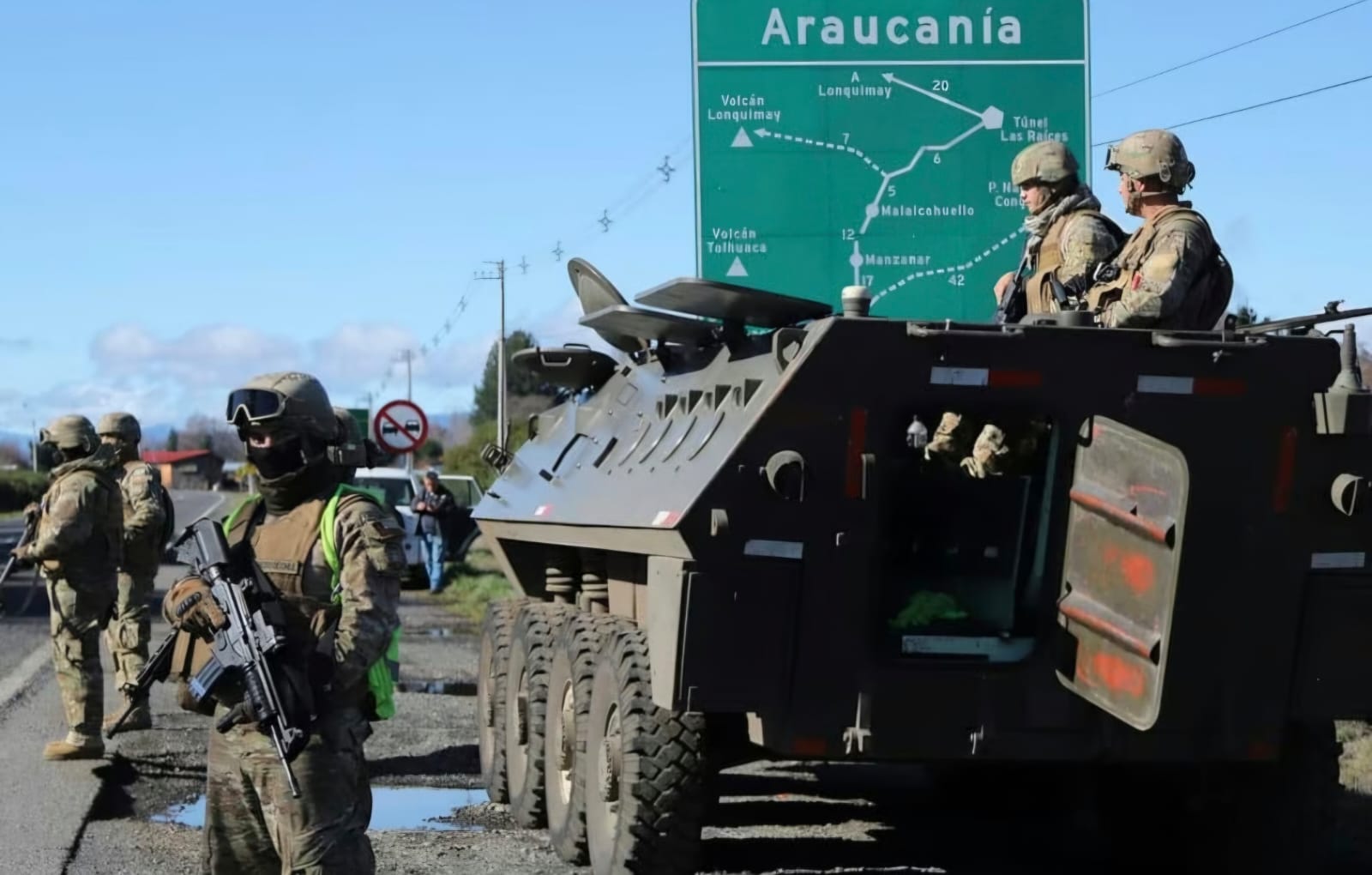
Since the arrival of the new authorities to the Executive, the situation in the Southern Macrozone has been a topic within the government of President José Antonio Kast. In less than a month, both the President and the Minister of Defense, Fernando Barros, have visited the areas under a state of exception twice, primarily to meet with military authorities in the zone that has now been under this constitutional measure for 1,416 days.
However, the situation of the Southern Macrozone has also been one of the central topics addressed during the Security Council, an instance created by the Kast administration. In these meetings, according to sources from La Tercera, the possibility of the government applying a "de-escalation" of the state of exception, leading to the termination of the measure, has already been raised and analyzed.
This de-escalation or possibility of ending the military deployment in the south of the country is something that Minister Barros himself has already raised. He first did so before Congress during the discussion on the renewal of the constitutional measure and also in various interviews.
"As is known, there is the intention to gradually reduce the presence, to take actions that allow a return to normality, strengthening the police, both Carabineros and the PDI, so that they can normally maintain control of public order. So that, ultimately, a situation of normality can be resumed," said the Minister of Defense in the Chamber, who has been following the situation very closely.
In a conversation with Radio Duna, and when asked if the measure was sustainable, he stated: "We would prefer it not to be. It's not that they are unsustainable, but that they are not necessary. The Armed Forces are in the fire zones, they are present and have been there for a significant time, and as one withdraws them, citizen complaints immediately arrive that they provide a sense of security and confidence."
The Reasons
Those familiar with the conversations that have taken place within the government regarding the southern zone affirm that one of the main reasons for considering the possibility of reducing the state of exception is the current reality of the Biobío and La Araucanía regions.
Conditions in the area are now better than the scenario that existed, for example, in 2021, which would allow for a reduction of the measure. In addition to achieving the arrest of a series of leaders of criminal organizations operating in the area, acts of violence have also been reduced. For instance, according to Carabineros figures presented by the Ministry of the Interior to Congress, rural violence incidents have decreased by 80% over the last five years.
Along with that, it has also been raised within the Executive that one of the reasons to roll back the constitutional measure is that "normality must be restored" in the area, despite a very positive evaluation of the deployment of the Armed Forces (FF.AA.) in the Southern Macrozone.
But in addition to that, there is also an analysis by Defense regarding the institutions operating in the area. This explains that another factor that could influence the de-escalation is that Carabineros is now better trained and equipped with tools to assume the security of the area without the collaboration of military institutions.
Also, in military matters, Defense sources state that another factor is a concern about the wear and tear on Army and Marine personnel deployed in the area, which could begin to translate into a high number of voluntary retirements by military personnel or an increase in medical leaves.
On Duna, Barros addressed this, stating that this type of deployment "involves long shifts, it is wear and tear, but President Kast, one of the first things he did was to go meet with the Armed Forces."
Although the minister highlighted "a very motivated troop" in the area, "clearly there is a hope to gradually reduce the presence of the FF.AA., freeing them from that. But let's not forget that every period or months, in this case already four years dedicated to that, means sacrificing to some extent the training, the preparation of our own forces."
The Possible Plan
Although all decisions -highlight government sources consulted by this media- will be made considering a thorough and realistic analysis of the situation in the southern zone, any decision could be gradual and would have April as a key month.
In that sense, among the initial alternatives being considered for applying a de-escalation of the state of exception in the Southern Macrozone is beginning to lift the measure in some provinces. That is, starting to reduce the provinces under that scenario until reaching a total lifting.
However, another possibility that exists, if conditions allow, would be that upon reaching the end of April, the time when the measure must be renewed in Congress, the government simply does not renew it and puts an end to the constitutional measure that has been applied since 2022.
Source:La Tercera





Comments (0)
No comments yet. Be the first to comment!
Leave a comment