

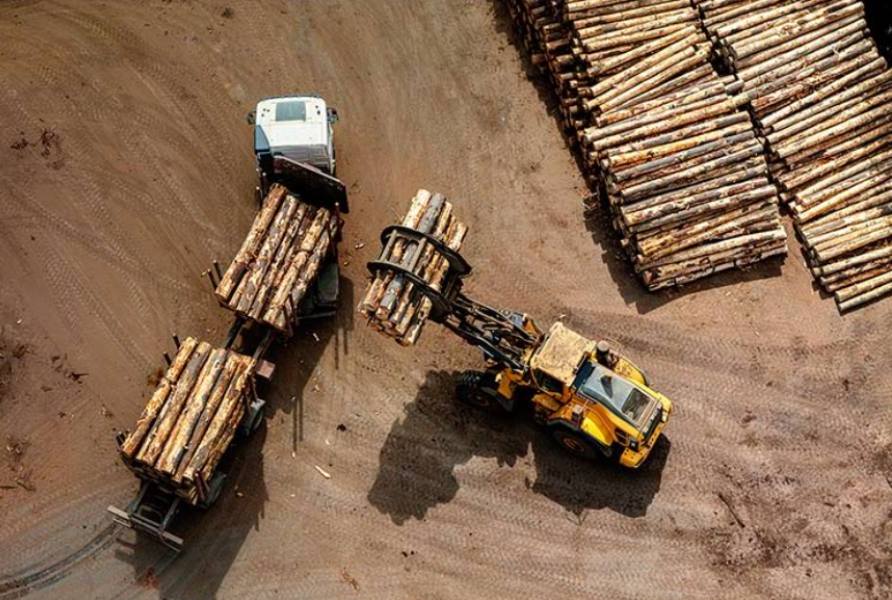
The concern over the imminent raw material supply crisis facing small and medium-sized timber enterprises was expressed by the guilds Corma (Chilean Wood Corporation) and Pymemad. Biregional guild leaders held meetings with authorities in Ñuble, where they presented challenges such as reforesting burned forests, a new forestry promotion law for small and medium-sized landowners, advancing the use of wood for public infrastructure and housing, and strengthening fire prevention.
Alejandro Casagrande, president of Corma Biobío-Ñuble, acknowledged the difficult scenario facing the industry, which has seen the closure of around 200 sawmills in the country over the last six years. "It is very challenging because the national and international scenario is very complex. So, if we were already in a period of decline for the forestry sector, that means industrial plants closing, fewer areas of productive forests, and also a significant loss of jobs; well, that has continued," he stated.
The leader explained that, together with the guilds that make up Futuro Madera, they are addressing four lines of work: fire prevention, reforestation on burned lands of small and medium-sized owners, promoting industrialized wood housing construction, and the use of wood in public infrastructure.
Casagrande valued the willingness of the Ñuble authorities, who took note of these proposals. Regarding fire prevention, he commented that "we are going to work on a project with Conaf and the Regional Government, to review the critical infrastructure in the region, houses, schools, towns, that are in the wildland-urban interface, and to establish prevention committees there."
He also advanced: "we are going to work on a project for the recovery of burned areas belonging to small and medium-sized owners, because at the heart of the sector's decline are fires and the fact that small and medium-sized owners are not planting; because they don't have money, because they are afraid. So, we propose that they need support."
He added: "we are going to put together a project with the Regional Government, which could be for this year, possibly for the next, but we are interested in the signal and support from the governor."
He mentioned that a similar initiative has been underway since this year with the Biobío Regional Government ($9 billion over three years) and the goal is for it to become a national public policy. "We want to combine it with the one from Ñuble and aim it at a public policy. The new government is talking about support for small owners, so we want to connect it to give it strength and have a public policy emerge that supports small owners in recovering their burned lands; and secondly, for those who have bare lands suitable for forestry, to plant them, and that would be afforestation; and hopefully with an objective to produce sawn wood to be sold to small and medium-sized industrial entrepreneurs. That's how it connects," he proposed.
Forestry Promotion
Since the last extension of DL 701 on Forestry Promotion expired in 2014, there have been no more afforestation subsidies, which explains the sharp drop in new plantations on small and medium-sized properties over the last ten years, a phenomenon that particularly threatens small and medium-sized timber industrial plants, which source their supply from these properties.
Despite attempts to create a forestry promotion law focused on small and medium-sized owners, there has been no political will to move forward. In fact, Casagrande recalled the announcements from the previous administration, which ultimately did not materialize into a bill. In that sense, he stated that "it is the first time we see a government strongly pushing the issue. So, we want to show that there are two regional governments interested in doing it."
When asked about the political will to advance a forestry promotion law, the president of Corma Biobío Ñuble acknowledged that "there is clearly an ideological issue against plantations and I believe that has been changing. With the previous government, at first it was very complex, but it changed; and with this government, from the very beginning the Minister of Agriculture stated that a promotion law needed to be passed. I believe there is strength and desire there."
Víctor Sandoval, president of Pymemad Biobío Ñuble, stated that "we have many more fears in the sense that, if decisions are not made soon, the SME industry runs a significant risk of disappearing, not only in Ñuble but nationally."
He added that "we are looking at long-term policies, a forest takes 20 years to grow. Maybe today we have availability, but if we don't take measures today to promote plantations, reforestation, avoid forest fires, the industry will not be viable in about five or ten years."
Housing Construction
"We want to connect the housing deficit with the crisis we are experiencing of small industrial plants closing. We are working on a project to eliminate the entry barriers that SMEs face to compete in the industrialized housing market. The project aims to enable small and medium-sized companies to participate, which are not doing so today because the investments are very large," stated the president of Corma.
In this regard, Víctor Sandoval of Pymemad detailed that "the requirements established by the Ministry of Housing to develop industrialization plants are high-tech and demand high investment amounts, which are not attainable for most SMEs."
Facing this, Sandoval elaborated that "the proposal we have been developing, first starting from Biobío and the idea is to continue working with Ñuble, where there is currently a PTI (from Corfo) focused on industrialization, is to develop a platform that brings together different SMEs around a parts and pieces model, which is very similar to how the automotive or aeronautical industry works, where each company specializes in a specific item and in the chain they deliver a joint high-quality solution. In this way, we intend to develop a path for SMEs to participate within the construction process."
Source:La Discusión



Comments (0)
No comments yet. Be the first to comment!
Leave a comment