

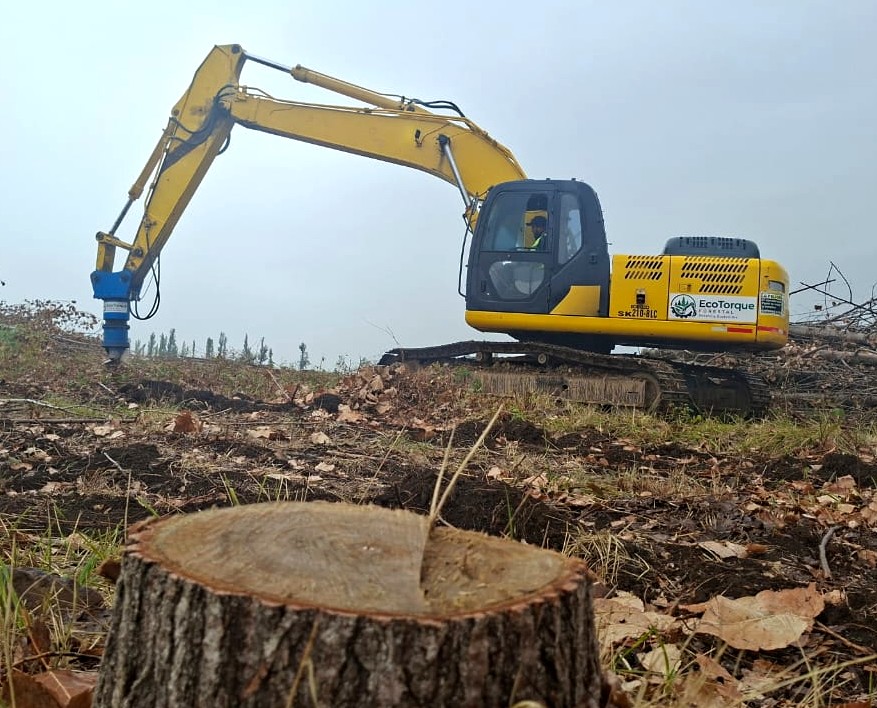
Amid the environmental challenges facing the forestry sector, a new proposal seeks to change the way soils are managed after harvests. This is EcoTorque Forestal, a startup that bets on mechanization with a sustainable approach, integrating technology to prevent environmental impacts and improve the land.
Its general manager, Franz García, summarizes the purpose: “EcoTorque is the union between operational power and environmental awareness. Making machinery not only produce, but also protect.” The initiative arises from a concrete idea: to use the force of machinery to maintain balance with the environment, especially in regions like Maule and Biobío, where forestry activity is key.
Currently, this work is being carried out on a property in Retiro, in the Maule Region, belonging to Compañía Chilena de Fósforos, where the company performs post-harvest management tasks with a sustainable approach.
In situ system
The heart of this proposal lies in the mechanism they use on site. Unlike traditional practices—which usually extract stumps and debris—EcoTorque introduces an in situ shredding system that allows organic matter to be reincorporated directly into the soil.
This process is carried out using a log grinding head, a specialized piece of equipment equipped with blades that rotate with high torque and low speed. This design allows stumps to be ground down to approximately 80 centimeters below the surface. The result is chipped material that remains in the same place, reintegrating into the soil.
According to García, this mechanism prevents the extraction of biomass that has formed over the years, returning essential nutrients to the land. “The idea is not to take away from the soil what belongs to it, but to reincorporate it as organic matter for its future recovery,” he states.
Sustainable impact
The use of this system has multiple benefits. Firstly, it improves soil quality by increasing its organic content, which favors moisture retention and biological activity. Additionally, it reduces the need for transporting forestry waste, lowering operational costs and associated emissions.
Another key aspect is its contribution to wildfire prevention. By managing fuel loads and preventing waste accumulation, the risk of fire spread is reduced, integrating prevention as part of the operational standard.
At the same time, waste from branches and smaller material is managed as biomass, being collected and later transported for use in energy generation, thus closing a more efficient production cycle.
EcoTorque currently operates with three teams and an itinerant model that allows it to work in different parts of the country, adapting to the needs of each operation. Although the company has only been operating for a few months, it is already positioning itself as an innovative alternative in the sector.
The bet is not without risks. Incorporating this technology required an initial investment with no guarantee of immediate success. However, García emphasizes that the challenge stems from a conviction: to transform the forestry sector from practice.
“The sector needs real changes. It’s not enough to declare sustainability; you have to execute it on the ground,” he affirms.
With this approach, EcoTorque Forestal seeks to establish a new way of working, where operational efficiency and environmental care are not opposing concepts, but part of the same mechanism.
At Acoforag, we value this type of innovation, highlighting that the incorporation of technologies aimed at sustainable soil management represents a significant advancement for the sector. Practices such as the reincorporation of organic matter not only contribute to long-term productivity but also strengthen the adaptation of forestry activity to current environmental challenges.
The report inAcoforag Magazine



Comments (0)
No comments yet. Be the first to comment!
Leave a comment