

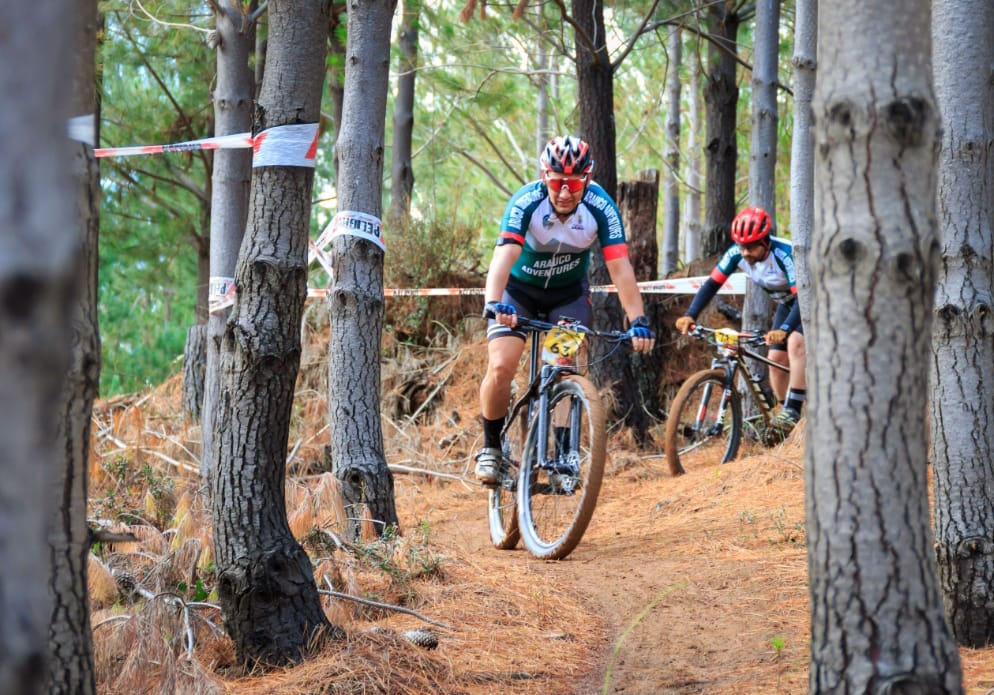
In the province of Arauco, where rural roads and forest trails intertwine with the natural landscape, outdoor sports have become a way to connect with the environment. This is how the Arauco Adventure sports club experiences it, a group that since 2008 brings together around 60 members around triathlon, cycling, and athletics, disciplines that find their main setting in the forests.
Myrna Muñoz Sáez, current president of the club, says she joined the organization in 2020, initially motivated by the desire for her son to practice sports. Over time, enthusiasm grew and today she leads a group that promotes eight sports disciplines, including road cycling, mountain biking, and athletics.
“Some members practice full triathlon, others focus only on cycling or athletics. Each one finds their space, but always with sport as the meeting point,” she explains.
Natural sport
Among all activities, mountain biking and trail running are those with the most direct connection to the forest. Members travel along trails and forest roads mainly in the Laraquete area, where they use existing routes to train and organize competitions.
However, the bond with the forest is not limited to sports use. According to Muñoz, the club has a strong commitment to caring for the environment. “The idea is not to intervene in the trails. We only clean what already exists when it becomes overgrown or the path closes, but we try not to modify the place,” she states.
These cleaning tasks not only facilitate the passage of cyclists and runners but can also serve a preventive function against forest fires, as some of the cleared trails act as firebreaks.
Shared care
Each year the club organizes three dates of the Winter Ranking, a mountain biking competition that brings together athletes from different parts of the area. For its execution, they have the support of institutions and forestry companies that provide land and collaborate with event safety.
During route preparation, athletes also face another reality of the territory: the presence of illegal dumpsites on little-traveled roads. When they detect them, they inform the municipality so they can be removed. “As athletes, we try to take care of the places where we practice. If we don't protect these spaces, we won't have anywhere to do sports later,” Muñoz affirms.
At Acoforag, we highlight that experiences like this reflect how athletes value the forest not only as a setting for physical activity but also as a natural space that must be protected and cared for by the entire community.
The report in theAcoforag Magazine




Comments (0)
No comments yet. Be the first to comment!
Leave a comment