

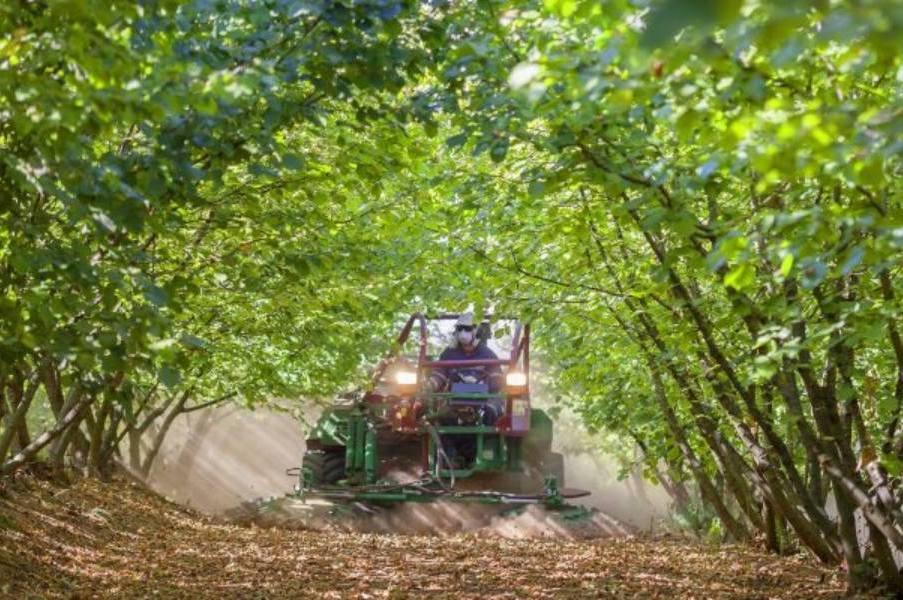
While the enthusiasm for cherries that prevailed a decade ago is fading, in a context of oversupply and lower prices, the European hazelnut has become a much more attractive alternative for more than 150 farmers in the Ñuble Region, who are driving explosive growth in the area dedicated to this fruit tree.
With advantages highly valued by producers, such as profitability, task mechanization, and lower labor use, superior yields compared to crops in Turkey -the main producer- and the strong presence of Ferrero – the Italian multinational that is the main buyer of this fruit-, the European hazelnut has become the favorite of fruit growers in the south-central zone of Chile.
According to the Odepa Fruit Census, with data updated to December 2024, the area of European hazelnut reached 8,850 hectares in Ñuble, showing a 35% increase compared to the 2022 census. Likewise, according to information provided by Agrichile -a subsidiary of Ferrero-, to date the area reaches approximately 13,500 hectares in the region, representing a 52.5% increase compared to 2024.
It is the most planted fruit crop in Ñuble, followed distantly by cherry, which totals 3,062 hectares.
Similarly, at the national level, an increase of 30.3% is estimated, rising from 49,263 hectares in 2024 to about 64,200 hectares currently.
Camilo Scocco, general manager of AgriChile, stated that the plantations in Ñuble "represent about 21% of the total national area," highlighting that "of that total, AgriChile participates with 1,046 hectares, while the rest corresponds to associated producers. It is an area that has shown high growth in recent years, consolidating itself as one of the main development hubs for the crop in Chile."
2026 Harvest
Asked about expectations for the results of the current harvest, which began in February, the executive stated that they are positive, compounded by new orchards coming into production.
"Sector estimates point to a good harvest, with a volume similar to last year's, especially thanks to new plantations coming into production, which confirms the strong growth this crop has had in the country over the last decade," Scocco said.
He recalled that, "from a productive point of view, the 2025 harvest was influenced by favorable climatic conditions, with good accumulation of cold hours and water during winter, a spring without severe events, and a harvest that, in general, took place under good conditions. The entry into production of new areas, the better performance of southern zones, the technical development of the crop, and the adoption of good agricultural practices also played a role."
Meanwhile, "for the 2025/2026 productive cycle, the season has developed similarly to the previous year in terms of winter and spring conditions," added the general manager of Agrichile. "For the 2026 harvest, we will have to observe the weather behavior. Rains can compromise quality, so it is recommended to harvest and dry the fruit as quickly as possible."
In 2024, Agrichile inaugurated its second hazelnut processing plant in the country in Ñiquén, betting on the growth of this sector in Chile, as part of a strategy to diversify the supply of raw materials globally. Meanwhile, last year it announced an investment plan that includes the expansion of this new plant.
Asked about the price scenario, Scocco stated that "the price of hazelnuts depends on quality and the balance between global supply and demand. During this season, price evolution will depend on the availability and quality of supply in the main producing countries, as well as on global demand response. The global hazelnut market is precisely characterized by this variability between years and between productive zones. Therefore, having a supply base from multiple origins across different countries is key to providing stability to the supply. In this context, Chile has been consolidating its presence as one of the relevant origins within world production."
Source:La Discusión






Comentarios (0)
No hay comentarios aún. ¡Sé el primero en comentar!
Deja un comentario