

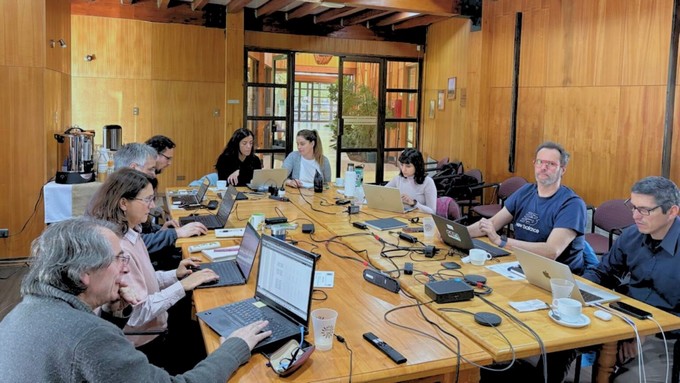
Within the framework of the National Strategy on Climate Change and Vegetation Resources (ENCCRV) and the Emissions Reduction Payment Agreement (ERPA), consultants from the World Bank, along with professionals from the Department of Climate Change and Ecosystem Services (DCCSE) of CONAF, and researchers from the Forestry Institute (INFOR) participated in a joint technical meeting in Valdivia aimed at conducting an in-depth review of the methodology used by the country to estimate emissions associated with forest degradation and recovery.
To strengthen the generation of robust, transparent, and consistent information for monitoring emissions and absorptions in the forestry sector, the mission reviewed the complete methodological flow for calculating degradation in forests that remain as forests. This included structural variables such as tree density, basal area, and volume, as well as the uncertainty analyses associated with these estimates.
For Yasna Rojas, a research professional in charge of the climate change research line at INFOR, "this methodology makes it possible to demonstrate the evolution of forest degradation, identifying both the improvements recorded in them and the areas where degradation persists and where recovery efforts need to be focused. In this context, at INFOR we believe that monitoring based on validated methodological standards contributes to strengthening climate transparency and advancing the fulfillment of the country's mitigation goals."
Georgina Trujillo, head of the Monitoring, Reporting, and Verification section of the DCCSE, stated that "monitoring reports constitute the technical basis for certifying emission reductions and increases in carbon stocks, an indispensable condition for accessing results-based payments from international mechanisms such as REDD+. For this reason, this meeting is of vital importance to continue making progress, as the generation of reliable information supports public policies, such as the ENCCRV, and guides investments to ensure the continuity of conservation and restoration actions for the country's forest ecosystems."
This type of instance is essential to strengthen and consolidate the National Forest Monitoring System, from which not only are results quantified, but it also allows the country to position itself as a reliable actor in global climate financing markets and mechanisms. This type of scientific evidence demonstrates that the actions implemented by the ENCCRV generate real, measurable, and verifiable climate benefits. In this sense, the technical support of the World Bank is key to ensuring that the procedures and methodologies applied by Chile meet international standards.
Naikoa Aguilar, a World Bank consultant, points out that these missions are essential for the country to have confidence in the validity of the data submitted to the Forest Carbon Partnership Facility (FCPF) and to the corresponding audits. This is part of the necessary quality control process for the values estimated by Chile to be recognized internationally, but also to understand the country's own context and dynamics that explain the performance in terms of emission reductions and, in turn, to evaluate the effectiveness of the mitigation activities currently implemented by the country.
The joint work being carried out by CONAF with the World Bank, through the Emissions Reduction Program (ERP), and with FAO, through the +Bosques Project, reinforces the positioning of the ENCCRV as a relevant public policy for forest-based mitigation. By having robust monitoring systems and technically supported reports, Chile strengthens its capacity to access international climate financing and consolidate strategic alliances with multilateral organizations.



Comentarios (0)
No hay comentarios aún. ¡Sé el primero en comentar!
Deja un comentario