

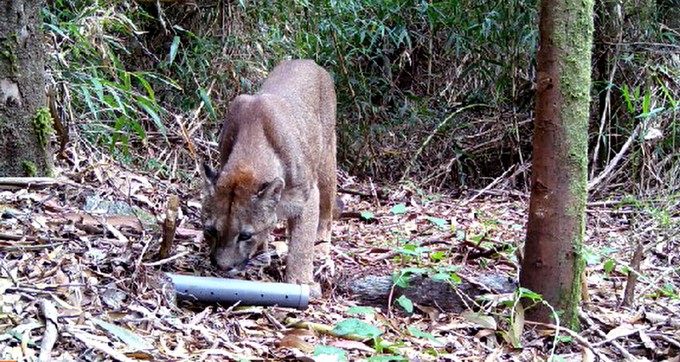
Understanding why wildlife populations decline, remain stable, or recover is one of the questions that a recently awarded Fondecyt project, led by Dr. Eduardo Silva, a professor at the Faculty of Forest Sciences and Natural Resources of UACh, aims to answer. This will be done using millions of camera trap images recorded over more than 15 years, along with new surveys covering an extensive territory.
The initiative "From defaunation to recovery: Separating the effects of land-use change and species interactions on occupancy dynamics in mammals" (Fondecyt 1262343) will allow researchers to understand population trends of various mammal species inhabiting the forests of southern Chile.
"The project is important because, to date, we know very little about the actual population trends of various species, such as the pudú and the kodkod. So, we will take advantage of the large number of sites we have sampled over the last 15 years, which correspond to around 900 points distributed across the Coastal and Andes mountain ranges in the Los Ríos and Los Lagos regions, and we will resample exactly the same sites. From this, we will be able to effectively estimate which species have decreased or increased in population," explained Dr. Silva.
Another important aspect they will observe is where this increase or decrease occurs and why. "We will cross-reference this information with land-use changes, as well as with the presence or absence of other species, both native and invasive, which could help understand temporal trends," he added.
Regarding the latter, the study will not only seek to understand how invasive species, such as hares, wild boars, or dogs, affect native species, but also how native species interact with each other. "For example, we might ask: if the population of the chilla fox increases, what happens to the Chilote fox? We are likely to find surprises that help us better understand the factors explaining both the decline and increase in wild animal populations, which have not been explored until now," he explained.
The professor also stated that it is important to consider that some sites sampled years ago may have changed their land use; a plot of land might have been built on, suffered a fire, or have the presence of dogs, but it is also possible that in other sites, the forest is now in better condition. This variation in scenarios is very likely to be found and will make it possible to evaluate how species respond to these changes.
"Our study will be conducted in the temperate forests of southern Chile and will focus on larger mammals, including forest species such as the pudú, Chilote fox, and kodkod; generalists, for example, the puma and chilla fox; and several non-native species, such as hares and dogs," he indicated.
It is worth mentioning that part of this initiative includes Drs. John Gajardo, from the Faculty of Forest Sciences and Natural Resources, and Mauricio Soto, from the Faculty of Sciences of UACh.





Comentarios (0)
No hay comentarios aún. ¡Sé el primero en comentar!
Deja un comentario